Bener Abdulbari, Dogan Muzeyyen, Barakat Lolwa, Al-Hamaq Abdulla O A A
Department of Medical Statistics and Epidemiology, Hamad Medical Corporation and, Departments of Public Health and Medical Education, Weill Cornell Medical College, Doha, Qatar.
Department of Chemistry, Faculty of Arts and Science, Yildiz Technical University, Istanbul, Turkey.
Indian J Pharmacol. 2014 Jan-Feb;46(1):88-93. doi: 10.4103/0253-7613.125184.
To determine efficacy safety and the cost effectiveness, of the four most commonly prescribed statins (rosuvastatin, atorvastatin, pravastatin, and simvastatin) in the treatment of dyslipidemia among diabetic patients.
This is a cohort, observational, population-based study conducted at diabetic clinics of the Hamad Medical Hospital and Primary Health Care Centers (PHCC) over a period from January 2007 to September 2012. The study included 1,542 consecutive diabetes patients above 18 years of age diagnosed with dyslipidemia and prescribed any of the indicated statins. Laboratory investigations were taken from the Electronic Medical Records Database (EMR-viewer). The sociodemographic, height, weight, and physical activities were collected from Patient's Medical Records. Information about statin was extracted from the pharmacy drug database. The effective reductions in total cholesterol using rosuvastatin with atorvastatin, simvastatin, and pravastatin in achieving cholesterol goals and improving plasma lipids in dyslipidemic diabetic patients were measured. Serum lipid levels measured a 1 week before the treatment and at the end 2(nd) year.
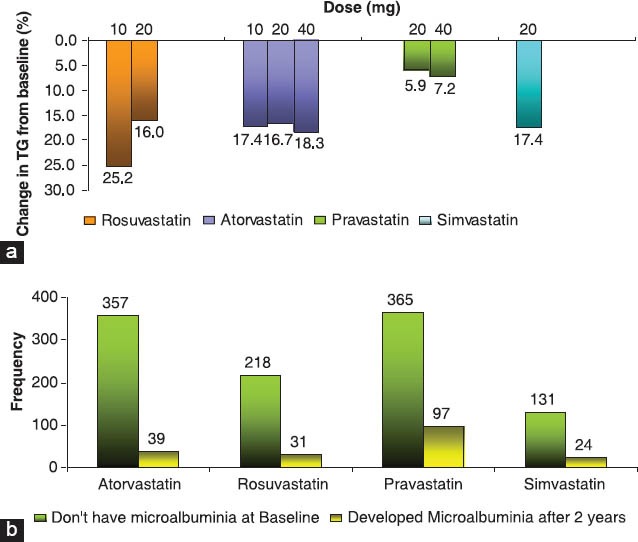
Rosuvastatin (10 mg) was the most effective in reducing low-density lipoprotein cholesterol (LDL-C; 28.59%), followed by simvastatin 20 mg (16.7%), atorvastatin 20 mg (15.9%), and pravastatin 20 mg (11.59.3%). All statins were safe with respect to muscular and hepatic functions. Atorvastatin was the safest statin as it resulted in the least number of patients with microalbuminuria (10.92%) as compared to other statins. Treatment with rosuvastatin 10 mg was more effective in allowing patients to reach European and Adult Treatment Plan (ATP) III LDL-C goals as compared to other statins (P < 0.0001) and produced greater reductions in LDL-C, total cholesterol, and non-HDL-C, produced similar or greater reductions in triglycerides (TGs) and increased in HDL-C.
Rosuvastatin 10 mg was the most effective statin in reducing serum lipids and total cholesterol in dyslipidemic diabetic patients.
确定四种最常用的他汀类药物(瑞舒伐他汀、阿托伐他汀、普伐他汀和辛伐他汀)治疗糖尿病患者血脂异常的疗效、安全性及成本效益。
这是一项队列观察性人群研究,于2007年1月至2012年9月在哈马德医疗医院和初级卫生保健中心(PHCC)的糖尿病诊所进行。该研究纳入了1542例年龄在18岁以上、被诊断为血脂异常并开具了任何一种指定他汀类药物的连续糖尿病患者。实验室检查数据取自电子病历数据库(EMR-viewer)。社会人口统计学、身高、体重和身体活动信息从患者病历中收集。他汀类药物信息从药房药品数据库中提取。测量了使用瑞舒伐他汀与阿托伐他汀、辛伐他汀和普伐他汀在实现血脂目标及改善血脂异常糖尿病患者血脂方面,总胆固醇的有效降低情况。在治疗前1周和第2年末测量血清脂质水平。
瑞舒伐他汀(10毫克)在降低低密度脂蛋白胆固醇(LDL-C;28.59%)方面最有效,其次是辛伐他汀20毫克(16.7%)、阿托伐他汀20毫克(15.9%)和普伐他汀20毫克(11.59.3%)。所有他汀类药物在肌肉和肝功能方面都是安全的。阿托伐他汀是最安全的他汀类药物,因为与其他他汀类药物相比,其导致微量白蛋白尿的患者数量最少(10.92%)。与其他他汀类药物相比,使用10毫克瑞舒伐他汀治疗能使患者更有效地达到欧洲和成人治疗计划(ATP)III的LDL-C目标(P < 0.0001),并能更大程度地降低LDL-C、总胆固醇和非HDL-C,在降低甘油三酯(TGs)方面产生相似或更大的降低效果,并能提高HDL-C。
10毫克瑞舒伐他汀是降低血脂异常糖尿病患者血清脂质和总胆固醇最有效的他汀类药物。