School of Allied Health Professions, Department of Health Administration, Virginia Commonwealth University, Richmond, VA, USA.
Center of Health Disparities, School of Medicine, Virginia Commonwealth University, Richmond, VA, USA.
J Multidiscip Healthc. 2014 Feb 10;7:105-10. doi: 10.2147/JMDH.S52019. eCollection 2014.
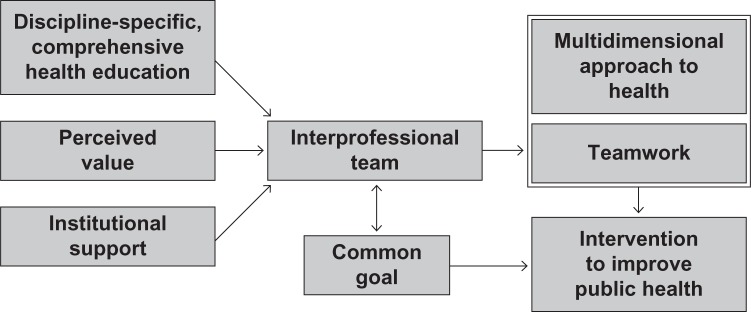
In the US, health care professionals are trained predominantly in uniprofessional settings independent of interprofessional education and collaboration. Yet, these professionals are tasked to work collaboratively as part of an interprofessional team in the practice environment to provide comprehensive care to complex patient populations. Although many advantages of interprofessional education have been cited in the literature, interprofessional education and collaboration present unique barriers that have challenged educators and practitioners for years. In spite of these impediments, one student-led organization has successfully implemented interprofessional education and cross-disciplinary collaboration. The purpose of this paper is to provide a conceptual framework for successful implementation of interprofessional education and collaboration for other student organizations, as well as for faculty and administrators. Each member of the interprofessional team brings discipline-specific expertise, allowing for a diverse team to attend to the multidimensional health needs of individual patients. The interprofessional team must organize around a common goal and work collaboratively to optimize patient outcomes. Successful interdisciplinary endeavors must address issues related to role clarity and skills regarding teamwork, communication, and conflict resolution. This conceptual framework can serve as a guide for student and health care organizations, in addition to academic institutions to produce health care professionals equipped with interdisciplinary teamwork skills to meet the changing health care demands of the 21st century.
在美国,医疗保健专业人员主要在单一专业环境中接受培训,而不接受跨专业教育和协作。然而,这些专业人员的任务是作为跨专业团队的一部分在实践环境中协作,为复杂的患者群体提供全面的护理。尽管文献中列举了许多跨专业教育的优势,但跨专业教育和协作带来了独特的障碍,多年来一直困扰着教育者和从业者。尽管存在这些障碍,但一个学生主导的组织已经成功地实施了跨专业教育和跨学科合作。本文的目的是为其他学生组织以及教师和管理人员提供一个成功实施跨专业教育和合作的概念框架。跨专业团队的每个成员都带来了特定于学科的专业知识,使多元化的团队能够满足个体患者的多维健康需求。跨专业团队必须围绕共同目标组织起来,并进行协作,以优化患者的结果。成功的跨学科努力必须解决与团队合作、沟通和冲突解决有关的角色明确和技能问题。除了学术机构外,这个概念框架还可以为学生和医疗保健组织提供指导,以培养具备跨学科团队合作技能的医疗保健专业人员,以满足 21 世纪不断变化的医疗保健需求。