
来自普通章鱼肠道的扁平微杆菌L-2所产蛋白酶的纯化与特性分析
Purification and Characterization of a Protease Produced by a Planomicrobium sp. L-2 from Gut of Octopus vulgaris.
作者信息
Liu Qing, Sun Shujing, Piao Meizi, Yang Ji Young
机构信息
Department of Food Science and Technology, College of Fisheries Sciences, Pukyong National University, Busan 608-737, Korea.
Department of Food Science and Technology, Qingdao Agricultural University, Qingdao 266109, China.
出版信息
Prev Nutr Food Sci. 2013 Dec;18(4):273-9. doi: 10.3746/pnf.2013.18.4.273.
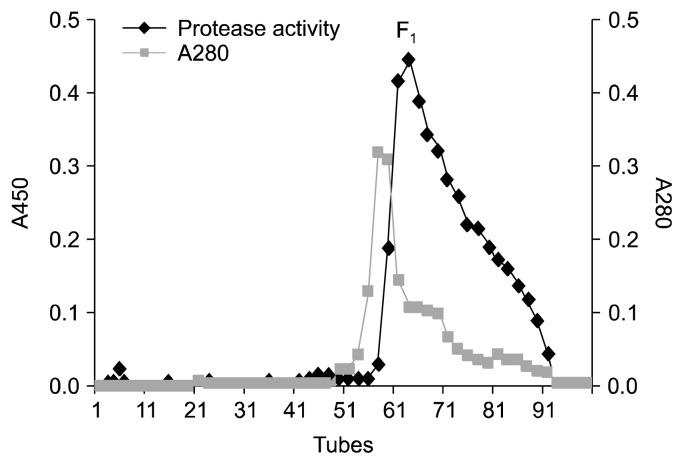
Protease widely exists in the digestive tract of animals and humans, playing a very important role in protein digestion and absorption. In this study, a high protease-producing strain Planomicrobium sp. L-2 was isolated and identified from the digestive tract of Octopus variabilis. The strain was identified by physiological and biochemical experiments and 16S rDNA sequences analysis. A protease was obtained from the strain Planomicrobium sp. L-2 through ammonium sulfate precipitation, dialysis and enrichment, DEAE-Sephadex A50 anion-exchange chromatography, and Sephadex G-100 gel chromatography. The molecular weight and properties of the protease were characterized, including optimum temperature and pH, thermal stability, protease inhibitions and metal ions. According to our results, the protease from Planomicrobium sp. L-2 strain designated as F1-1 was obtained by three-step separation and purification from crude enzyme. The molecular weight of the protease was 61.4 kDa and its optimum temperature was 40°C. The protease F1-1 showed a broad pH profile for casein hydrolysis between 5.0~11.0. No residual activity was observed after incubation for 40 min at 60°C and 60 min at 50°C. F1-1 protease was inhibited by Mn(2+), Hg(2+), Pb(2+), Zn(2+), and Cu(2+) ions, as well as PMSF, indicating that the protease F1-1 was a serine protease. Additionally, research basis provided by this study could be considered for industrial application of octopus intestinal proteases.
蛋白酶广泛存在于动物和人类的消化道中,在蛋白质的消化和吸收过程中发挥着非常重要的作用。在本研究中,从长蛸的消化道中分离并鉴定出一株高产蛋白酶的菌株扁平微杆菌属L-2。通过生理生化实验和16S rDNA序列分析对该菌株进行了鉴定。通过硫酸铵沉淀、透析和浓缩、DEAE-葡聚糖A50阴离子交换层析以及葡聚糖G-100凝胶层析,从扁平微杆菌属L-2菌株中获得了一种蛋白酶。对该蛋白酶的分子量和性质进行了表征,包括最适温度和pH、热稳定性、蛋白酶抑制作用和金属离子。根据我们的结果,从粗酶中通过三步分离纯化获得了来自扁平微杆菌属L-2菌株的蛋白酶,命名为F1-1。该蛋白酶的分子量为61.4 kDa,最适温度为40°C。蛋白酶F1-1在5.0~11.0之间对酪蛋白水解显示出较宽的pH范围。在60°C孵育40分钟和50°C孵育60分钟后未观察到残留活性。F1-1蛋白酶受到Mn(2+)、Hg(2+)、Pb(2+)、Zn(2+)和Cu(2+)离子以及PMSF的抑制,表明蛋白酶F1-1是一种丝氨酸蛋白酶。此外,本研究提供的研究基础可用于章鱼肠道蛋白酶的工业应用。




 Zotero 插件