Center for AIDS Prevention Studies, University of California, 50 Beale Street, San Francisco, CA 94105, USA.
Trials. 2014 Feb 20;15:64. doi: 10.1186/1745-6215-15-64.
Couples-based HIV counseling and testing (CHCT) is a proven strategy to reduce the risk of HIV transmission between partners, but uptake of CHCT is low. We describe the study design of a randomized controlled trial (RCT) aimed to increase participation in CHCT and reduce sexual risk behavior for HIV among heterosexual couples in rural KwaZulu-Natal, South Africa. We hypothesize that the rate of participation in CHCT will be higher and sexual risk behavior will be lower in the intervention group as compared to the control.
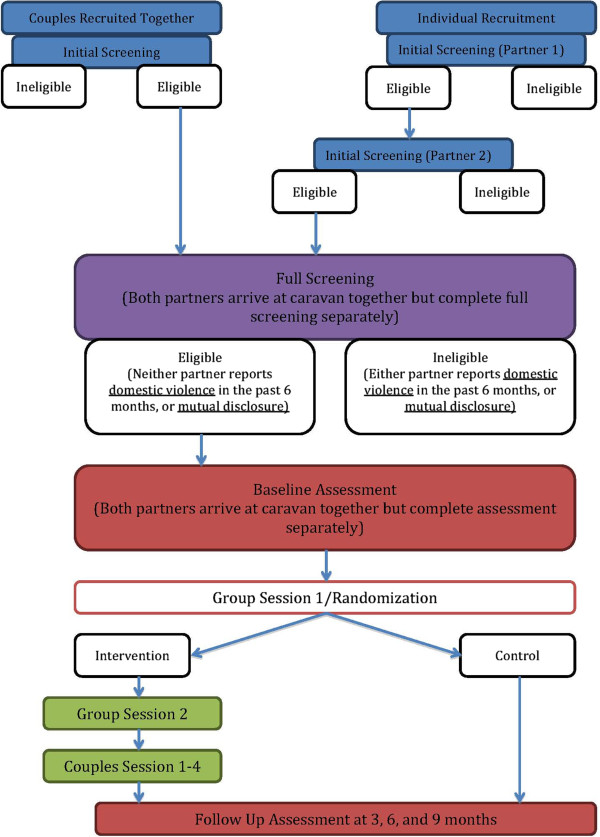
METHODS/DESIGN: Heterosexual couples (N=350 couples, 700 individuals) are being recruited to participate in a randomized trial of a couples-based intervention comprising two group sessions (one mixed gender, one single gender) and four couples' counseling sessions. Couples must have been in a relationship together for at least 6 months. Quantitative assessments are conducted via mobile phones by gender-matched interviewers at baseline, 3, 6, and 9 months post-randomization. Intervention content is aimed to improve relationship dynamics, and includes communication skills and setting goals regarding CHCT.
The Uthando Lwethu ('our love') intervention is the first couples-based intervention to have CHCT as its outcome. We are also targeting reductions in unprotected sex. CHCT necessitates the testing and mutual disclosure of both partners, conditions that are essential for improving subsequent outcomes such as disclosure of HIV status, sexual risk reduction, and improving treatment outcomes. Thus, improving rates of CHCT has the potential to improve health outcomes for heterosexual couples in a rural area of South Africa that is highly impacted by HIV. The results of our ongoing clinical trial will provide much needed information regarding whether a relationship-focused approach is effective in increasing rates of participation in CHCT. Our intervention represents an attempt to move away from individual-level conceptualizations, to a more integrated approach for HIV prevention.
Study Name: Couples in Context: An RCT of a Couples-based HIV Prevention InterventionClinicalTrials.gov identifier: NCT01953133.South African clinical trial registration number: DOH-27-0212-3937.
基于伴侣的艾滋病咨询和检测(CHCT)是减少伴侣间艾滋病传播风险的一种已被证实的策略,但 CHCT 的参与率很低。我们描述了一项随机对照试验(RCT)的研究设计,旨在增加南非夸祖鲁-纳塔尔省农村地区异性恋夫妇对 CHCT 的参与,并降低其艾滋病毒相关的性风险行为。我们假设,与对照组相比,干预组的 CHCT 参与率会更高,性风险行为会更低。
方法/设计:正在招募 350 对异性恋夫妇(700 人)参加一项基于伴侣的干预的 RCT,该干预包括两次小组会议(一次男女混合,一次男女分开)和四次伴侣咨询会议。夫妇必须在一起至少 6 个月。通过性别匹配的访谈者在基线、3、6 和 9 个月后使用移动电话进行定量评估。干预内容旨在改善关系动态,包括沟通技巧和设定关于 CHCT 的目标。
Uthando Lwethu(“我们的爱”)干预是第一个以 CHCT 为结果的基于伴侣的干预。我们也针对无保护性行为的减少。CHCT 需要双方的测试和相互披露,这是改善后续结果的必要条件,如 HIV 状况的披露、性风险的降低,以及改善治疗结果。因此,提高 CHCT 的参与率有可能改善南非农村地区深受艾滋病影响的异性恋夫妇的健康结果。我们正在进行的临床试验的结果将提供急需的信息,即基于关系的方法是否能有效提高参与 CHCT 的比率。我们的干预代表了从个体层面概念向更综合的艾滋病毒预防方法的转变。
研究名称:语境中的伴侣:基于伴侣的艾滋病毒预防干预的 RCTClinicalTrials.gov 标识符:NCT01953133.南非临床试验注册号码:DOH-27-0212-3937.