Kirui Dickson K, Mai Juahua, Palange Anna-Lisa, Qin Guoting, van de Ven Anne L, Liu Xuewu, Shen Haifa, Ferrari Mauro
Department of NanoMedicine, Houston Methodist Research Institute, Houston, Texas, United States of America.
Department of NanoMedicine, Houston Methodist Research Institute, Houston, Texas, United States of America ; Department of Cell and Development Biology, Weill Cornell Medical College, New York, New York, United States of America.
PLoS One. 2014 Feb 18;9(2):e86489. doi: 10.1371/journal.pone.0086489. eCollection 2014.
Hyperthermia treatment has been explored as a strategy to overcome biological barriers that hinder effective drug delivery in solid tumors. Most studies have used mild hyperthermia treatment (MHT) to target the delivery of thermo-sensitive liposomes carriers. Others have studied its application to permeabilize tumor vessels and improve tumor interstitial transport. However, the role of MHT in altering tumor vessel interfacial and adhesion properties and its relationship to improved delivery has not been established. In the present study, we evaluated effects of MHT treatment on tumor vessel flow dynamics and expression of adhesion molecules and assessed enhancement in particle localization using mesoporous silicon vectors (MSVs). We also determined the optimal time window at which maximal accumulation occur.
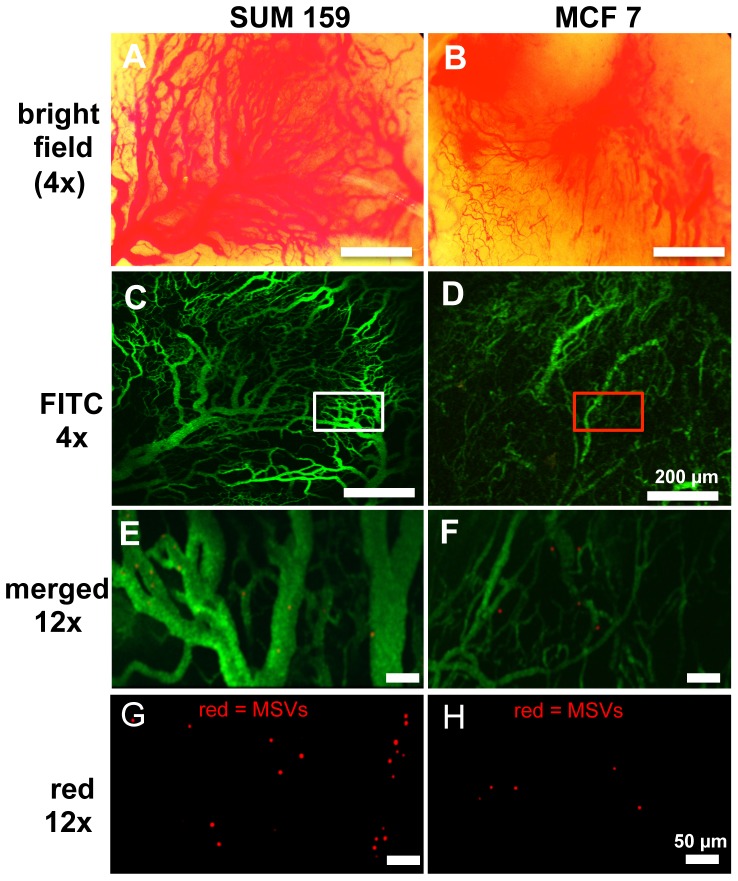
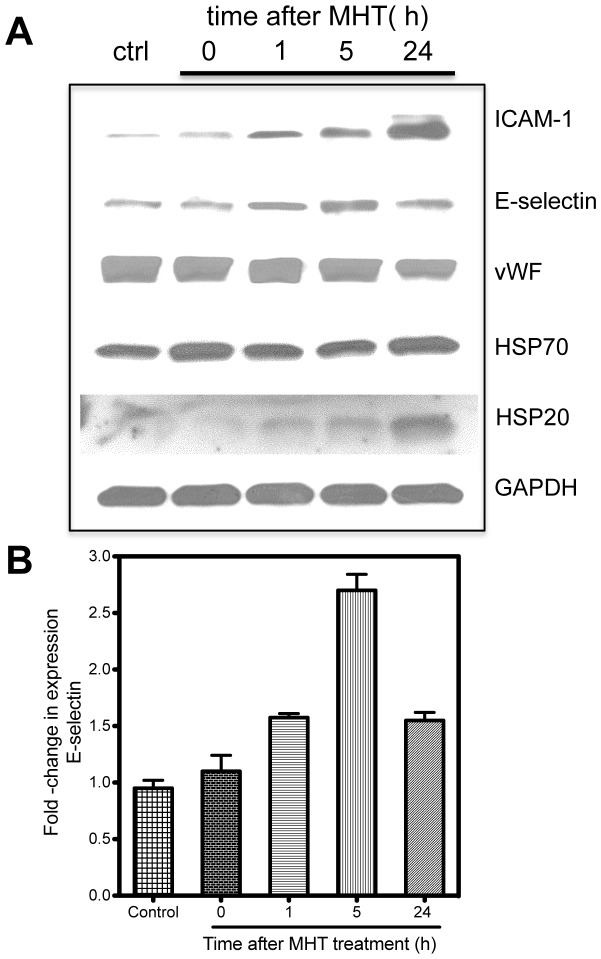
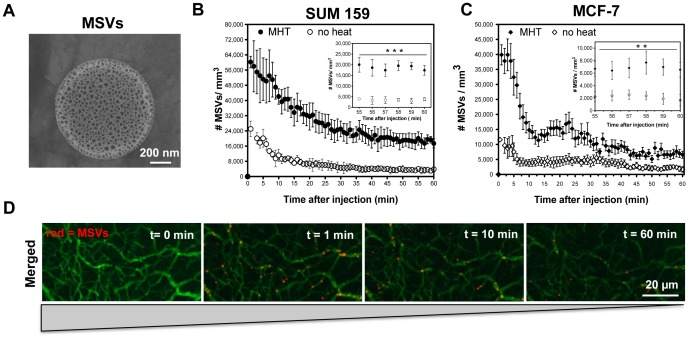
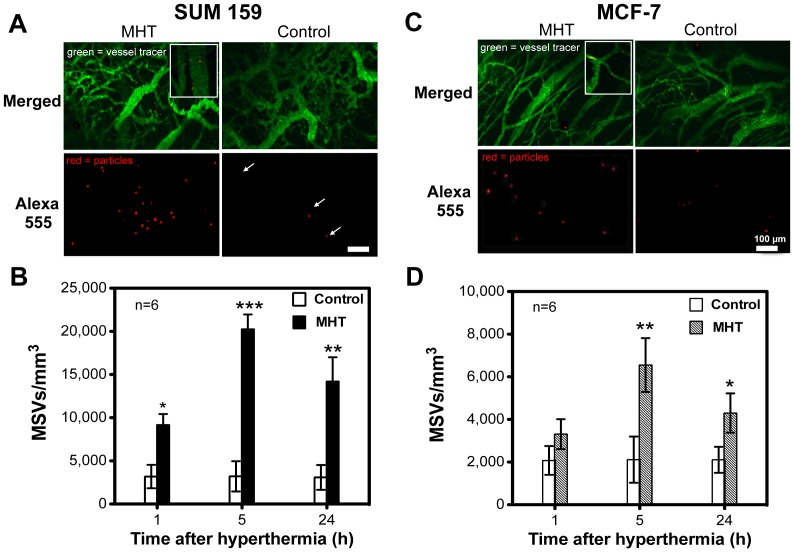
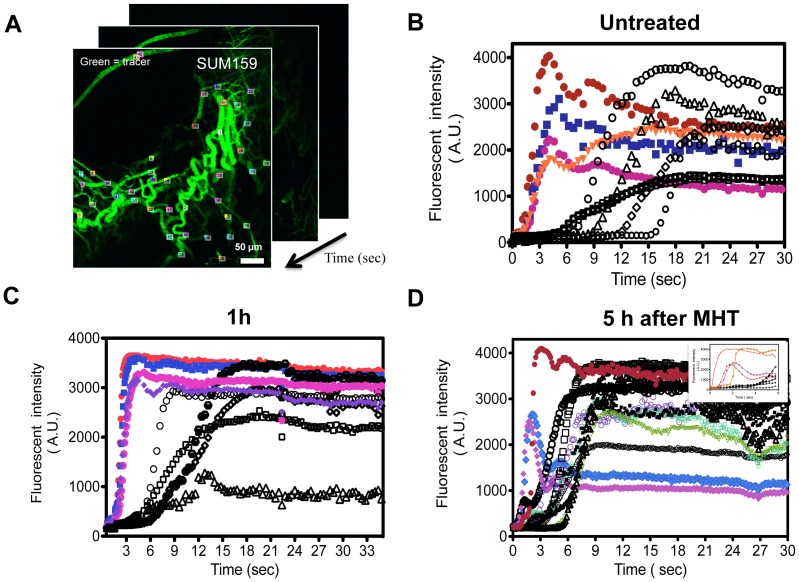
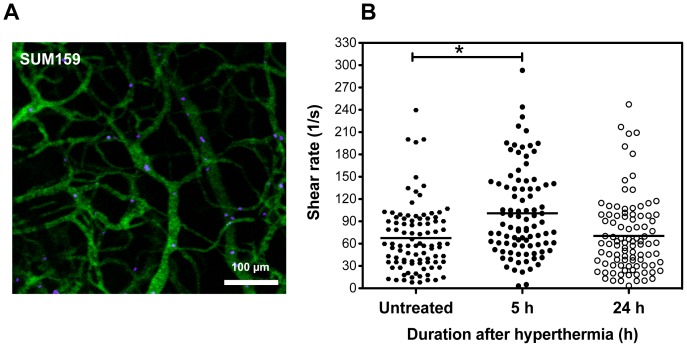
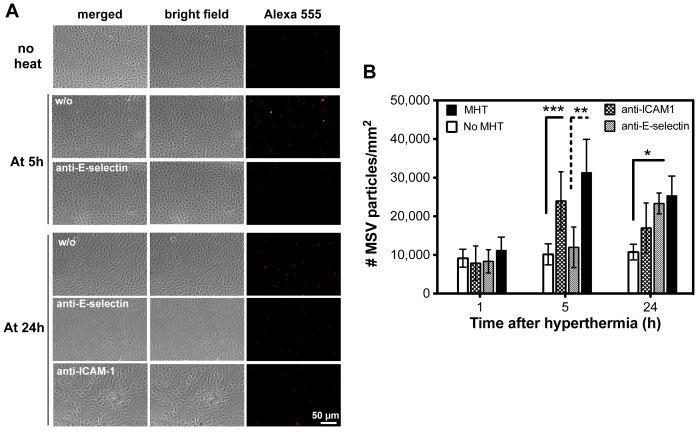
In this study, using intravital microscopy analyses, we showed that temporal mild hyperthermia (∼1 W/cm(2)) amplified delivery and accumulation of MSVs in orthotopic breast cancer tumors. The number of discoidal MSVs (1000×400 nm) adhering to tumor vasculature increased 6-fold for SUM159 tumors and 3-fold for MCF-7 breast cancer tumors. By flow chamber experiments and Western blotting, we established that a temporal increase in E-selectin expression correlated with enhanced particle accumulation. Furthermore, MHT treatment was shown to increase tumor perfusion in a time-dependent fashion.
Our findings reveal that well-timed mild hyperthermia treatment can transiently elevate tumor transport and alter vascular adhesion properties and thereby provides a means to enhance tumor localization of non-thermally sensitive particles such as MSVs. Such enhancement in accumulation could be leveraged to increase therapeutic efficacy and reduce drug dosing in cancer therapy.
热疗已被探索作为一种克服阻碍实体瘤有效药物递送的生物屏障的策略。大多数研究使用温和热疗(MHT)来靶向热敏脂质体载体的递送。其他研究则探讨了其在使肿瘤血管通透性增加和改善肿瘤间质运输方面的应用。然而,MHT在改变肿瘤血管界面和黏附特性方面的作用及其与改善递送的关系尚未明确。在本研究中,我们评估了MHT治疗对肿瘤血管流动动力学和黏附分子表达的影响,并使用介孔硅载体(MSV)评估了颗粒定位的增强情况。我们还确定了最大积累发生的最佳时间窗口。
在本研究中,通过活体显微镜分析,我们表明短暂的温和热疗(约1 W/cm²)可增强原位乳腺癌肿瘤中MSV的递送和积累。对于SUM159肿瘤,附着于肿瘤脉管系统的盘状MSV(1000×400 nm)数量增加了6倍,对于MCF-7乳腺癌肿瘤增加了3倍。通过流动腔实验和蛋白质免疫印迹法,我们确定E-选择素表达的短暂增加与颗粒积累增强相关。此外,MHT治疗显示出以时间依赖性方式增加肿瘤灌注。
我们的研究结果表明,适时的温和热疗可短暂提高肿瘤运输并改变血管黏附特性,从而提供一种增强非热敏性颗粒(如MSV)在肿瘤中定位的方法。这种积累的增强可用于提高癌症治疗的疗效并减少药物剂量。