de Ronde Jorma J, Bonder Marc Jan, Lips Esther H, Rodenhuis Sjoerd, Wessels Lodewyk F A
Department of Molecular Carcinogenesis, The Netherlands Cancer Institute, Amsterdam, The Netherlands ; Department of Molecular Pathology, The Netherlands Cancer Institute, Amsterdam, The Netherlands.
Department of Molecular Carcinogenesis, The Netherlands Cancer Institute, Amsterdam, The Netherlands.
PLoS One. 2014 Feb 18;9(2):e88551. doi: 10.1371/journal.pone.0088551. eCollection 2014.
Despite continuous efforts, not a single predictor of breast cancer chemotherapy resistance has made it into the clinic yet. However, it has become clear in recent years that breast cancer is a collection of molecularly distinct diseases. With ever increasing amounts of breast cancer data becoming available, we set out to study if gene expression based predictors of chemotherapy resistance that are specific for breast cancer subtypes can improve upon the performance of generic predictors.
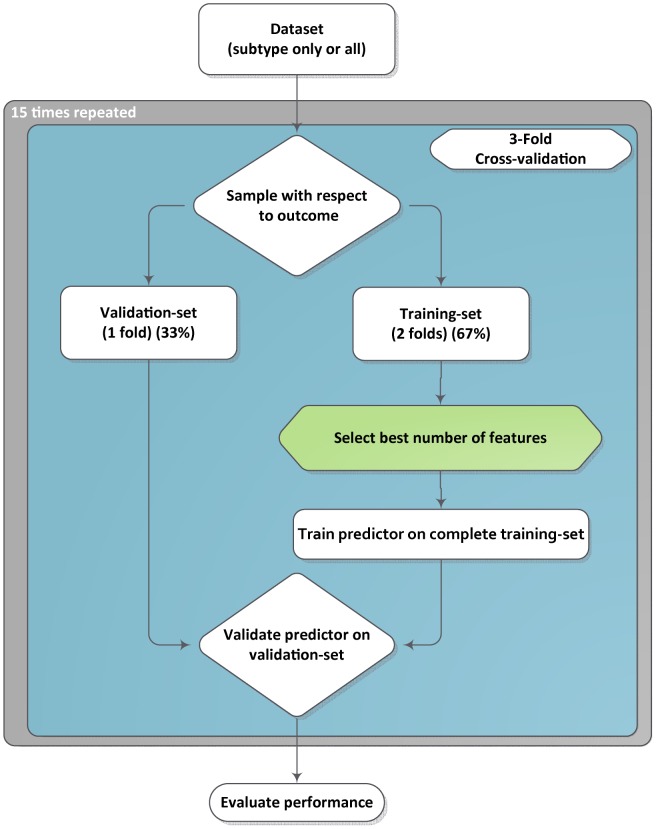
We trained predictors of resistance that were specific for a subtype and generic predictors that were not specific for a particular subtype, i.e. trained on all subtypes simultaneously. Through a rigorous double-loop cross-validation we compared the performance of these two types of predictors on the different subtypes on a large set of tumors all profiled on the same expression platform (n = 394). We evaluated predictors based on either mRNA gene expression or clinical features.
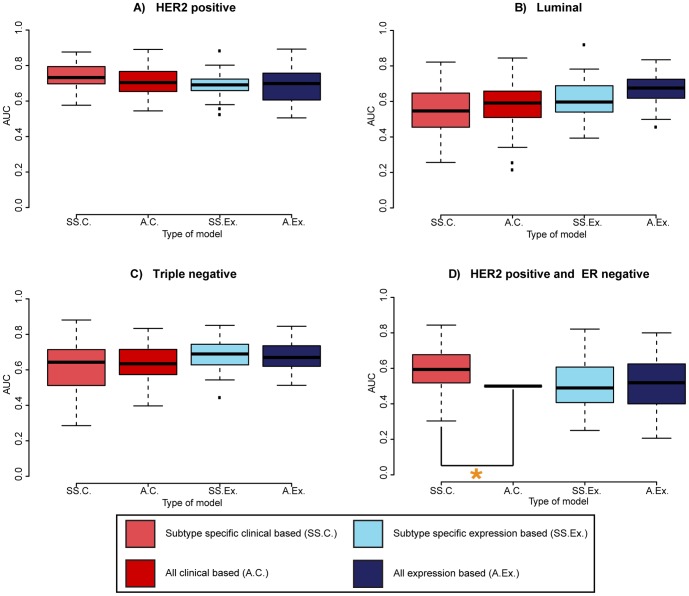
For HER2+, ER- breast cancer, subtype specific predictor based on clinical features outperformed the generic, non-specific predictor. This can be explained by the fact that the generic predictor included HER2 and ER status, features that are predictive over the whole set, but not within this subtype. In all other scenarios the generic predictors outperformed the subtype specific predictors or showed equal performance.
Since it depends on the specific context which type of predictor - subtype specific or generic- performed better, it is highly recommended to evaluate both specific and generic predictors when attempting to predict treatment response in breast cancer.
尽管不断努力,但尚未有一个乳腺癌化疗耐药的预测指标进入临床应用。然而,近年来已明确乳腺癌是一组分子特征不同的疾病。随着越来越多的乳腺癌数据可得,我们着手研究针对乳腺癌亚型的基于基因表达的化疗耐药预测指标是否能优于通用预测指标。
我们训练了针对特定亚型的耐药预测指标以及不针对特定亚型(即在所有亚型上同时训练)的通用预测指标。通过严格的双循环交叉验证,我们在同一表达平台上分析的一大组肿瘤(n = 394)上比较了这两种类型预测指标在不同亚型上的性能。我们基于mRNA基因表达或临床特征评估预测指标。
对于HER2阳性、雌激素受体阴性的乳腺癌,基于临床特征的亚型特异性预测指标优于通用的非特异性预测指标。这可以通过以下事实来解释:通用预测指标纳入了HER2和雌激素受体状态,这些特征在整个数据集上具有预测性,但在该亚型内并非如此。在所有其他情况下,通用预测指标优于亚型特异性预测指标或表现相当。
由于哪种类型的预测指标——亚型特异性或通用型——表现更好取决于具体情况,因此在尝试预测乳腺癌的治疗反应时,强烈建议同时评估特异性和通用型预测指标。