Chang Hsiao-Han, Hartl Daniel L
Department of Organismic and Evolutionary Biology,Harvard University,Cambridge, MA 02138,USA.
Parasitology. 2015 Feb;142 Suppl 1(Suppl 1):S98-S107. doi: 10.1017/S0031182014000067. Epub 2014 Feb 20.
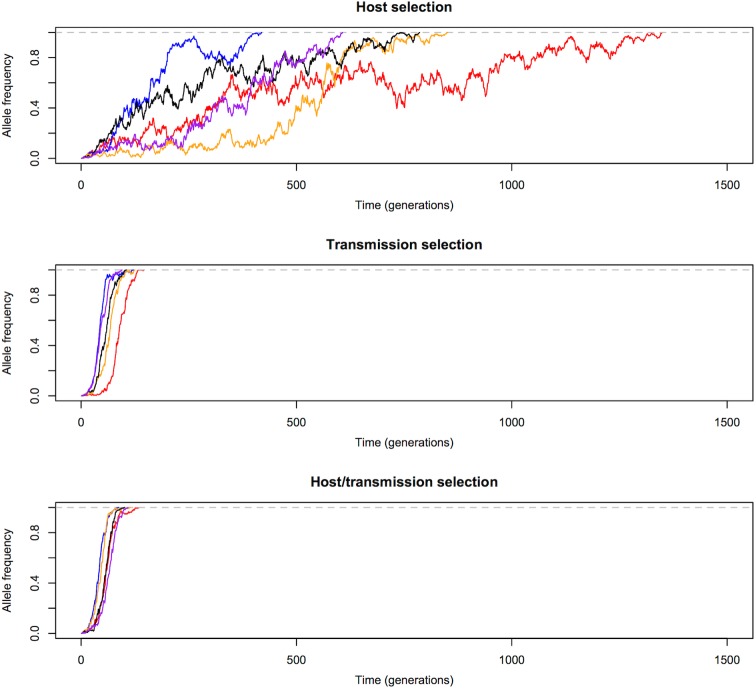
Detecting signals of selection in the genome of malaria parasites is a key to identify targets for drug and vaccine development. Malaria parasites have a unique life cycle alternating between vector and host organism with a population bottleneck at each transition. These recurrent bottlenecks could influence the patterns of genetic diversity and the power of existing population genetic tools to identify sites under positive selection. We therefore simulated the site-frequency spectrum of a beneficial mutant allele through time under the malaria life cycle. We investigated the power of current population genetic methods to detect positive selection based on the site-frequency spectrum as well as temporal changes in allele frequency. We found that a within-host selective advantage is difficult to detect using these methods. Although a between-host transmission advantage could be detected, the power is decreased when compared with the classical Wright-Fisher (WF) population model. Using an adjusted null site-frequency spectrum that takes the malaria life cycle into account, the power of tests based on the site-frequency spectrum to detect positive selection is greatly improved. Our study demonstrates the importance of considering the life cycle in genetic analysis, especially in parasites with complex life cycles.
检测疟原虫基因组中的选择信号是确定药物和疫苗开发靶点的关键。疟原虫具有独特的生命周期,在媒介和宿主体内交替,每次转换时都会出现种群瓶颈。这些反复出现的瓶颈可能会影响遗传多样性模式以及现有群体遗传工具识别正选择位点的能力。因此,我们模拟了有益突变等位基因在疟原虫生命周期中的位点频率谱随时间的变化。我们研究了当前群体遗传方法基于位点频率谱以及等位基因频率的时间变化来检测正选择的能力。我们发现,使用这些方法很难检测到宿主内的选择优势。虽然可以检测到宿主间的传播优势,但与经典的赖特 - 费希尔(WF)群体模型相比,其效力会降低。使用考虑了疟原虫生命周期的调整后的零位点频率谱,基于位点频率谱检测正选择的测试效力会大大提高。我们的研究证明了在遗传分析中考虑生命周期的重要性,特别是对于具有复杂生命周期的寄生虫。