a Department of General Psychology University of Padua.
Behav Sleep Med. 2015;13(2):157-68. doi: 10.1080/15402002.2013.845782. Epub 2014 Feb 24.
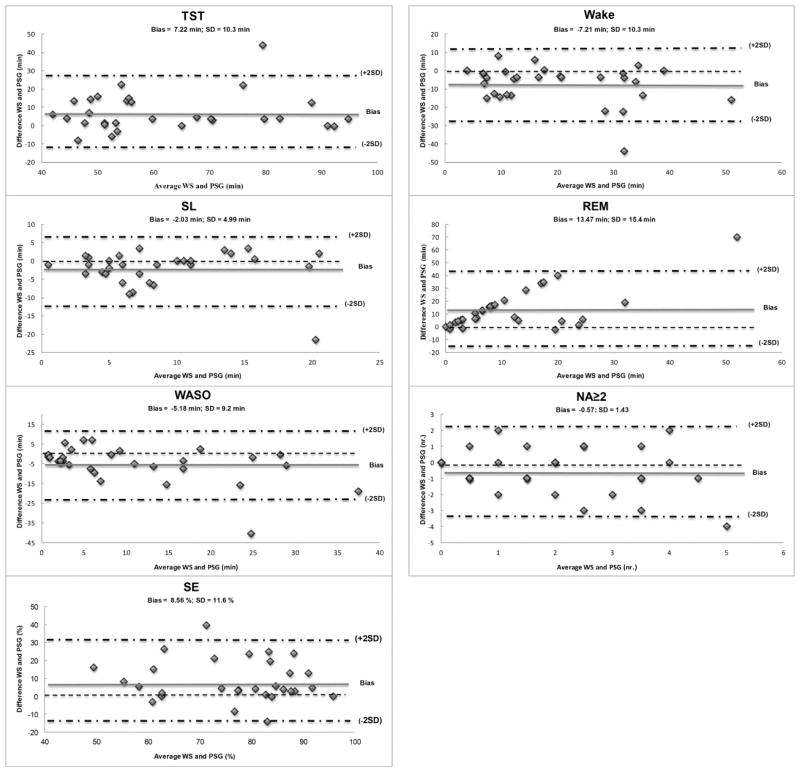
An automated wireless system (WS) for sleep monitoring was recently developed and validated for assessing nighttime sleep. Here, we aimed to evaluate the validity of the WS to correctly monitor daytime sleep during naps compared to polysomnography (PSG). We found that the WS underestimated wake, sleep onset latency, and wake after sleep onset. Meanwhile, it overestimated total sleep time, sleep efficiency, and duration of REM sleep. Sensitivity was moderate for wake (58.51%) and light sleep (66.92%) and strong for deep sleep (83.46%) and REM sleep (82.12%). These results demonstrated that the WS had a low ability to detect wake and systematically overscored REM sleep, implicating the WS as an inadequate substitute for PSG in diagnosing sleep disorders or for research in which sleep staging is essential.
最近开发并验证了一种用于睡眠监测的自动化无线系统(WS),用于评估夜间睡眠。在这里,我们旨在评估 WS 在监测白天小睡时的睡眠与多导睡眠图(PSG)相比的有效性。我们发现,WS 低估了觉醒、睡眠潜伏期和睡眠后觉醒时间。同时,它高估了总睡眠时间、睡眠效率和 REM 睡眠时间。WS 对觉醒(58.51%)和浅睡眠(66.92%)的敏感性中等,对深睡眠(83.46%)和 REM 睡眠(82.12%)的敏感性较强。这些结果表明,WS 检测觉醒的能力较低,并且 REM 睡眠的评分过高,这意味着 WS 在诊断睡眠障碍或研究中需要睡眠分期时,不能替代 PSG。