Department of Psychology, Laboratory for Sleep, Cognition and Consciousness Research, University of Salzburg, Hellbrunnerstrasse 34, 5020 Salzburg, Austria.
Sleep Breath. 2013 May;17(2):747-52. doi: 10.1007/s11325-012-0757-4. Epub 2012 Sep 21.
Classically, professional assessment of sleep is done in the sleep laboratory using whole-night polysomnography (PSG). However, given a misbalance between accredited sleep laboratories and the large amount of patients suffering from sleep disorders, only few receive appropriate diagnostic assessment. Recently, some low-cost home sleep scoring systems have been proposed, yet such systems are rarely tested scientifically. The aim of the present study was to evaluate the staging accuracy of the home sleep scoring system Zeo (Newton, MA, USA).
A final sample of 21 nights from ten subjects (aged 23-45) was digitally recorded with PSG as well as with the Zeo system. We compared scorings of Zeo (on an epoch-be-epoch basis) with the Somnolyzer 24 × 7 (an automatic staging algorithm), expert scorers as well as the freeware SleepExplorer.
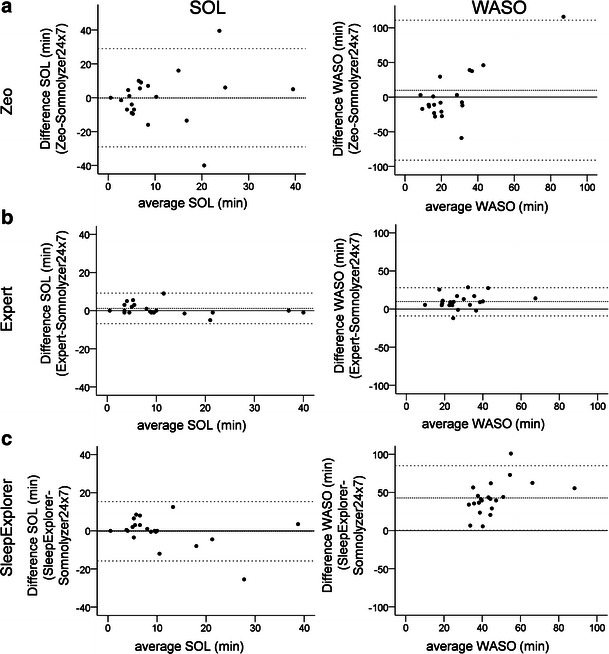
It was revealed that Zeo shows moderate overall agreement as compared to our study standard Somnolyzer 24 × 7 (κ = 0.56). The most obvious performance difference between Zeo and both other scoring approaches was stage wake (sleep onset latency + wake after sleep onset). While Zeo detected only 40.8 % of the study standard wake epochs, 70.1 % were detected by the expert scorers and 83.4 % by the SleepExplorer, respectively.
Data suggest that the Zeo system produces acceptable sleep scoring for stage REM, light and deep sleep, with a specific weakness in correctly detecting waking periods.
传统上,专业的睡眠评估是在睡眠实验室中通过整夜多导睡眠图(PSG)进行的。然而,由于经过认证的睡眠实验室与患有睡眠障碍的大量患者之间存在不平衡,只有少数人接受了适当的诊断评估。最近,一些低成本的家庭睡眠评分系统已经被提出,但这些系统很少经过科学测试。本研究的目的是评估家庭睡眠评分系统 Zeo(美国马萨诸塞州牛顿)的分期准确性。
最终从 10 名受试者(年龄 23-45 岁)中获得了 21 晚的数字记录,这些记录是通过 PSG 以及 Zeo 系统获得的。我们将 Zeo 的评分(逐epoch 进行比较)与 Somnolyzer 24×7(自动分期算法)、专家评分者以及免费的 SleepExplorer 进行了比较。
结果表明,与我们的研究标准 Somnolyzer 24×7 相比,Zeo 的总体一致性中等(κ=0.56)。Zeo 与其他两种评分方法之间最明显的性能差异是阶段清醒(睡眠潜伏期+睡眠后觉醒)。虽然 Zeo 仅检测到研究标准清醒期的 40.8%,但专家评分者检测到 70.1%,SleepExplorer 检测到 83.4%。
数据表明,Zeo 系统可产生可接受的 REM、轻度和深度睡眠评分,在正确检测清醒期方面存在特定弱点。