BMC Bioinformatics. 2013;14 Suppl 16(Suppl 16):S10. doi: 10.1186/1471-2105-14-S16-S10. Epub 2013 Oct 22.
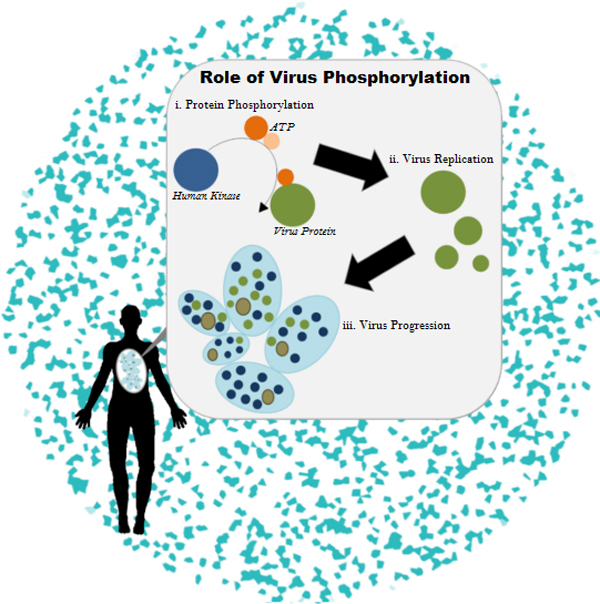
The phosphorylation of virus proteins by host kinases is linked to viral replication. This leads to an inhibition of normal host-cell functions. Further elucidation of phosphorylation in virus proteins is required in order to aid in drug design and treatment. However, only a few studies have investigated substrate motifs in identifying virus phosphorylation sites. Additionally, existing bioinformatics tool do not consider potential host kinases that may initiate the phosphorylation of a virus protein.
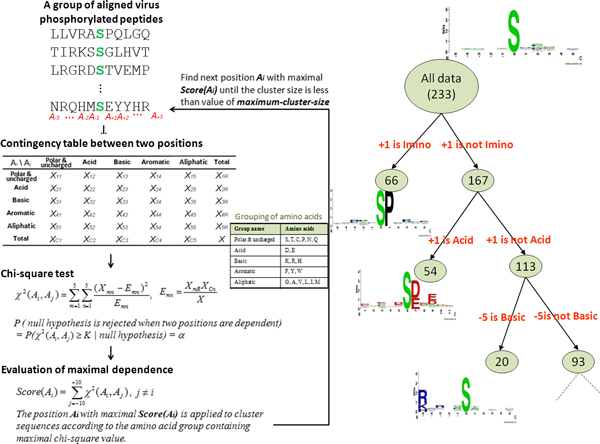
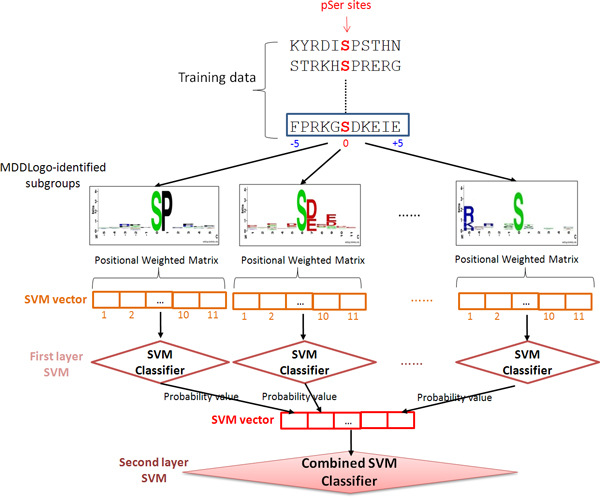
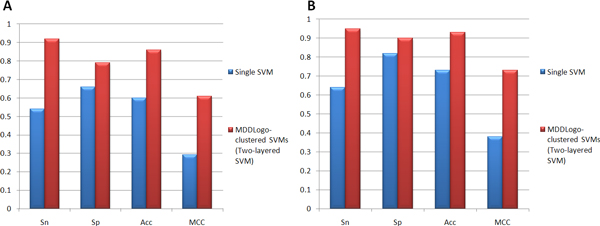
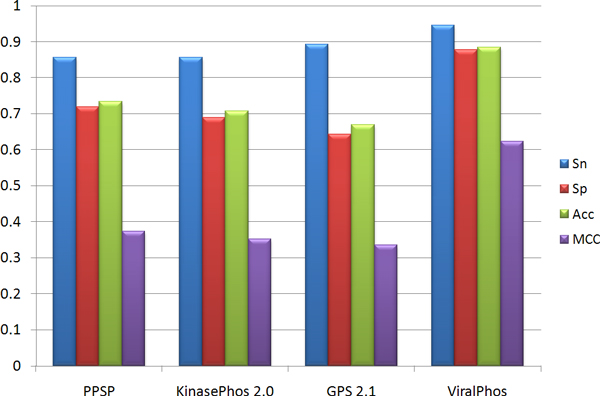
329 experimentally verified phosphorylation fragments on 111 virus proteins were collected from virPTM. These were clustered into subgroups of significantly conserved motifs using a recursively statistical method. Two-layered Support Vector Machines (SVMs) were then applied to train a predictive model for the identified substrate motifs. The SVM models were evaluated using a five-fold cross validation which yields an average accuracy of 0.86 for serine, and 0.81 for threonine. Furthermore, the proposed method is shown to perform at par with three other phosphorylation site prediction tools: PPSP, KinasePhos 2.0 and GPS 2.1.
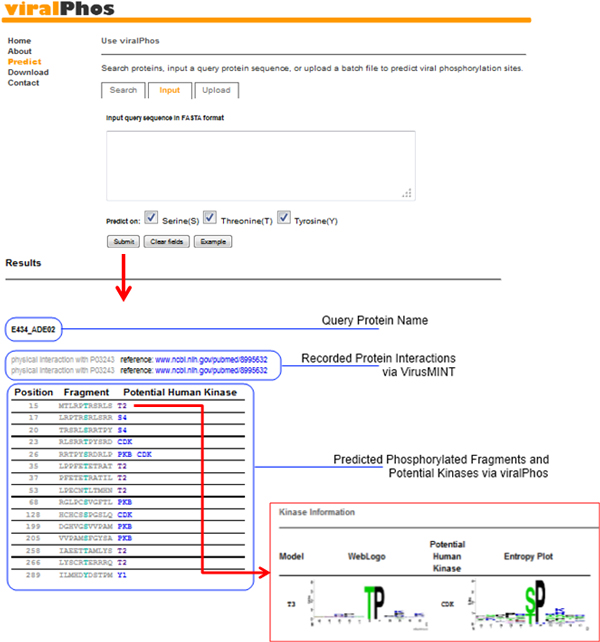
In this study, we propose a computational method, ViralPhos, which aims to investigate virus substrate site motifs and identify potential phosphorylation sites on virus proteins. We identified informative substrate motifs that matched with several well-studied kinase groups as potential catalytic kinases for virus protein substrates. The identified substrate motifs were further exploited to identify potential virus phosphorylation sites. The proposed method is shown to be capable of predicting virus phosphorylation sites and has been implemented as a web server http://csb.cse.yzu.edu.tw/ViralPhos/.
宿主激酶对病毒蛋白的磷酸化与病毒复制有关。这导致正常的宿主细胞功能受到抑制。为了辅助药物设计和治疗,需要进一步阐明病毒蛋白中的磷酸化。然而,只有少数研究调查了识别病毒磷酸化位点的底物基序。此外,现有的生物信息学工具没有考虑可能启动病毒蛋白磷酸化的潜在宿主激酶。
从 virPTM 收集了 111 种病毒蛋白上的 329 个经过实验验证的磷酸化片段。这些片段使用递归统计方法聚类成具有显著保守基序的亚组。然后,应用双层支持向量机(SVM)对识别的底物基序训练预测模型。使用五重交叉验证评估 SVM 模型,得到丝氨酸的平均准确率为 0.86,苏氨酸的平均准确率为 0.81。此外,所提出的方法与其他三种磷酸化位点预测工具(PPSP、KinasePhos 2.0 和 GPS 2.1)表现相当。
在这项研究中,我们提出了一种计算方法 ViralPhos,旨在研究病毒底物基序并识别病毒蛋白上的潜在磷酸化位点。我们确定了与几个研究充分的激酶组相匹配的信息性底物基序,作为病毒蛋白底物的潜在催化激酶。进一步利用鉴定的底物基序来鉴定潜在的病毒磷酸化位点。所提出的方法能够预测病毒磷酸化位点,并已作为网络服务器实现:http://csb.cse.yzu.edu.tw/ViralPhos/。