Chen Yi-Ju, Lu Cheng-Tsung, Huang Kai-Yao, Wu Hsin-Yi, Chen Yu-Ju, Lee Tzong-Yi
Institute of Chemistry, Academia Sinica, Taipei, Taiwan.
Department of Computer Science and Engineering, Yuan Ze University, Taoyuan, Taiwan.
PLoS One. 2015 Apr 7;10(4):e0118752. doi: 10.1371/journal.pone.0118752. eCollection 2015.
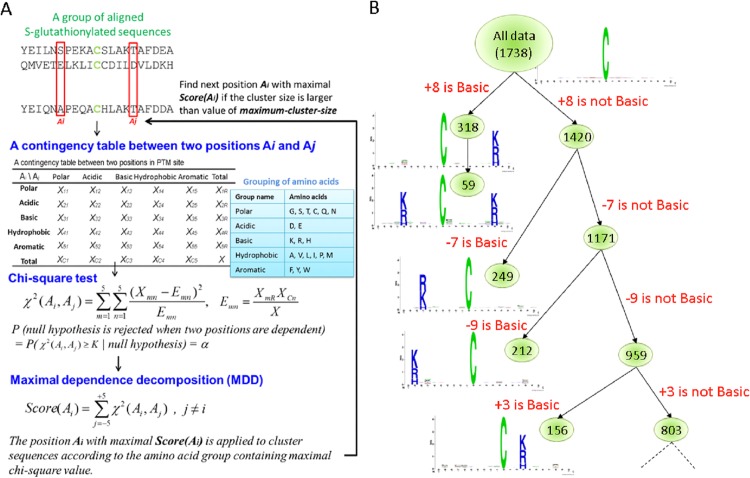
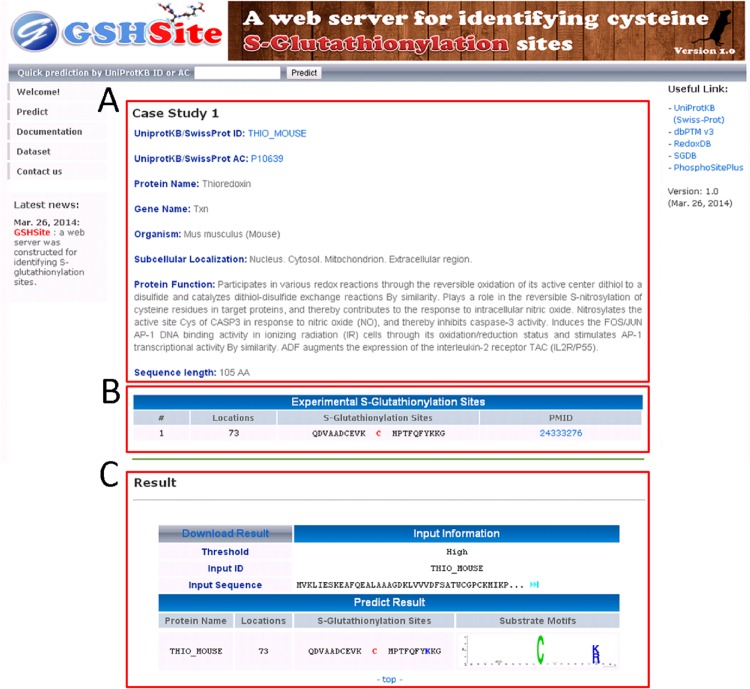
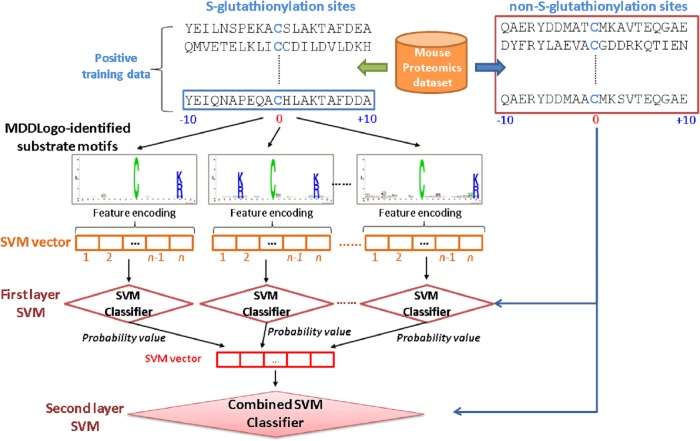
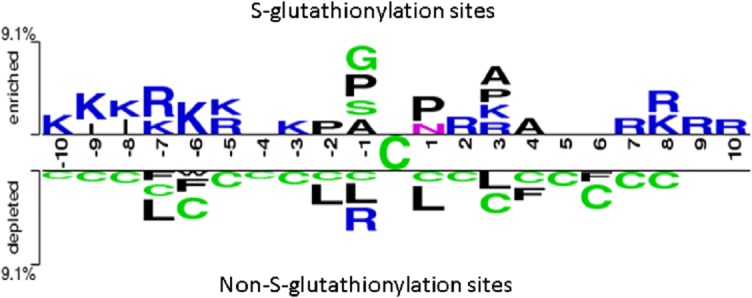
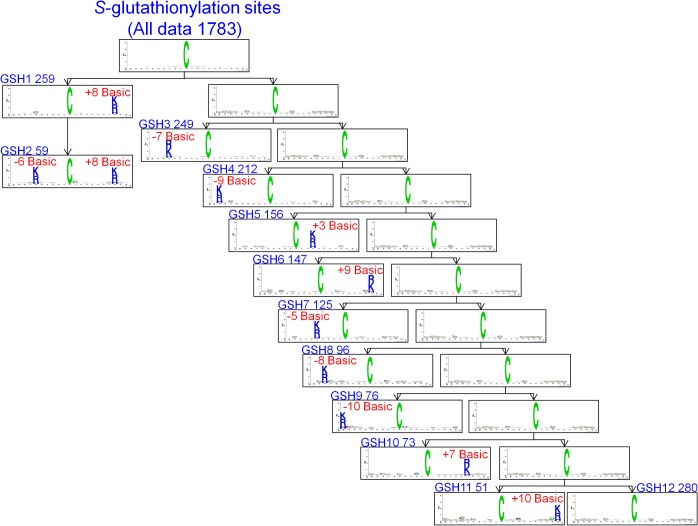
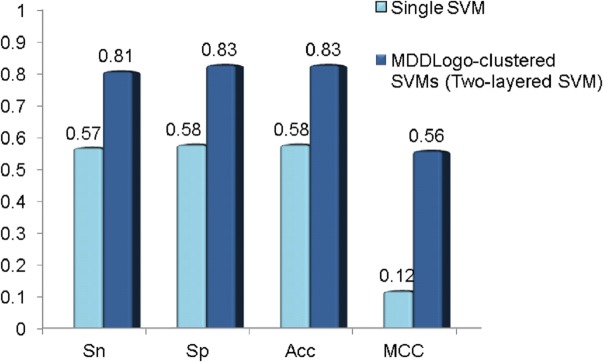
S-glutathionylation, the covalent attachment of a glutathione (GSH) to the sulfur atom of cysteine, is a selective and reversible protein post-translational modification (PTM) that regulates protein activity, localization, and stability. Despite its implication in the regulation of protein functions and cell signaling, the substrate specificity of cysteine S-glutathionylation remains unknown. Based on a total of 1783 experimentally identified S-glutathionylation sites from mouse macrophages, this work presents an informatics investigation on S-glutathionylation sites including structural factors such as the flanking amino acids composition and the accessible surface area (ASA). TwoSampleLogo presents that positively charged amino acids flanking the S-glutathionylated cysteine may influence the formation of S-glutathionylation in closed three-dimensional environment. A statistical method is further applied to iteratively detect the conserved substrate motifs with statistical significance. Support vector machine (SVM) is then applied to generate predictive model considering the substrate motifs. According to five-fold cross-validation, the SVMs trained with substrate motifs could achieve an enhanced sensitivity, specificity, and accuracy, and provides a promising performance in an independent test set. The effectiveness of the proposed method is demonstrated by the correct identification of previously reported S-glutathionylation sites of mouse thioredoxin (TXN) and human protein tyrosine phosphatase 1b (PTP1B). Finally, the constructed models are adopted to implement an effective web-based tool, named GSHSite (http://csb.cse.yzu.edu.tw/GSHSite/), for identifying uncharacterized GSH substrate sites on the protein sequences.
S-谷胱甘肽化,即谷胱甘肽(GSH)与半胱氨酸的硫原子共价连接,是一种选择性且可逆的蛋白质翻译后修饰(PTM),可调节蛋白质活性、定位和稳定性。尽管其在蛋白质功能和细胞信号传导调节中具有重要作用,但半胱氨酸S-谷胱甘肽化的底物特异性仍不清楚。基于从小鼠巨噬细胞中实验鉴定出的总共1783个S-谷胱甘肽化位点,本研究对S-谷胱甘肽化位点进行了信息学研究,包括侧翼氨基酸组成和可及表面积(ASA)等结构因素。TwoSampleLogo显示,S-谷胱甘肽化半胱氨酸侧翼的带正电荷氨基酸可能会在封闭的三维环境中影响S-谷胱甘肽化的形成。进一步应用一种统计方法迭代检测具有统计学意义的保守底物基序。然后应用支持向量机(SVM)生成考虑底物基序的预测模型。根据五折交叉验证,用底物基序训练的SVM可以提高敏感性、特异性和准确性,并在独立测试集中表现出良好的性能。通过正确识别先前报道的小鼠硫氧还蛋白(TXN)和人蛋白酪氨酸磷酸酶1b(PTP1B)的S-谷胱甘肽化位点,证明了所提方法的有效性。最后,采用构建的模型实现了一个名为GSHSite(http://csb.cse.yzu.edu.tw/GSHSite/)的基于网络的有效工具,用于识别蛋白质序列上未表征的GSH底物位点。