Liu I-Hsin, Lo Yu-Shu, Yang Jinn-Moon
BMC Genomics. 2013;14 Suppl 5(Suppl 5):S5. doi: 10.1186/1471-2164-14-S5-S5. Epub 2013 Oct 16.
The adaptive immune response is antigen-specific and triggered by pathogen recognition through T cells. Although the interactions and mechanisms of TCR-peptide-MHC (TCR-pMHC) have been studied over three decades, the biological basis for these processes remains controversial. As an increasing number of high-throughput binding epitopes and available TCR-pMHC complex structures, a fast genome-wide structural modelling of TCR-pMHC interactions is an emergent task for understanding immune interactions and developing peptide vaccines.
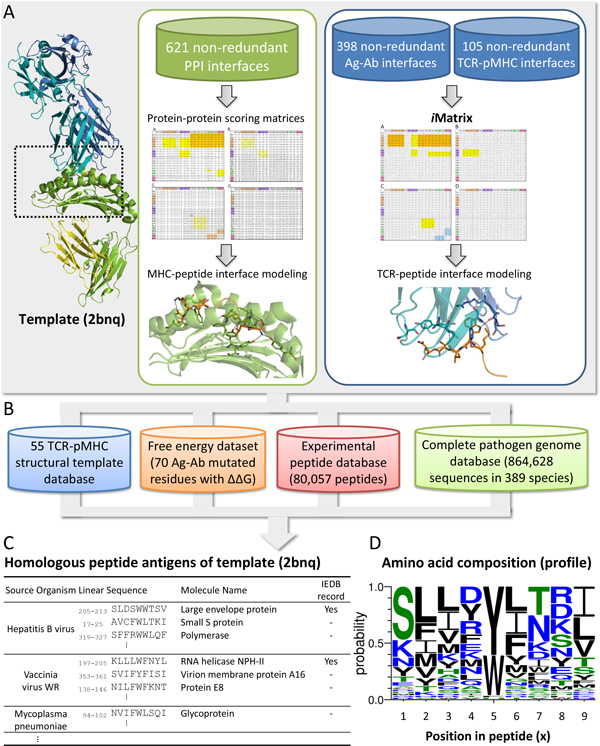
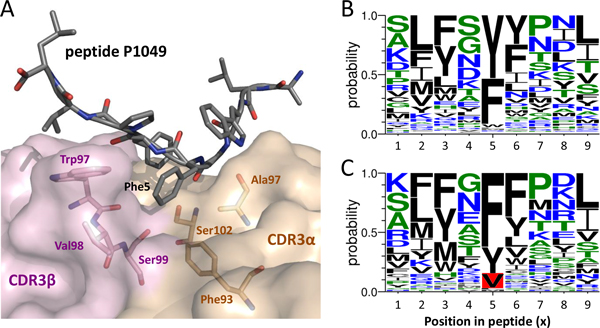
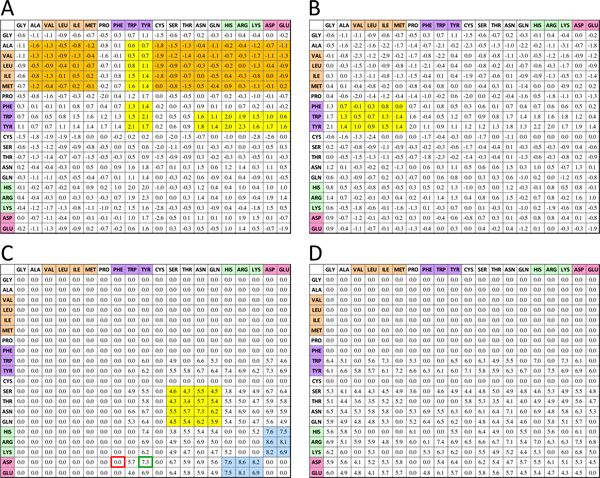
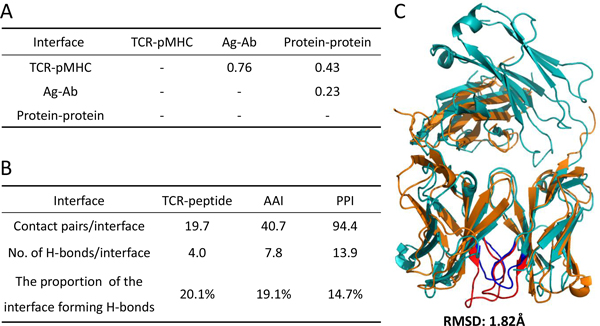
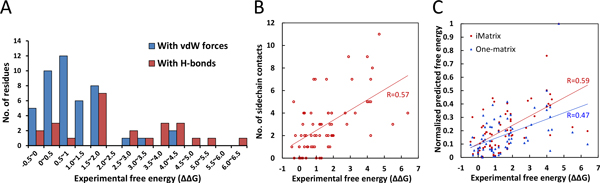
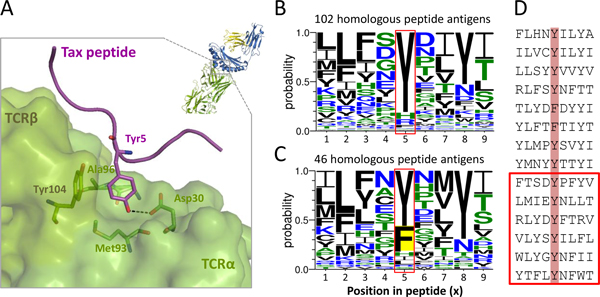
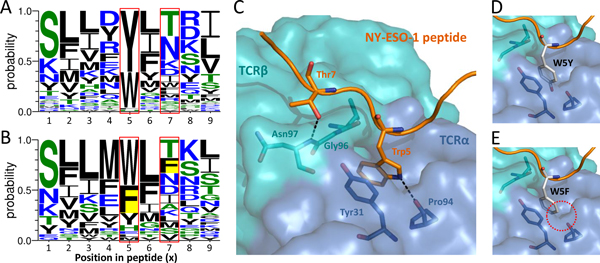
We first constructed the PPI matrices and iMatrix, using 621 non-redundant PPI interfaces and 398 non-redundant antigen-antibody interfaces, respectively, for modelling the MHC-peptide and TCR-peptide interfaces, respectively. The iMatrix consists of four knowledge-based scoring matrices to evaluate the hydrogen bonds and van der Waals forces between sidechains or backbones, respectively. The predicted energies of iMatrix are high correlated (Pearson's correlation coefficient is 0.6) to 70 experimental free energies on antigen-antibody interfaces. To further investigate iMatrix and PPI matrices, we inferred the 701,897 potential peptide antigens with significant statistic from 389 pathogen genomes and modelled the TCR-pMHC interactions using available TCR-pMHC complex structures. These identified peptide antigens keep hydrogen-bond energies and consensus interactions and our TCR-pMHC models can provide detailed interacting models and crucial binding regions.
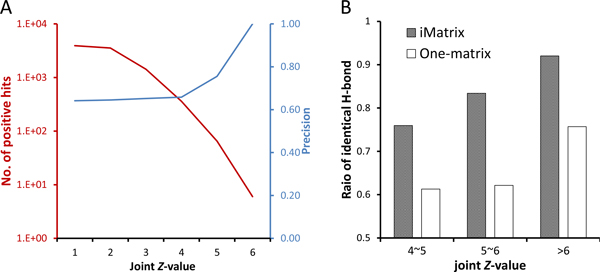
Experimental results demonstrate that our method can achieve high precision for predicting binding affinity and potential peptide antigens. We believe that iMatrix and our template-based method can be useful for the binding mechanisms of TCR-pMHC complexes and peptide vaccine designs.
适应性免疫反应具有抗原特异性,由T细胞识别病原体引发。尽管T细胞受体-肽-主要组织相容性复合体(TCR-pMHC)的相互作用和机制已被研究了三十多年,但这些过程的生物学基础仍存在争议。随着高通量结合表位数量的增加以及TCR-pMHC复合体结构的可得性,对TCR-pMHC相互作用进行全基因组快速结构建模成为理解免疫相互作用和开发肽疫苗的一项紧迫任务。
我们首先构建了蛋白质-蛋白质相互作用(PPI)矩阵和iMatrix,分别使用621个非冗余的PPI界面和398个非冗余的抗原-抗体界面,来分别模拟MHC-肽和TCR-肽界面。iMatrix由四个基于知识的评分矩阵组成,分别用于评估侧链或主链之间的氢键和范德华力。iMatrix预测的能量与抗原-抗体界面上的70个实验自由能高度相关(皮尔逊相关系数为0.6)。为了进一步研究iMatrix和PPI矩阵,我们从389个病原体基因组中推断出701,897个具有显著统计学意义的潜在肽抗原,并使用可用的TCR-pMHC复合体结构对TCR-pMHC相互作用进行建模。这些鉴定出的肽抗原保留了氢键能量和共有相互作用,并且我们的TCR-pMHC模型能够提供详细的相互作用模型和关键结合区域。
实验结果表明,我们的方法在预测结合亲和力和潜在肽抗原方面能够达到高精度。我们相信iMatrix和我们基于模板的方法对于TCR-pMHC复合体的结合机制和肽疫苗设计可能是有用的。