Stem Cell Res Ther. 2013;4 Suppl 1(Suppl 1):S10. doi: 10.1186/scrt371. Epub 2013 Dec 20.
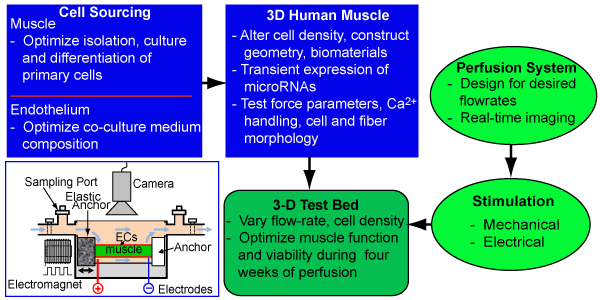
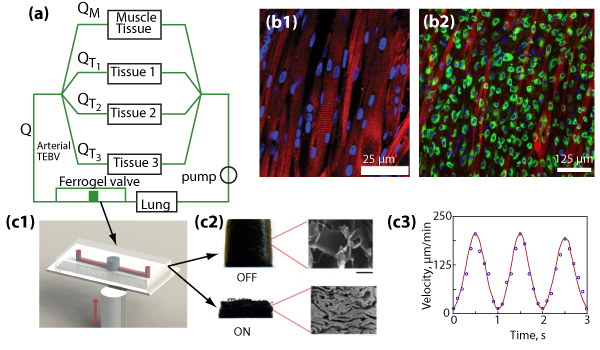
Microphysiological systems provide a tool to simulate normal and pathological function of organs for prolonged periods. These systems must incorporate the key functions of the individual organs and enable interactions among the corresponding microphysiological units. The relative size of different microphysiological organs and their flow rates are scaled in proportion to in vivo values. We have developed a microphysiological three-dimensional engineered human skeletal muscle system connected to a circulatory system that consists of a tissue-engineered blood vessel as part of a high-pressure arterial system. The engineered human skeletal muscle tissue reproduces key mechanical behaviors of skeletal muscle in vivo. Pulsatile flow is produced using a novel computer-controlled magnetically activated ferrogel. The system is versatile and the muscle unit can be integrated with other organ systems. Periodic monitoring of biomechanical function provides a non-invasive assessment of the health of the tissue and a way to measure the response to drugs and toxins.
微生理系统为模拟器官的正常和病理功能提供了一种工具,可以长时间进行模拟。这些系统必须包含各个器官的关键功能,并能够实现相应的微生理单元之间的相互作用。不同微生理器官的相对大小及其流速按比例缩小到与体内值相对应的大小。我们开发了一种连接到循环系统的三维工程化人体骨骼肌系统,该循环系统包括作为高压动脉系统一部分的组织工程血管。工程化的人体骨骼肌组织再现了体内骨骼肌的关键机械行为。使用新型计算机控制的磁激活铁磁凝胶产生脉动流。该系统用途广泛,肌肉单元可以与其他器官系统集成。定期监测生物力学功能为评估组织的健康状况提供了一种非侵入性的方法,并可以测量对药物和毒素的反应。