Richards Jennifer S, Vásquez Alejandro Arias, Rommelse Nanda N J, Oosterlaan Jaap, Hoekstra Pieter J, Franke Barbara, Hartman Catharina A, Buitelaar Jan K
Donders Institute for Brain, Cognition and Behavior, Radboud University Medical Center, Nijmegen, the Netherlands; Karakter Child and Adolescent Psychiatry University Centre, Nijmegen, the Netherlands.
Donders Institute for Brain, Cognition and Behavior, Radboud University Medical Center, Nijmegen, the Netherlands.
J Am Acad Child Adolesc Psychiatry. 2014 Mar;53(3):311-9.e1. doi: 10.1016/j.jaac.2013.11.011. Epub 2013 Dec 3.
Attention-deficit/hyperactivity disorder (ADHD) is associated with conflicted parent-child relationships. The underlying mechanisms of this association are not yet fully understood. We investigated the cross-sectional and longitudinal relationships between externalizing psychopathology in children with ADHD, and expressed emotion (EE; warmth and criticism) and psychopathology in mothers.
In this 6-year follow-up study, 385 children with an ADHD combined subtype were included at baseline (mean, 11.5 years, 83.4% male), of which 285 children (74%) were available at follow-up (mean, 17.5 years, 83.5% male). At both time points, measures of child psychopathology (i.e., ADHD severity, oppositional, and conduct problems), maternal EE, and maternal psychopathology (i.e., ADHD and affective problems) were obtained.
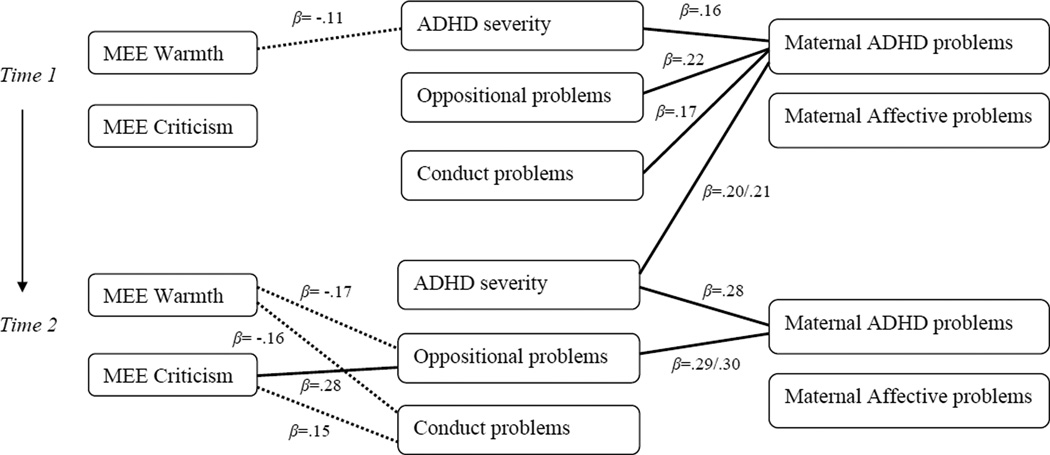
EE was not significantly correlated over time. At baseline, we found a nominally negative association (p ≤ .05) between maternal warmth and child ADHD severity. At follow-up, maternal criticism was significantly associated with child oppositional problems, and nominally with child conduct problems. Maternal warmth was nominally associated with child oppositional and conduct problems. These associations were independent of maternal psychopathology. No longitudinal associations were found between EE at baseline and child psychopathology at follow-up, or child psychopathology at baseline and EE at follow-up.
The results support previous findings of cross-sectional associations between parental EE and child psychopathology. This, together with the finding that EE was not stable over 6 years, suggests that EE is a momentary state measure varying with contextual and developmental factors. EE does not appear to be a risk factor for later externalizing behavior in children with ADHD.
注意缺陷多动障碍(ADHD)与亲子关系冲突有关。这种关联的潜在机制尚未完全明了。我们调查了ADHD患儿的外化精神病理学与母亲的情感表达(EE;温暖与批评)及精神病理学之间的横断面和纵向关系。
在这项为期6年的随访研究中,385名ADHD混合型患儿在基线时被纳入研究(平均年龄11.5岁,83.4%为男性),其中285名患儿(74%)在随访时仍可参与研究(平均年龄17.5岁,83.5%为男性)。在两个时间点,均获取了儿童精神病理学指标(即ADHD严重程度、对立违抗及品行问题)、母亲的情感表达以及母亲的精神病理学指标(即ADHD和情感问题)。
情感表达随时间变化无显著相关性。在基线时,我们发现母亲的温暖与儿童ADHD严重程度之间存在名义上的负相关(p≤.05)。在随访时,母亲的批评与儿童对立违抗问题显著相关,与儿童品行问题名义上相关。母亲的温暖与儿童对立违抗及品行问题名义上相关。这些关联独立于母亲的精神病理学情况。在基线时的情感表达与随访时的儿童精神病理学之间,或基线时的儿童精神病理学与随访时的情感表达之间,均未发现纵向关联。
研究结果支持了先前关于父母情感表达与儿童精神病理学之间横断面关联的研究发现。这一结果,连同情感表达在6年期间不稳定这一发现,表明情感表达是一种随情境和发育因素而变化的瞬时状态指标。情感表达似乎并非ADHD患儿后期外化行为的危险因素。