Spies Georgina, Seedat Soraya
South African Research Chairs Initiative (SARChI), PTSD Program, Department of Psychiatry, Stellenbosch University, Tygerberg, Western Cape, South Africa.
BMJ Open. 2014 Feb 24;4(2):e004200. doi: 10.1136/bmjopen-2013-004200.
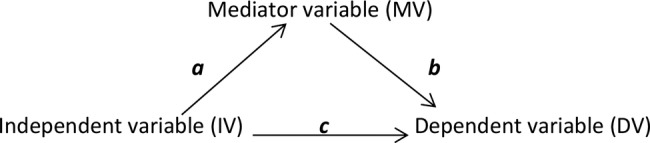
The present study sought to assess the relationship between depressive symptomatology and resilience among women infected with HIV and to investigate whether trauma exposure (childhood trauma, other discrete lifetime traumatic events) or the presence of post-traumatic stress symptomatology mediated this relationship.
Cross-sectional study.
Western Cape, South Africa.
A convenience sample of 95 women infected with HIV in peri-urban communities in the Western Cape, South Africa. All women had exposure to moderate-to-severe childhood trauma as determined by the Childhood Trauma Questionnaire.
We examined the relationship between depressive symptomatology and resilience (the Connor-Davidson Resilience Scale) and investigated whether trauma exposure or the presence of post-traumatic stress symptomatology mediated this relationship through the Sobel test for mediation and PLS path analysis.
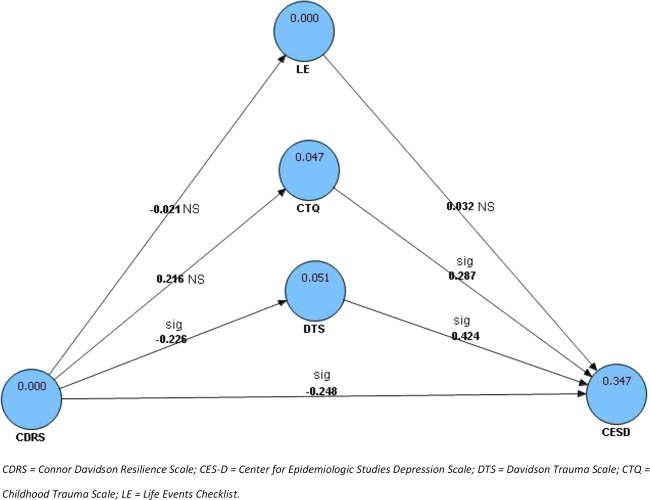
There was a significant negative correlation between depressive symptomatology and resilience (p=<0.01). PLS path analysis revealed a significant direct effect between depression and resilience. On the Sobel test for mediation, distal (childhood trauma) and proximal traumatic events did not significantly mediate this association (p=> 0.05). However, post-traumatic stress symptomatology significantly mediated the relationship between depression and resilience in trauma-exposed women living with HIV.
In the present study, higher levels of resilience were associated with lower levels of self-reported depression. Although causal inferences are not possible, this suggests that in this sample, resilience may act as protective factor against the development of clinical depression. The results also indicate that post-traumatic stress symptoms (PTSS), which are highly prevalent in HIV-infected and trauma exposed individuals and often comorbid with depression, may further explain and account for this relationship. Further investigation is required to determine whether early identification and treatment of PTSS in this population may ameliorate the onset and persistence of major depression.
本研究旨在评估感染艾滋病毒的女性抑郁症状与心理韧性之间的关系,并调查创伤暴露(童年创伤、其他离散的终身创伤事件)或创伤后应激症状的存在是否介导了这种关系。
横断面研究。
南非西开普省。
从南非西开普省城市周边社区便利抽取的95名感染艾滋病毒的女性。根据儿童创伤问卷确定,所有女性都曾遭受中度至重度童年创伤。
我们研究了抑郁症状与心理韧性(康纳-戴维森心理韧性量表)之间的关系,并通过中介效应的索贝尔检验和偏最小二乘路径分析调查创伤暴露或创伤后应激症状的存在是否介导了这种关系。
抑郁症状与心理韧性之间存在显著负相关(p<0.01)。偏最小二乘路径分析显示抑郁与心理韧性之间存在显著直接效应。在中介效应的索贝尔检验中,远期(童年创伤)和近期创伤事件并未显著介导这种关联(p>0.05)。然而,创伤后应激症状显著介导了感染艾滋病毒且有创伤暴露史女性的抑郁与心理韧性之间的关系。
在本研究中,较高水平的心理韧性与较低水平的自我报告抑郁相关。尽管无法进行因果推断,但这表明在该样本中,心理韧性可能是预防临床抑郁症发生的保护因素。结果还表明,创伤后应激症状在感染艾滋病毒且有创伤暴露史的个体中非常普遍,且常与抑郁症共病,可能进一步解释并说明这种关系。需要进一步研究以确定在该人群中早期识别和治疗创伤后应激症状是否可改善重度抑郁症的发病和持续情况。