Telfer Alison
Department of Life Sciences, Sir Ernst Chain Building, Imperial College London, London SW7 2AZ, UK
Plant Cell Physiol. 2014 Jul;55(7):1216-23. doi: 10.1093/pcp/pcu040. Epub 2014 Feb 23.
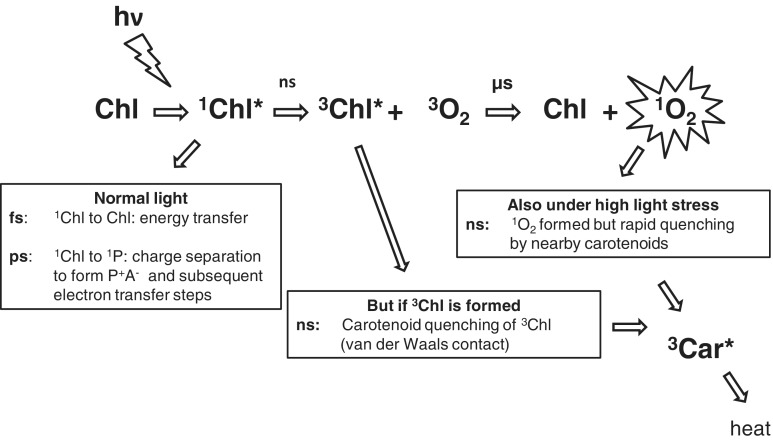
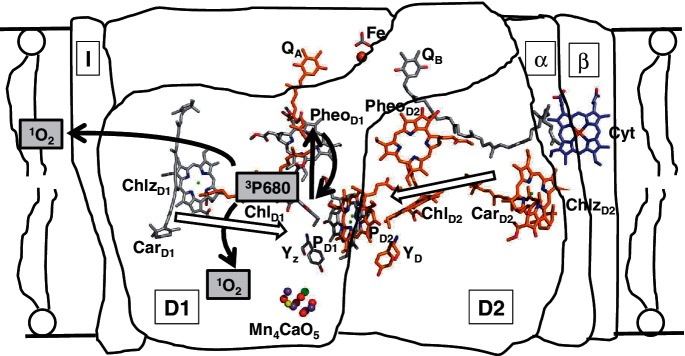
In this review, I outline the indirect evidence for the formation of singlet oxygen ((1)O(2)) obtained from experiments with the isolated PSII reaction center complex. I also review the methods we used to measure singlet oxygen directly, including luminescence at 1,270 nm, both steady state and time resolved. Other methods we used were histidine-catalyzed molecular oxygen uptake (enabling (1)O(2) yield measurements), and dye bleaching and difference absorption spectroscopy to identify where quenchers of (1)O(2) can access this toxic species. We also demonstrated the protective behavior of carotenoids bound within Chl-protein complexes which bring about a substantial amount of (1)O(2) quenching within the reaction center complex. Finally, I describe how these techniques have been used and expanded in research on photoinhibition and on the role of (1)O(2) as a signaling molecule in instigating cellular responses to various stress factors. I also discuss the current views on the role of (1)O(2) as a signaling molecule and the distance it might be able to travel within cells.
在这篇综述中,我概述了从分离的光系统II反应中心复合物实验中获得的单线态氧((1)O(2))形成的间接证据。我还回顾了我们直接测量单线态氧的方法,包括1270nm处的稳态和时间分辨发光。我们使用的其他方法有组氨酸催化的分子氧摄取(用于测量(1)O(2)产率),以及染料漂白和差分吸收光谱法,以确定(1)O(2)淬灭剂可接触到这种有毒物质的位置。我们还证明了叶绿素-蛋白质复合物中结合的类胡萝卜素的保护行为,这种行为在反应中心复合物内导致大量的(1)O(2)淬灭。最后,我描述了这些技术如何在光抑制研究以及(1)O(2)作为信号分子在引发细胞对各种应激因素的反应中的作用研究中得到应用和扩展。我还讨论了关于(1)O(2)作为信号分子的作用以及它在细胞内可能传播的距离的当前观点。