Carey Mariko, Small Hannah, Yoong Sze Lin, Boyes Allison, Bisquera Alessandra, Sanson-Fisher Rob
Priority Research Centre for Health Behaviour, School of Medicine and Public Health;
Br J Gen Pract. 2014 Mar;64(620):e122-7. doi: 10.3399/bjgp14X677482.
General practice is a common setting for the provision of weight-management advice, as well as the treatment of depression. While there is some evidence of a reciprocal relationship between obesity and depression, there are limited data about the rates of depression among general practice patients who are underweight, normal weight, overweight, and obese. AIM To explore the prevalence of depression among underweight, normal weight, overweight, and obese general practice patients.
A cross-sectional survey was conducted in 12 Australian general practices. METHOD Patients aged ≥18 years and older who were presenting for general practice care were eligible to participate. Consenting patients completed a touchscreen computer survey assessing self-reported weight and height. Depression was assessed by the Patient Health Questionnaire-9 (PHQ-9), with a score of ≥10 used to indicate possible depression.
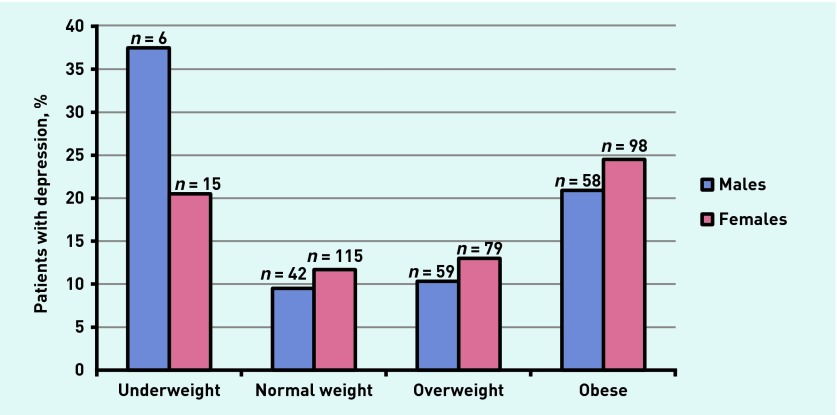
Data were obtained from 3361 participants. The prevalence of depression was 24% (95% confidence interval [CI] = 11.86 to 39.28) among underweight participants, 11% (95% CI = 8.5 to 14.0) among normal weight participants, 12% (95% CI = 0.9 to 15.2) among overweight participants, and 23% (95% CI = 17.8 to 29.0) among obese participants. The prevalence of depression was higher for women than for men across all weight categories except underweight.
Weight and depression demonstrated a U-shaped relationship, with higher prevalence of depression observed among underweight and obese general practice patients. These conditions may act as red flags for opportunistic screening of depression in the general practice setting.
全科医疗是提供体重管理建议以及治疗抑郁症的常见场所。虽然有一些证据表明肥胖与抑郁症之间存在相互关系,但关于体重过轻、正常体重、超重和肥胖的全科医疗患者中抑郁症发病率的数据有限。目的:探讨体重过轻、正常体重、超重和肥胖的全科医疗患者中抑郁症的患病率。
在澳大利亚的12家全科诊所进行了一项横断面调查。方法:年龄≥18岁且前来接受全科医疗服务的患者有资格参与。同意参与的患者完成了一项触摸屏电脑调查,评估自我报告的体重和身高。通过患者健康问卷-9(PHQ-9)评估抑郁症,得分≥10用于表明可能患有抑郁症。
从3361名参与者中获得了数据。体重过轻的参与者中抑郁症患病率为24%(95%置信区间[CI]=11.86至39.28),正常体重的参与者中为11%(95%CI=8.5至14.0),超重的参与者中为12%(95%CI=0.9至15.2),肥胖的参与者中为23%(95%CI=17.8至29.0)。除体重过轻外,所有体重类别中女性的抑郁症患病率均高于男性。
体重与抑郁症呈U形关系,体重过轻和肥胖的全科医疗患者中抑郁症患病率较高。这些情况可能是在全科医疗环境中对抑郁症进行机会性筛查的警示信号。