Department of Pharmaceutical Sciences, Computational Chemical Genomics Screening Center, School of Pharmacy, University of Pittsburgh Pittsburgh, PA, USA ; Center for Chemical Methodologies and Library Development (UPCMLD) and Department of Chemistry, University of Pittsburgh Pittsburgh, PA, USA ; Drug Discovery Institute, University of Pittsburgh Pittsburgh, PA, USA ; Departments of Computational and Systems Biology, University of Pittsburgh Pittsburgh, PA, USA.
Department of Pharmaceutical Sciences, Computational Chemical Genomics Screening Center, School of Pharmacy, University of Pittsburgh Pittsburgh, PA, USA ; Center for Chemical Methodologies and Library Development (UPCMLD) and Department of Chemistry, University of Pittsburgh Pittsburgh, PA, USA ; Drug Discovery Institute, University of Pittsburgh Pittsburgh, PA, USA.
Front Pharmacol. 2014 Feb 6;5:3. doi: 10.3389/fphar.2014.00003. eCollection 2014.
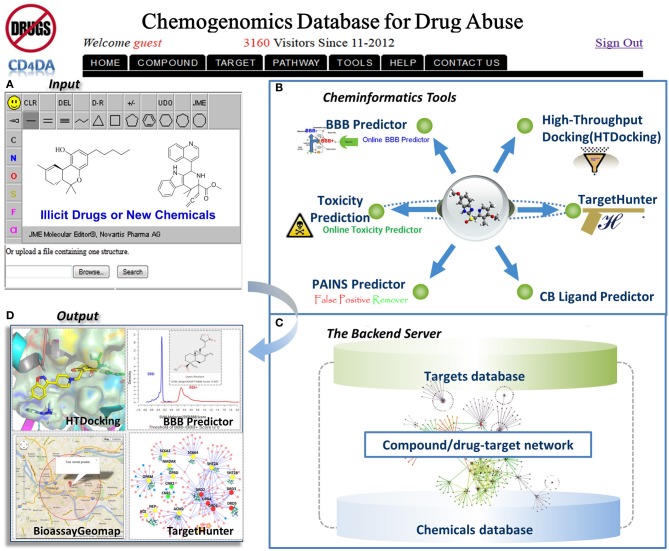
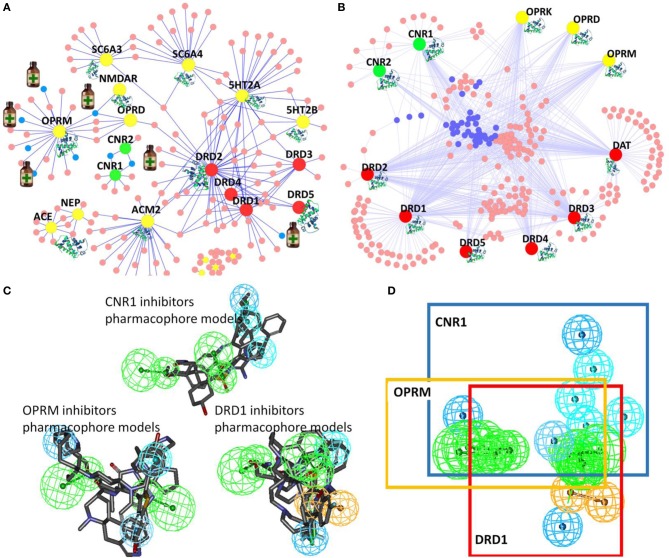
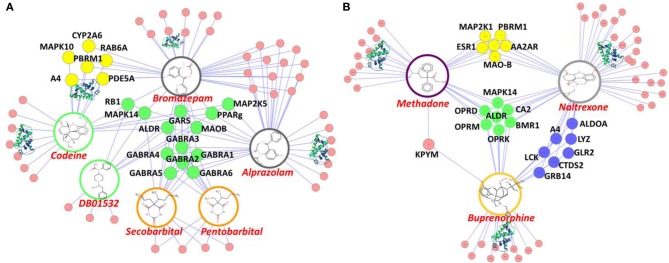
Drug abuse (DA) and addiction is a complex illness, broadly viewed as a neurobiological impairment with genetic and environmental factors that influence its development and manifestation. Abused substances can disrupt the activity of neurons by interacting with many proteins, particularly G-protein coupled receptors (GPCRs). A few medicines that target the central nervous system (CNS) can also modulate DA related proteins, such as GPCRs, which can act in conjunction with the controlled psychoactive substance(s) and increase side effects. To fully explore the molecular interaction networks that underlie DA and to effectively modulate the GPCRs in these networks with small molecules for DA treatment, we built a drug-abuse domain specific chemogenomics knowledgebase (DA-KB) to centralize the reported chemogenomics research information related to DA and CNS disorders in an effort to benefit researchers across a broad range of disciplines. We then focus on the analysis of GPCRs as many of them are closely related with DA. Their distribution in human tissues was also analyzed for the study of side effects caused by abused drugs. We further implement our computational algorithms/tools to explore DA targets, DA mechanisms and pathways involved in polydrug addiction and to explore polypharmacological effects of the GPCR ligands. Finally, the polypharmacology effects of GPCRs-targeted medicines for DA treatment were investigated and such effects can be exploited for the development of drugs with polypharmacophore for DA intervention. The chemogenomics database and the analysis tools will help us better understand the mechanism of drugs abuse and facilitate to design new medications for system pharmacotherapy of DA.
药物滥用(DA)和成瘾是一种复杂的疾病,通常被视为一种神经生物学障碍,其发展和表现受到遗传和环境因素的影响。滥用物质可以通过与许多蛋白质相互作用来破坏神经元的活动,特别是 G 蛋白偶联受体(GPCR)。一些针对中枢神经系统(CNS)的药物也可以调节与 DA 相关的蛋白质,例如 GPCR,它们可以与受控的精神活性物质一起作用,并增加副作用。为了充分探索 DA 背后的分子相互作用网络,并有效地用小分子调节这些网络中的 GPCR,我们构建了一个专门针对药物滥用的化学生物基因组学知识库(DA-KB),集中报告与 DA 和 CNS 障碍相关的化学生物基因组学研究信息,努力使广泛学科的研究人员受益。然后,我们专注于分析 GPCR,因为它们中的许多与 DA 密切相关。还分析了它们在人体组织中的分布,以研究滥用药物引起的副作用。我们进一步实施我们的计算算法/工具,以探索涉及多药成瘾的 DA 靶标、DA 机制和途径,并探索 GPCR 配体的多药理学效应。最后,研究了针对 DA 治疗的 GPCR 靶向药物的多药理学效应,并且可以利用这些效应来开发具有多药效团的药物,以进行 DA 干预。该化学生物基因组学数据库和分析工具将帮助我们更好地理解药物滥用的机制,并促进设计用于 DA 系统药理学治疗的新药物。