Kim Tae Hoon, Lee Heung Kyu
Laboratory of Host Defenses, Graduate School of Medical Science and Engineering, Korea Advanced Institute of Science and Technology (KAIST), Daejeon 305-701, Korea.
BMB Rep. 2014 Apr;47(4):184-91. doi: 10.5483/bmbrep.2014.47.4.050.
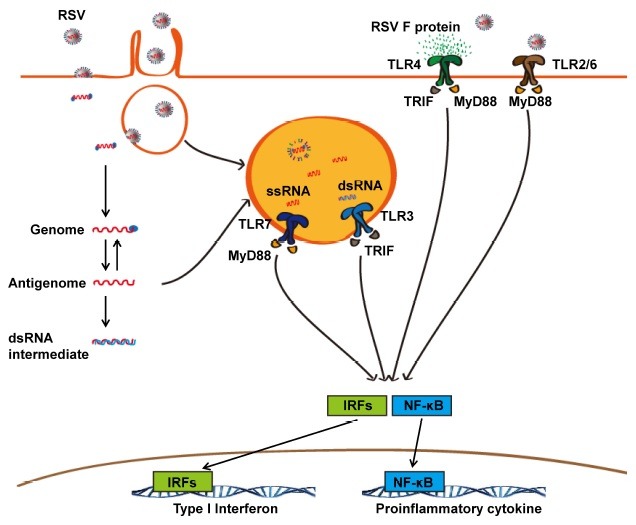
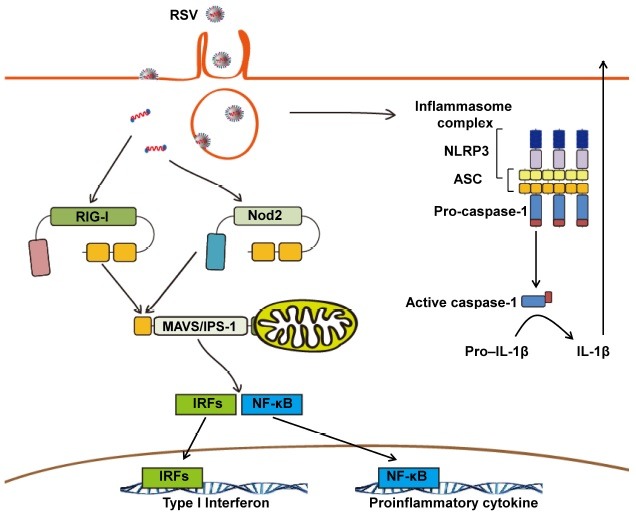
Respiratory syncytial virus (RSV) is the leading cause of respiratory infection in infants and young children. Severe clinical manifestation of RSV infection is a bronchiolitis, which is common in infants under six months of age. Recently, RSV has been recognized as an important cause of respiratory infection in older populations with cardiovascular morbidity or immunocompromised patients. However, neither a vaccine nor an effective antiviral therapy is currently available. Moreover, the interaction between the host immune system and the RSV pathogen during an infection is not well understood. The innate immune system recognizes RSV through multiple mechanisms. The first innate immune RSV detectors are the pattern recognition receptors (PRRs), including toll-like receptors (TLRs), retinoic acid-inducible gene-I (RIG-I)-like receptors (RLRs), and nucleotide-biding oligomerization domain (NOD)-like receptors (NLRs). The following is a review of studies associated with various PRRs that are responsible for RSV virion recognition and subsequent induction of the antiviral immune response during RSV infection.
呼吸道合胞病毒(RSV)是婴幼儿呼吸道感染的主要原因。RSV感染的严重临床表现为细支气管炎,这在6个月以下的婴儿中很常见。最近,RSV已被认为是患有心血管疾病的老年人群或免疫功能低下患者呼吸道感染的重要原因。然而,目前既没有疫苗也没有有效的抗病毒疗法。此外,宿主免疫系统与RSV病原体在感染期间的相互作用尚不清楚。先天性免疫系统通过多种机制识别RSV。第一批先天性免疫RSV探测器是模式识别受体(PRR),包括Toll样受体(TLR)、视黄酸诱导基因-I(RIG-I)样受体(RLR)和核苷酸结合寡聚化结构域(NOD)样受体(NLR)。以下是与各种PRR相关研究的综述,这些PRR负责RSV病毒体的识别以及RSV感染期间随后的抗病毒免疫反应诱导。