College of Chemistry, Chemical Engineering and Food Safety, Bohai University, Jinzhou 121013, People's Republic of China.
Nanoscale Res Lett. 2014 Feb 27;9(1):98. doi: 10.1186/1556-276X-9-98.
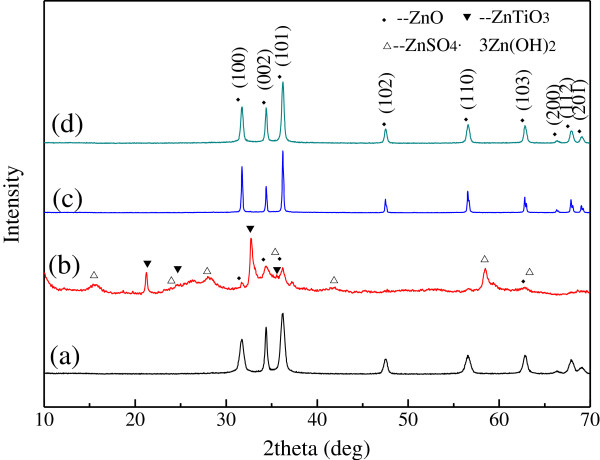
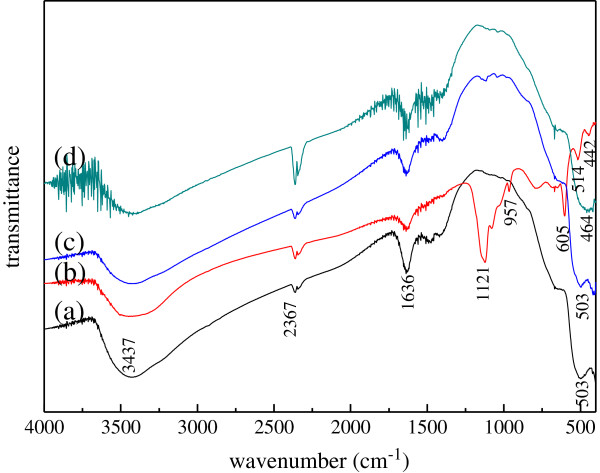
To research the relationship of micro-structures and antibacterial properties of the titanium-doped ZnO powders and probe their antibacterial mechanism, titanium-doped ZnO powders with different shapes and sizes were prepared from different zinc salts by alcohothermal method. The ZnO powders were characterized by X-ray powder diffraction (XRD), Fourier transform infrared spectroscopy (FT-IR), ultraviolet-visible spectroscopy (UV-vis), scanning electron microscopy (SEM), transmission electron microscopy (TEM), and selected area electron diffraction (SAED), and the antibacterial activities of titanium-doped ZnO powders on Escherichia coli and Staphylococcus aureus were evaluated. Furthermore, the tested strains were characterized by SEM, and the electrical conductance variation trend of the bacterial suspension was characterized. The results indicate that the morphologies of the powders are different due to preparation from different zinc salts. The XRD results manifest that the samples synthesized from zinc acetate, zinc nitrate, and zinc chloride are zincite ZnO, and the sample synthesized from zinc sulfate is the mixture of ZnO, ZnTiO3, and ZnSO4 · 3Zn (OH)2 crystal. UV-vis spectra show that the absorption edges of the titanium-doped ZnO powders are red shifted to more than 400 nm which are prepared from zinc acetate, zinc nitrate, and zinc chloride. The antibacterial activity of titanium-doped ZnO powders synthesized from zinc chloride is optimal, and its minimum inhibitory concentration (MIC) and minimum bactericidal concentration (MBC) are lower than 0.25 g L-1. Likewise, when the bacteria are treated by ZnO powders synthesized from zinc chloride, the bacterial cells are damaged most seriously, and the electrical conductance increment of bacterial suspension is slightly high. It can be inferred that the antibacterial properties of the titanium-doped ZnO powders are relevant to the microstructure, particle size, and the crystal. The powders can damage the cell walls; thus, the electrolyte is leaked from cells.
为了研究钛掺杂 ZnO 粉末的微观结构与抗菌性能的关系,并探究其抗菌机制,我们采用醇热法,以不同的锌盐为原料,制备出了具有不同形貌和尺寸的钛掺杂 ZnO 粉末。采用 X 射线粉末衍射(XRD)、傅里叶变换红外光谱(FT-IR)、紫外-可见漫反射光谱(UV-vis)、扫描电子显微镜(SEM)、透射电子显微镜(TEM)和选区电子衍射(SAED)对 ZnO 粉末进行了表征,并评价了钛掺杂 ZnO 粉末对大肠杆菌和金黄色葡萄球菌的抗菌活性。此外,还通过 SEM 对受试菌株进行了表征,并考察了细菌悬浮液电导率的变化趋势。结果表明,由于原料锌盐的不同,粉末的形貌也有所差异。XRD 结果表明,由醋酸锌、硝酸锌和氯化锌合成的样品均为 ZnO 锌矿,而由硫酸锌合成的样品则是 ZnO、ZnTiO3 和 ZnSO4·3Zn(OH)2 晶体的混合物。UV-vis 光谱表明,由醋酸锌、硝酸锌和氯化锌合成的钛掺杂 ZnO 粉末的吸收边红移至 400nm 以上。由氯化锌合成的钛掺杂 ZnO 粉末的抗菌活性最佳,其最小抑菌浓度(MIC)和最小杀菌浓度(MBC)均低于 0.25g·L-1。同样,当用氯化锌合成的 ZnO 粉末处理细菌时,细菌细胞受到的损伤最严重,细菌悬浮液的电导率增量也略高。由此推断,钛掺杂 ZnO 粉末的抗菌性能与微观结构、粒径和晶体有关。粉末可以破坏细胞壁,导致细胞内电解质泄漏。