Ciobanu Carmen Steluta, Iconaru Simona Liliana, Le Coustumer Phillippe, Constantin Liliana Violeta, Predoi Daniela
National Institute of Materials Physics, 105 bis Atomistilor, P,O, Box MG 07, Magurele, Bucuresti, 077125, Romania.
Nanoscale Res Lett. 2012 Jun 21;7(1):324. doi: 10.1186/1556-276X-7-324.
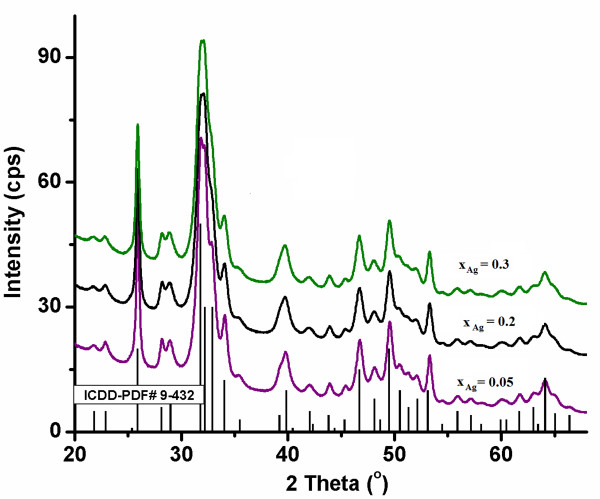
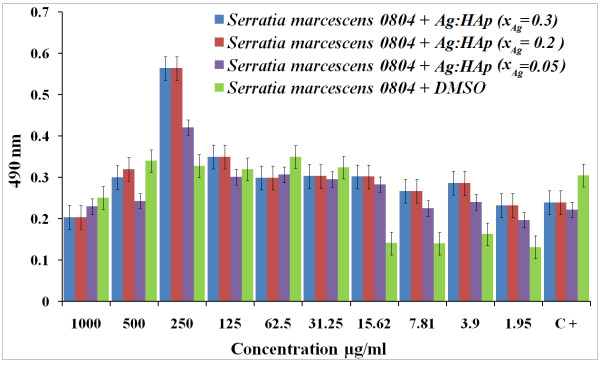
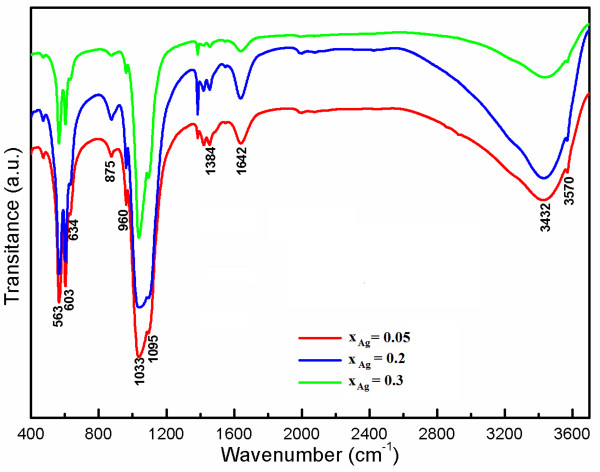
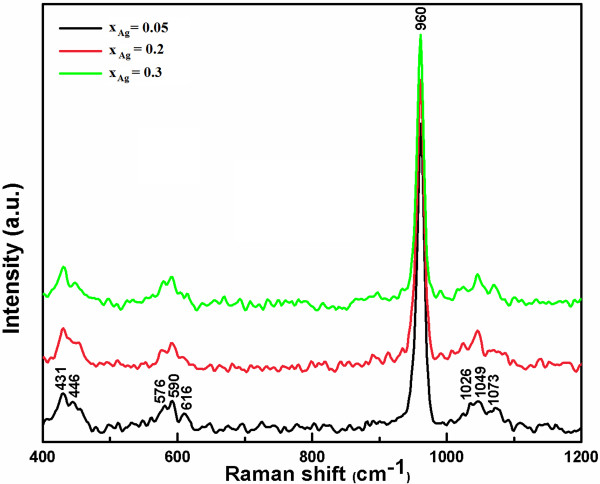
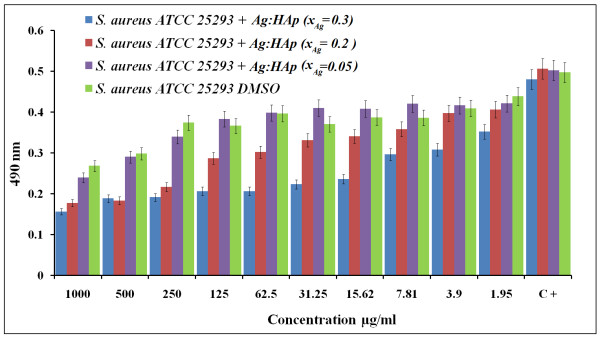
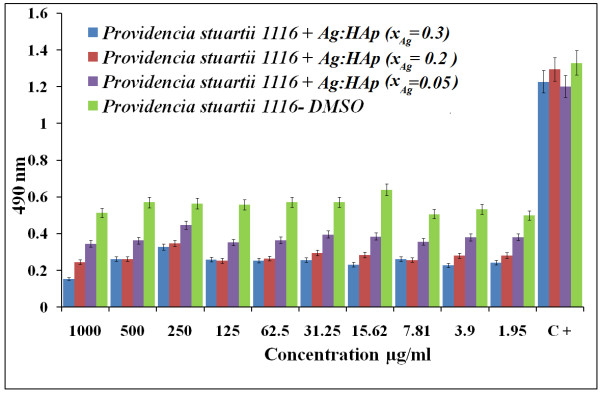
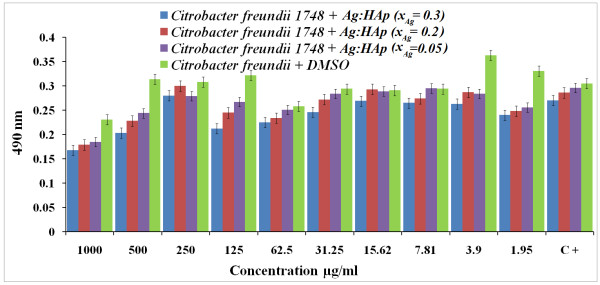
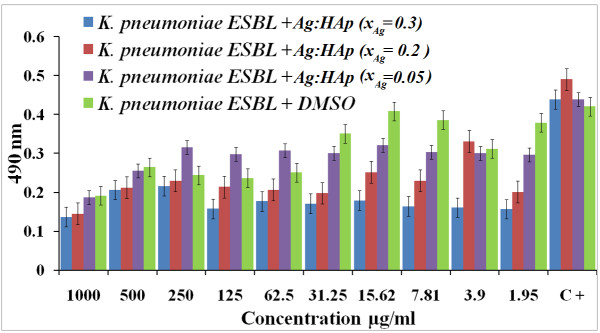
Ag-doped nanocrystalline hydroxyapatite nanoparticles (Ag:HAp-NPs) (Ca10-xAgx(PO4)6(OH)2, xAg = 0.05, 0.2, and 0.3) with antibacterial properties are of great interest in the development of new products. Coprecipitation method is a promising route for obtaining nanocrystalline Ag:HAp with antibacterial properties. X-ray diffraction identified HAp as an unique crystalline phase in each sample. The calculated lattice constants of a = b = 9.435 Å, c = 6.876 Å for xAg = 0.05, a = b = 9.443 Å, c = 6.875 Å for xAg = 0.2, and a = b = 9.445 Å, c = 6.877 Å for xAg = 0.3 are in good agreement with the standard of a = b = 9.418 Å, c = 6.884 Å (space group P63/m). The Fourier transform infrared and Raman spectra of the sintered HAp show the absorption bands characteristic to hydroxyapatite. The Ag:HAp nanoparticles are evaluated for their antibacterial activity against Staphylococcus aureus, Klebsiella pneumoniae, Providencia stuartii, Citrobacter freundii and Serratia marcescens. The results showed that the antibacterial activity of these materials, regardless of the sample types, was greatest against S. aureus, K. pneumoniae, P. stuartii, and C. freundii. The results of qualitative antibacterial tests revealed that the tested Ag:HAp-NPs had an important inhibitory activity on P. stuartii and C. freundii. The absorbance values measured at 490 nm of the P. stuartii and C. freundii in the presence of Ag:HAp-NPs decreased compared with those of organic solvent used (DMSO) for all the samples (xAg = 0.05, 0.2, and 0.3). Antibacterial activity increased with the increase of xAg in the samples. The Ag:HAp-NP concentration had little influence on the bacterial growth (P. stuartii).
具有抗菌性能的银掺杂纳米晶羟基磷灰石纳米颗粒(Ag:HAp-NPs)(Ca10-xAgx(PO4)6(OH)2,xAg = 0.05、0.2和0.3)在新产品开发中备受关注。共沉淀法是获得具有抗菌性能的纳米晶Ag:HAp的一种有前景的途径。X射线衍射确定HAp是每个样品中的唯一晶相。对于xAg = 0.05,计算得到的晶格常数a = b = 9.435 Å,c = 6.876 Å;对于xAg = 0.2,a = b = 9.443 Å,c = 6.875 Å;对于xAg = 0.3,a = b = 9.445 Å,c = 6.877 Å,与标准值a = b = 9.418 Å,c = 6.884 Å(空间群P63/m)吻合良好。烧结HAp的傅里叶变换红外光谱和拉曼光谱显示出羟基磷灰石特有的吸收带。对Ag:HAp纳米颗粒针对金黄色葡萄球菌、肺炎克雷伯菌、斯氏普罗威登斯菌、弗氏柠檬酸杆菌和粘质沙雷氏菌的抗菌活性进行了评估。结果表明,这些材料的抗菌活性,无论样品类型如何,对金黄色葡萄球菌、肺炎克雷伯菌、斯氏普罗威登斯菌和弗氏柠檬酸杆菌的抗菌活性最强。定性抗菌测试结果表明,测试的Ag:HAp-NPs对斯氏普罗威登斯菌和弗氏柠檬酸杆菌具有重要的抑制活性。与所有样品(xAg = 0.05、0.2和0.3)所使用的有机溶剂(二甲基亚砜)相比,在存在Ag:HAp-NPs的情况下,斯氏普罗威登斯菌和弗氏柠檬酸杆菌在490 nm处测得的吸光度值降低。抗菌活性随样品中xAg的增加而增加。Ag:HAp-NP浓度对细菌生长(斯氏普罗威登斯菌)影响很小。