Department of Animal and Plant Sciences, University of Sheffield, Sheffield, UK.
J Evol Biol. 2014 Apr;27(4):772-83. doi: 10.1111/jeb.12350. Epub 2014 Mar 3.
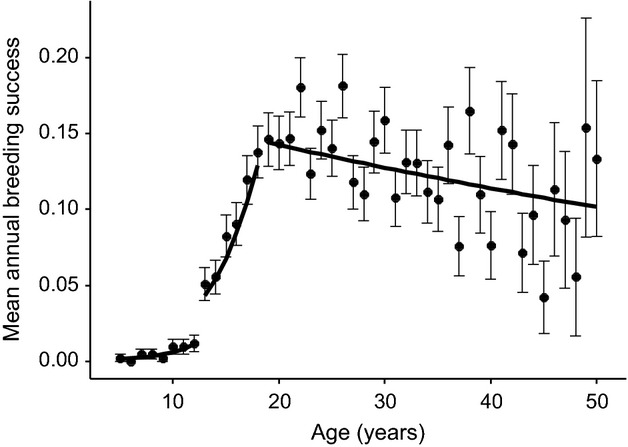
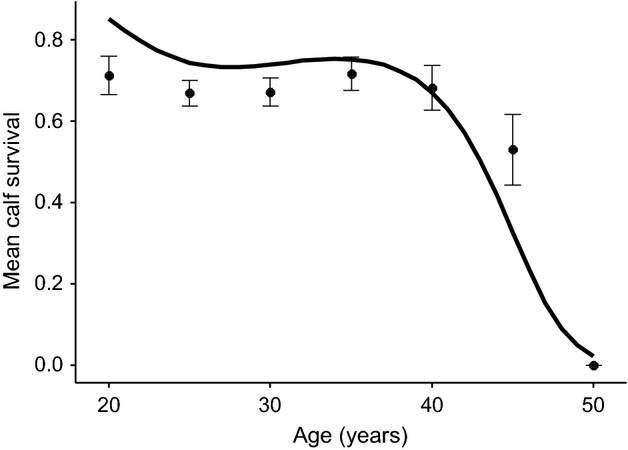
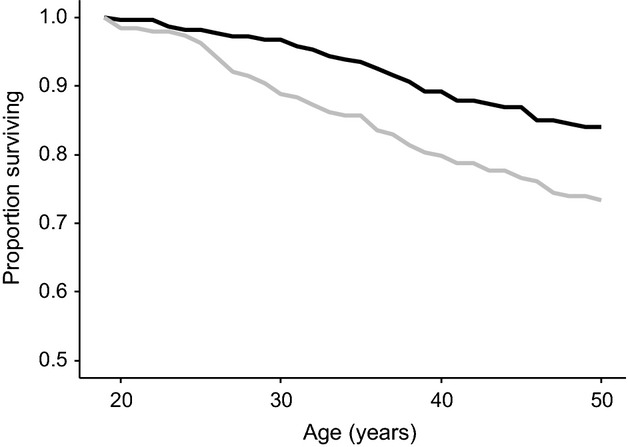
The evolutionary theory of senescence posits that as the probability of extrinsic mortality increases with age, selection should favour early-life over late-life reproduction. Studies on natural vertebrate populations show early reproduction may impair later-life performance, but the consequences for lifetime fitness have rarely been determined, and little is known of whether similar patterns apply to mammals which typically live for several decades. We used a longitudinal dataset on Asian elephants (Elephas maximus) to investigate associations between early-life reproduction and female age-specific survival, fecundity and offspring survival to independence, as well as lifetime breeding success (lifetime number of calves produced). Females showed low fecundity following sexual maturity, followed by a rapid increase to a peak at age 19 and a subsequent decline. High early life reproductive output (before the peak of performance) was positively associated with subsequent age-specific fecundity and offspring survival, but significantly impaired a female's own later-life survival. Despite the negative effects of early reproduction on late-life survival, early reproduction is under positive selection through a positive association with lifetime breeding success. Our results suggest a trade-off between early reproduction and later survival which is maintained by strong selection for high early fecundity, and thus support the prediction from life history theory that high investment in reproductive success in early life is favoured by selection through lifetime fitness despite costs to later-life survival. That maternal survival in elephants depends on previous reproductive investment also has implications for the success of (semi-)captive breeding programmes of this endangered species.
衰老的进化理论认为,随着外在死亡率随年龄的增加而增加,选择应该有利于早期生活而不是晚期生活的繁殖。对自然脊椎动物种群的研究表明,早期繁殖可能会损害后期生活的表现,但对终生适应度的影响很少被确定,也不知道类似的模式是否适用于通常可以活几十年的哺乳动物。我们使用了关于亚洲象(Elephas maximus)的纵向数据集,调查了早期繁殖与雌性特定年龄的存活率、繁殖力和后代存活至独立以及终生繁殖成功(终生生育的幼崽数量)之间的关联。雌性在性成熟后表现出低繁殖力,随后迅速增加到 19 岁的峰值,随后下降。高早期生殖输出(在表现高峰期之前)与随后的特定年龄的繁殖力和后代存活率呈正相关,但显著损害了雌性自身的后期生活存活率。尽管早期繁殖对后期生活的存活率有负面影响,但通过与终生繁殖成功呈正相关,早期繁殖受到积极选择。我们的研究结果表明,早期繁殖和后期生存之间存在权衡,这是通过对早期高繁殖力的强烈选择来维持的,因此支持了生命周期理论的预测,即尽管对后期生存的成本很高,但早期生活中生殖成功的高投资通过终生适应度受到选择的青睐。大象的母亲生存取决于以前的生殖投资,这对这个濒危物种的(半)圈养繁殖计划的成功也有影响。