Ku N S, Lee Y, Ahn J Y, Song J E, Kim M H, Kim S B, Jeong S J, Hong K-W, Kim E, Han S H, Song J Y, Cheong H J, Song Y G, Kim W J, Kim J M, Smith D M, Choi J Y
Department of Internal Medicine and AIDS Research Institute, Seoul, South Korea.
HIV Med. 2014 Sep;15(8):470-7. doi: 10.1111/hiv.12137. Epub 2014 Feb 24.
HIV-associated neurocognitive disorder (HAND) is an independent predictor of early mortality and is associated with many difficulties in activities of daily living. We sought to determine the prevalence of and risk factors for HAND in HIV-infected Koreans. In addition, we investigated the performance of screening tools and components of neuropsychological (NP) tests for diagnosing HAND.
HIV-infected patients were enrolled consecutively from two different urban teaching hospitals in Seoul, South Korea between March 2012 and September 2012. Participants completed a detailed NP assessment of six cognitive domains commonly affected by HIV. The Frascati criteria were used for diagnosing HAND. Four key questions, the International HIV Dementia Scale (IHDS) and Montreal Cognitive Assessment (MoCA)-K were also assessed as potential tools for screening for HAND.
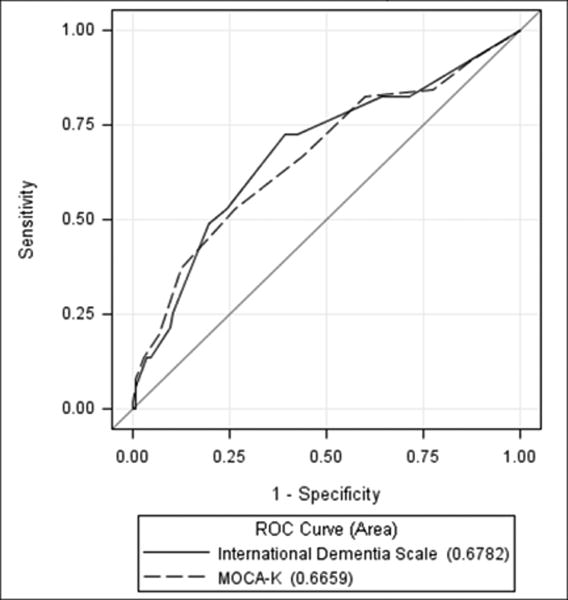
Among the 194 participants, the prevalence of HAND was 26.3%. Asymptomatic neurocognitive impairment and minor neurocognitive disorder accounted for 52.9 and 47.1% of the patients with HAND, respectively. In multivariate analysis, haemoglobin (Hb) level ≤ 13 g/dL (P = 0.046) and current use of a protease inhibitor-based regimen (P = 0.031) were independent risk factors for HAND. The sensitivity and specificity of the IHDS were 72.6 and 60.8%, and those of MoCA-K were 52.9 and 73.4%, respectively. The IHDS (P < 0.001) and MoCA-K (P < 0.001) were both useful for screening for HAND. Among NP tests, the sensitivity and specificity of the Grooved Pegboard Test were 90.2 and 72.0%, and those of the Wisconsin Card Sorting Test were 61.2 and 84.4%, respectively.
HAND is a prevalent comorbidity in HIV-infected Koreans. Active screening and diagnosis with effective tools, such as the IHDS, MoCA-K and Grooved Pegboard Test, could be used to identify this important complication.
HIV 相关神经认知障碍(HAND)是早期死亡的独立预测因素,且与日常生活中的诸多困难相关。我们旨在确定韩国 HIV 感染者中 HAND 的患病率及危险因素。此外,我们还研究了用于诊断 HAND 的筛查工具及神经心理学(NP)测试组件的性能。
2012 年 3 月至 2012 年 9 月期间,从韩国首尔的两家不同城市教学医院连续招募 HIV 感染患者。参与者完成了对六个通常受 HIV 影响的认知领域的详细 NP 评估。采用 Frascati 标准诊断 HAND。还评估了四个关键问题、国际 HIV 痴呆量表(IHDS)和蒙特利尔认知评估(MoCA)-K 作为 HAND 筛查的潜在工具。
在 194 名参与者中,HAND 的患病率为 26.3%。无症状神经认知损害和轻度神经认知障碍分别占 HAND 患者的 52.9%和 47.1%。多因素分析中,血红蛋白(Hb)水平≤13 g/dL(P = 0.046)和目前使用基于蛋白酶抑制剂的治疗方案(P = 0.031)是 HAND 的独立危险因素。IHDS 的敏感性和特异性分别为 72.6%和 60.8%,MoCA-K 的敏感性和特异性分别为 52.9%和 73.4%。IHDS(P < 0.001)和 MoCA-K(P < 0.001)均有助于 HAND 的筛查。在 NP 测试中,沟槽钉板测试的敏感性和特异性分别为 90.2%和 72.0%,威斯康星卡片分类测试的敏感性和特异性分别为 61.2%和 84.4%。
HAND 在韩国 HIV 感染者中是一种常见的合并症。使用 IHDS、MoCA-K 和沟槽钉板测试等有效工具进行积极筛查和诊断,可用于识别这一重要并发症。