Department of Cardiology, the First Affiliated Hospital of Soochow University, Suzhou, China.
Department of Cardiology, The Affiliated Wuxi People's Hospital of Nanjing Medical University, Wuxi, China.
PLoS One. 2014 Feb 21;9(2):e88755. doi: 10.1371/journal.pone.0088755. eCollection 2014.
Periostin was proved to play an important role in extra-cellular matrix remodeling after acute myocardial infarction (AMI). Myocardial periostin was markedly up-regulated after AMI and participated in the maladaptive process of cardiac remodeling. However, few researches focused on the circulating periostin and its significance. This study aims to investigate the association of serum periostin level with cardiac function and short-term prognosis in AMI patients.
METHODOLOGY/PRINCIPAL FINDINGS: We totally recruited 50 patients diagnosed as ST-elevation myocardial infarction. Blood samples were taken within 12 hours after the onset of AMI before emergency coronary revascularization procedures. Serum periostin was measured using enzyme-linked immunosorbent assay. All patients received echocardiography examination within one week after hospitalization. Correlations of serum periostin with echocardiography parameters, Killip class and myocardium injury biomarkers (CK-MB/troponin T) were investigated. AMI patients were divided into two groups by serum periostin level (higher/lower periostin group) and followed up for six months. Primary endpoints included cardiovascular mortality, nonfatal stroke/transient ischemic attack, chest pain occurrence and re-hospitalization. Secondary endpoint referred to composite cardiovascular events including all the primary endpoints.
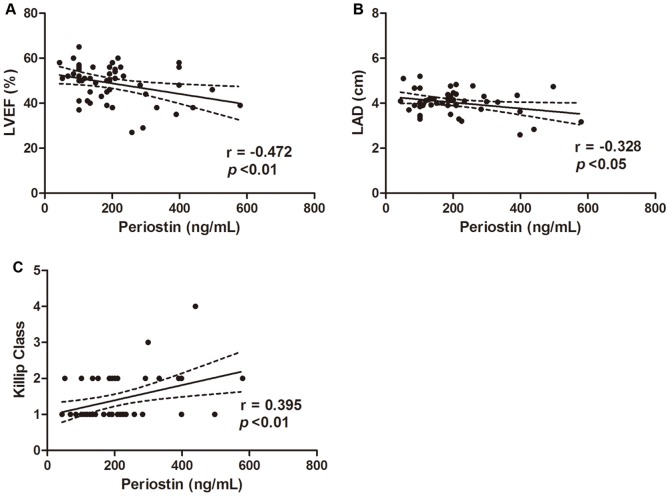
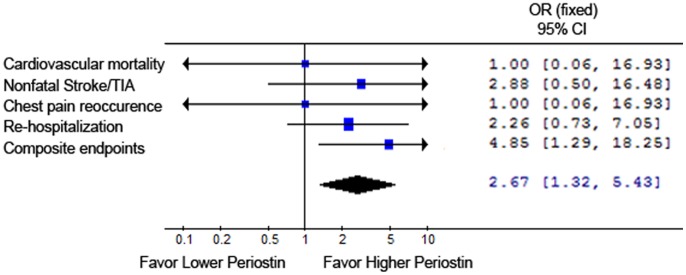
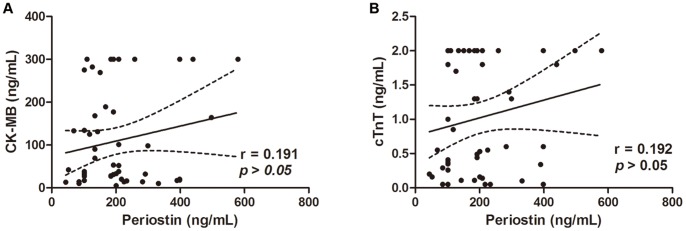
Serum periostin was in negative association with left ventricular ejection fraction (LVEF) (r = -0.472, *p<0.01) and left atrium diameter (LAD) (r = -0.328, *p<0.05). Positive correlation was found between serum periostin level and Killip class (r = 0.395, *p<0.01). There was no association between serum periostin and CK-MB or troponin T (p>0.05). After six months follow up, patients in higher periostin group showed increased composite cardiovascular events (*p<0.05). Patients showed no significant difference in primary endpoints between the two groups.
CONCLUSIONS/SIGNIFICANCE: Serum periostin was in negative correlation with LVEF and LAD, in positive association with Killip class and higher serum periostin level may be predictive for worse short-term disease prognosis indicated as more composite cardiovascular events six months post AMI.
骨膜蛋白在急性心肌梗死(AMI)后细胞外基质重塑中起着重要作用。AMI 后心肌骨膜蛋白明显上调,并参与心脏重构的适应性过程。然而,很少有研究关注循环骨膜蛋白及其意义。本研究旨在探讨血清骨膜蛋白水平与 AMI 患者心功能和短期预后的关系。
方法/主要发现:我们共招募了 50 名诊断为 ST 段抬高型心肌梗死的患者。在急诊冠状动脉血运重建前,于 AMI 发病后 12 小时内采集血样。采用酶联免疫吸附试验测定血清骨膜蛋白。所有患者均在入院后一周内接受超声心动图检查。探讨了血清骨膜蛋白与超声心动图参数、Killip 分级和心肌损伤标志物(CK-MB/肌钙蛋白 T)的相关性。根据血清骨膜蛋白水平(高/低骨膜蛋白组)将 AMI 患者分为两组,并进行了 6 个月的随访。主要终点包括心血管死亡、非致死性卒中/短暂性脑缺血发作、胸痛发作和再入院。次要终点是指包括所有主要终点的复合心血管事件。
血清骨膜蛋白与左心室射血分数(LVEF)呈负相关(r=-0.472,*p<0.01),与左心房直径(LAD)呈负相关(r=-0.328,*p<0.05)。血清骨膜蛋白水平与 Killip 分级呈正相关(r=0.395,*p<0.01)。血清骨膜蛋白与 CK-MB 或肌钙蛋白 T 无相关性(p>0.05)。随访 6 个月后,高骨膜蛋白组患者的复合心血管事件增加(*p<0.05)。两组患者在主要终点方面无显著差异。
结论/意义:血清骨膜蛋白与 LVEF 和 LAD 呈负相关,与 Killip 分级呈正相关,高血清骨膜蛋白水平可能预示着 AMI 后 6 个月更严重的短期疾病预后,表现为更多的复合心血管事件。