Centro de Investigación Mente, Cerebro y Comportamiento, Universidad de Granada, Granada, Spain.
Departamento de Fisiología, Universidad de Murcia, Murcia, Spain.
PLoS One. 2014 Feb 19;9(2):e88820. doi: 10.1371/journal.pone.0088820. eCollection 2014.
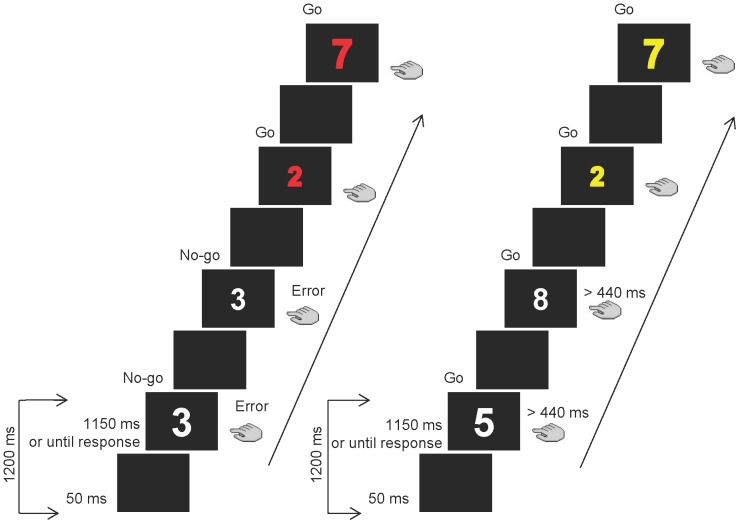
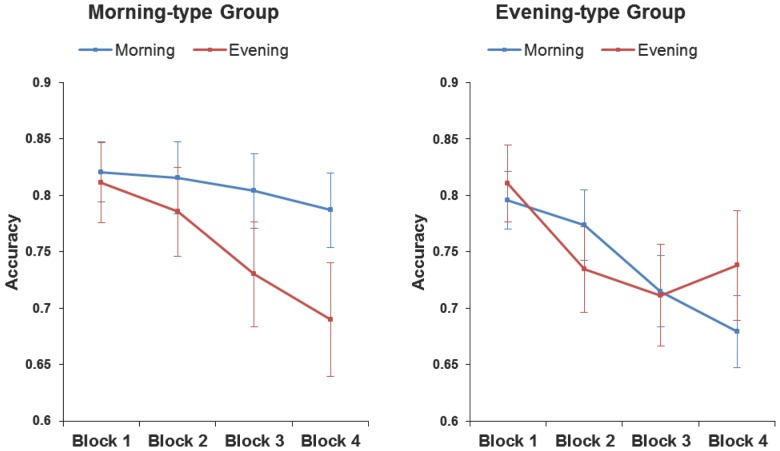
Time of day modulates our cognitive functions, especially those related to executive control, such as the ability to inhibit inappropriate responses. However, the impact of individual differences in time of day preferences (i.e. morning vs. evening chronotype) had not been considered by most studies. It was also unclear whether the vigilance decrement (impaired performance with time on task) depends on both time of day and chronotype. In this study, morning-type and evening-type participants performed a task measuring vigilance and response inhibition (the Sustained Attention to Response Task, SART) in morning and evening sessions. The results showed that the vigilance decrement in inhibitory performance was accentuated at non-optimal as compared to optimal times of day. In the morning-type group, inhibition performance decreased linearly with time on task only in the evening session, whereas in the morning session it remained more accurate and stable over time. In contrast, inhibition performance in the evening-type group showed a linear vigilance decrement in the morning session, whereas in the evening session the vigilance decrement was attenuated, following a quadratic trend. Our findings imply that the negative effects of time on task in executive control can be prevented by scheduling cognitive tasks at the optimal time of day according to specific circadian profiles of individuals. Therefore, time of day and chronotype influences should be considered in research and clinical studies as well as real-word situations demanding executive control for response inhibition.
昼夜节律调节我们的认知功能,特别是那些与执行控制相关的功能,如抑制不适当反应的能力。然而,大多数研究都没有考虑到个体昼夜节律偏好(即晨型与夜型)的差异的影响。警觉度下降(随着时间推移而表现下降)是否取决于昼夜节律和昼夜类型也不清楚。在这项研究中,晨型和夜型参与者在早晨和晚上的时段进行了一项测量警觉性和反应抑制的任务(持续注意反应任务,SART)。结果表明,与最佳时间相比,在非最佳时间,抑制性能的警觉度下降更为明显。在晨型组中,只有在晚上的时段,抑制性能才会随着时间的推移而线性下降,而在早晨的时段,它的准确性和稳定性随着时间的推移而保持不变。相比之下,夜型组的抑制性能在早晨的时段表现出线性的警觉度下降,而在晚上的时段,警觉度下降则减弱,呈二次趋势。我们的发现表明,根据个体特定的昼夜节律模式,在最佳时间安排执行控制任务,可以防止执行控制中因时间推移而产生的负面影响。因此,在研究和临床研究以及需要执行控制来抑制反应的实际情况下,应该考虑昼夜节律和昼夜类型的影响。