Werner Jan, Griebeler Eva Maria
Department of Ecology, Zoological Institute, University of Mainz, Mainz, Germany.
PLoS One. 2014 Feb 25;9(2):e88834. doi: 10.1371/journal.pone.0088834. eCollection 2014.
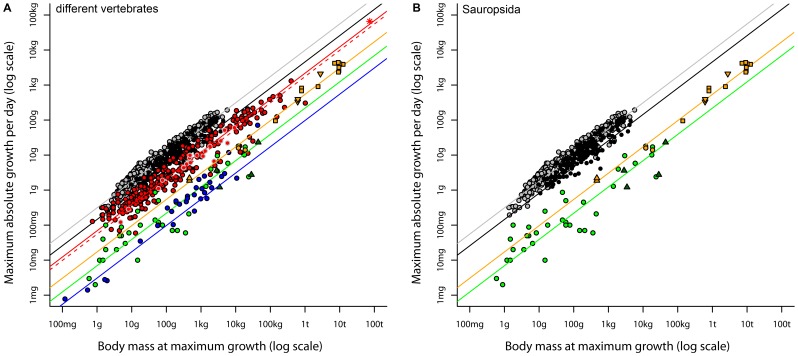
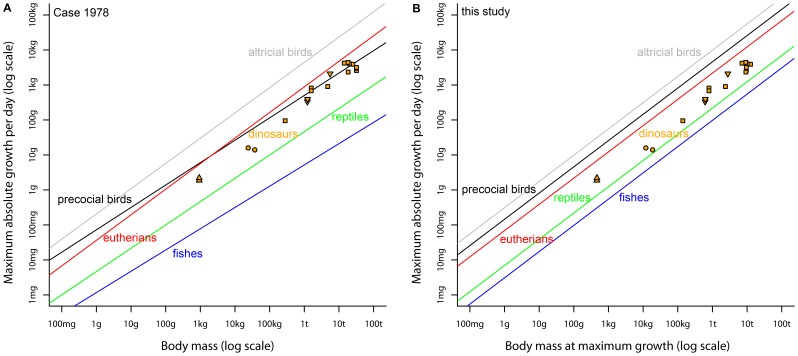
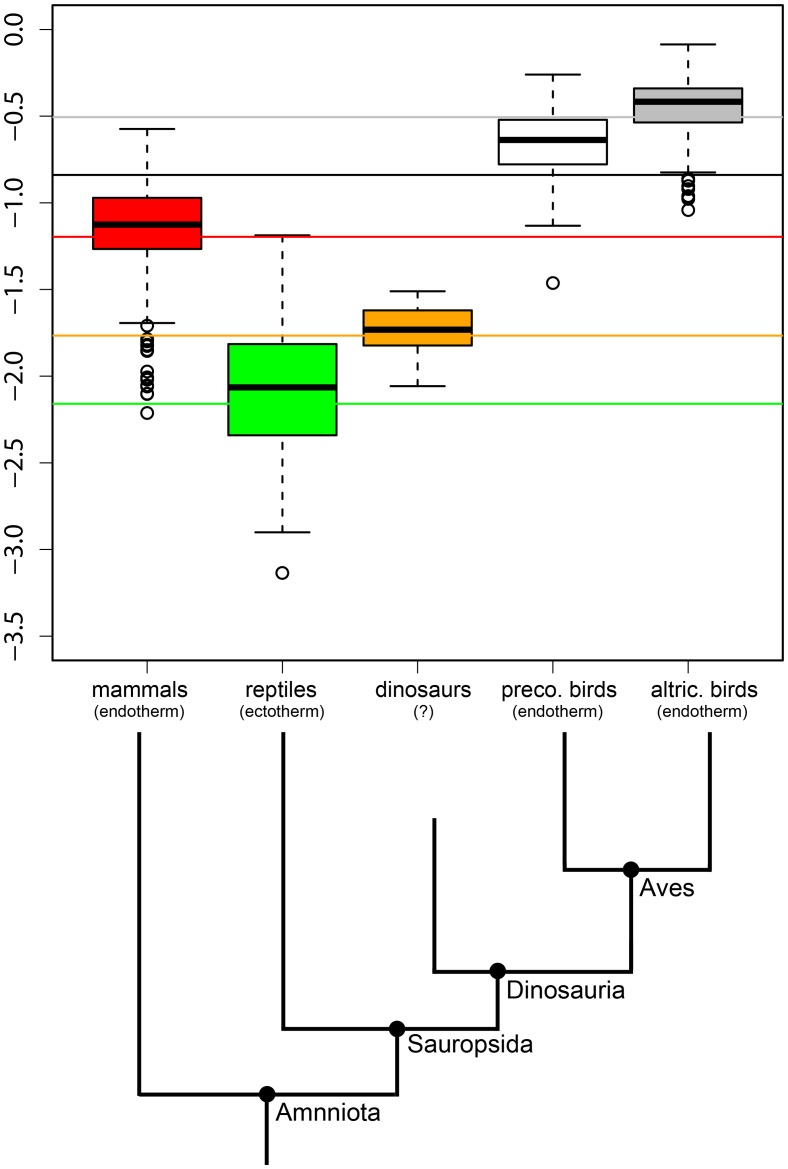
We tested if growth rates of recent taxa are unequivocally separated between endotherms and ectotherms, and compared these to dinosaurian growth rates. We therefore performed linear regression analyses on the log-transformed maximum growth rate against log-transformed body mass at maximum growth for extant altricial birds, precocial birds, eutherians, marsupials, reptiles, fishes and dinosaurs. Regression models of precocial birds (and fishes) strongly differed from Case's study (1978), which is often used to compare dinosaurian growth rates to those of extant vertebrates. For all taxonomic groups, the slope of 0.75 expected from the Metabolic Theory of Ecology was statistically supported. To compare growth rates between taxonomic groups we therefore used regressions with this fixed slope and group-specific intercepts. On average, maximum growth rates of ectotherms were about 10 (reptiles) to 20 (fishes) times (in comparison to mammals) or even 45 (reptiles) to 100 (fishes) times (in comparison to birds) lower than in endotherms. While on average all taxa were clearly separated from each other, individual growth rates overlapped between several taxa and even between endotherms and ectotherms. Dinosaurs had growth rates intermediate between similar sized/scaled-up reptiles and mammals, but a much lower rate than scaled-up birds. All dinosaurian growth rates were within the range of extant reptiles and mammals, and were lower than those of birds. Under the assumption that growth rate and metabolic rate are indeed linked, our results suggest two alternative interpretations. Compared to other sauropsids, the growth rates of studied dinosaurs clearly indicate that they had an ectothermic rather than an endothermic metabolic rate. Compared to other vertebrate growth rates, the overall high variability in growth rates of extant groups and the high overlap between individual growth rates of endothermic and ectothermic extant species make it impossible to rule out either of the two thermoregulation strategies for studied dinosaurs.
我们测试了近期类群的生长速率在恒温动物和变温动物之间是否存在明确的差异,并将这些与恐龙的生长速率进行了比较。因此,我们对现存的晚成鸟、早成鸟、真兽类、有袋类、爬行动物、鱼类和恐龙在最大生长时的对数转换后的最大生长速率与对数转换后的体重进行了线性回归分析。早成鸟(和鱼类)的回归模型与常被用于将恐龙生长速率与现存脊椎动物生长速率进行比较的凯斯(1978年)的研究有很大不同。对于所有分类群,生态代谢理论预期的0.75斜率得到了统计学支持。因此,为了比较不同分类群之间的生长速率,我们使用了具有该固定斜率和特定类群截距的回归分析。平均而言,变温动物的最大生长速率比恒温动物低约10倍(爬行动物)至20倍(鱼类)(与哺乳动物相比),甚至低45倍(爬行动物)至100倍(鱼类)(与鸟类相比)。虽然平均而言所有分类群都明显相互分离,但几个分类群之间甚至恒温动物和变温动物之间的个体生长速率存在重叠。恐龙的生长速率介于体型相似/按比例放大的爬行动物和哺乳动物之间,但比按比例放大的鸟类低得多。所有恐龙的生长速率都在现存爬行动物和哺乳动物的范围内,且低于鸟类。假设生长速率和代谢速率确实相关,我们的结果提出了两种不同的解释。与其他蜥形纲动物相比,所研究恐龙的生长速率清楚地表明它们具有变温而非恒温的代谢速率。与其他脊椎动物的生长速率相比,现存类群生长速率的总体高度变异性以及恒温动物和变温动物现存物种个体生长速率之间的高度重叠使得无法排除所研究恐龙的两种体温调节策略中的任何一种。