Li Wei, Tang Xiaoqian, Xing Jing, Sheng Xiuzhen, Zhan Wenbin
Laboratory of Pathology and Immunology of Aquatic Animals, Ocean University of China, Qingdao, Shandong, China.
PLoS One. 2014 Feb 27;9(2):e89962. doi: 10.1371/journal.pone.0089962. eCollection 2014.
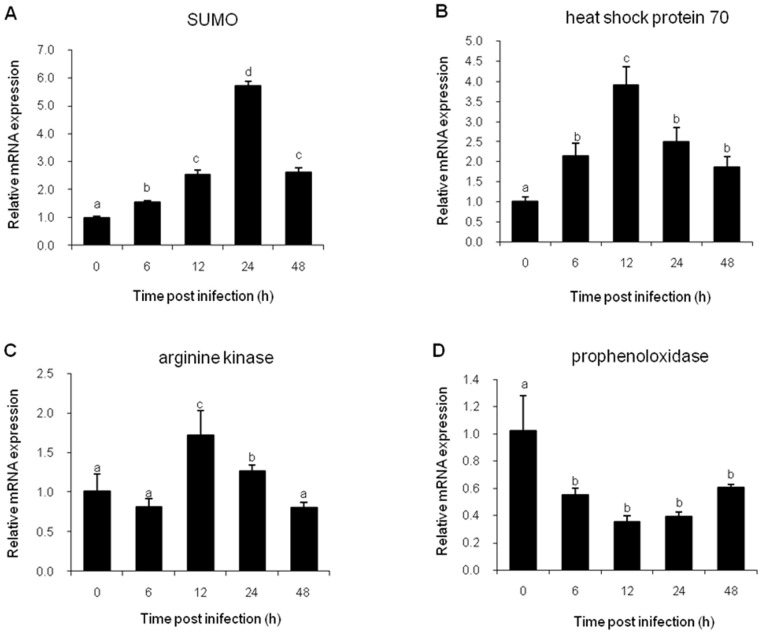
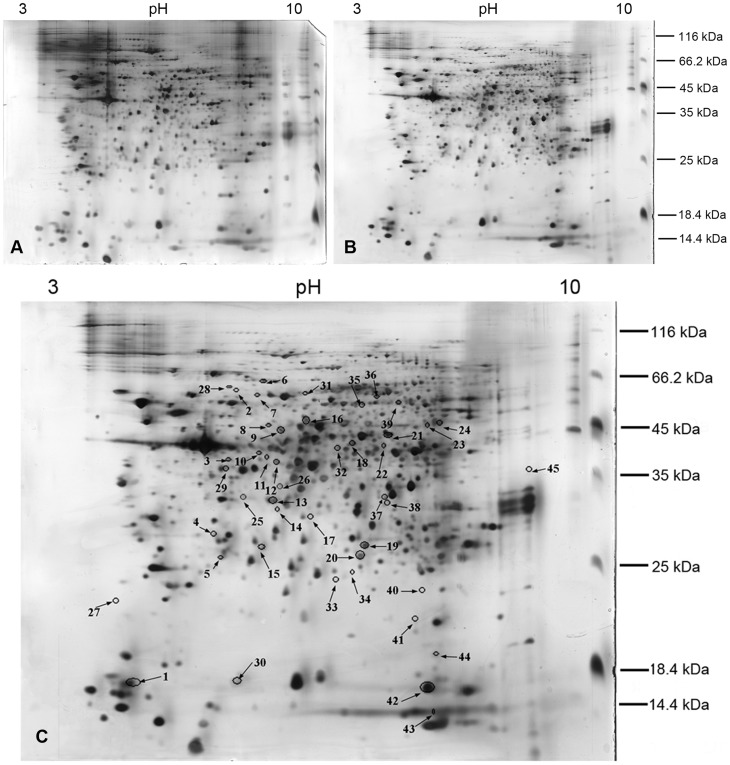
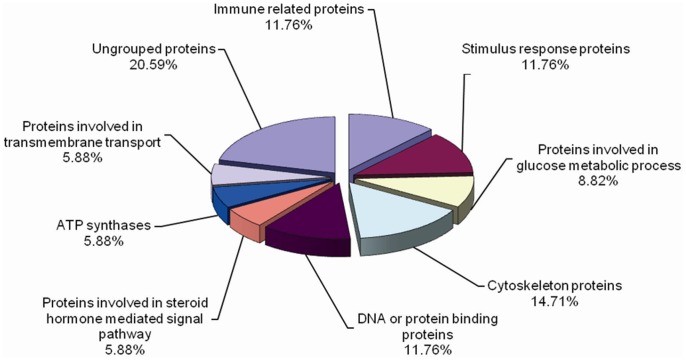
To elucidate molecular responses of shrimp hemocytes to white spot syndrome virus (WSSV) infection, two-dimensional gel electrophoresis was applied to investigate differentially expressed proteins in hemocytes of Chinese shrimp (Fenneropenaeus chinensis) at 24 h post infection (hpi). Approximately 580 protein spots were detected in hemocytes of healthy and WSSV-infected shrimps. Quantitative intensity analysis revealed 26 protein spots were significantly up-regulated, and 19 spots were significantly down-regulated. By mass spectrometry, small ubiquitin-like modifier (SUMO) 1, cytosolic MnSOD, triosephosphate isomerase, tubulin alpha-1 chain, microtubule-actin cross-linking factor 1, nuclear receptor E75 protein, vacuolar ATP synthase subunit B L form, inositol 1,4,5-trisphosphate receptor, arginine kinase, etc., amounting to 33 differentially modulated proteins were identified successfully. According to Gene Ontology annotation, the identified proteins were classified into nine categories, consisting of immune related proteins, stimulus response proteins, proteins involved in glucose metabolic process, cytoskeleton proteins, DNA or protein binding proteins, proteins involved in steroid hormone mediated signal pathway, ATP synthases, proteins involved in transmembrane transport and ungrouped proteins. Meanwhile, the expression profiles of three up-regulated proteins (SUMO, heat shock protein 70, and arginine kinase) and one down-regulated protein (prophenoloxidase) were further analyzed by real-time RT-PCR at the transcription level after WSSV infection. The results showed that SUMO and heat shock protein 70 were significantly up-regulated at each sampling time point, while arginine kinase was significantly up-regulated at 12 and 24 hpi. In contrast, prophenoloxidase was significantly down-regulated at each sampling time point. The results of this work provided preliminary data on proteins in shrimp hemocytes involved in WSSV infection.
为阐明对虾血细胞对白斑综合征病毒(WSSV)感染的分子反应,采用二维凝胶电泳技术研究了感染后24小时(hpi)中国对虾(凡纳滨对虾)血细胞中差异表达的蛋白质。在健康和WSSV感染对虾的血细胞中检测到约580个蛋白点。定量强度分析显示,26个蛋白点显著上调,19个蛋白点显著下调。通过质谱分析,成功鉴定出小泛素样修饰物(SUMO)1、胞质锰超氧化物歧化酶、磷酸丙糖异构酶、微管蛋白α-1链、微管-肌动蛋白交联因子1、核受体E75蛋白、液泡ATP合酶亚基B L型、肌醇1,4,5-三磷酸受体、精氨酸激酶等33种差异调节蛋白。根据基因本体注释,鉴定出的蛋白质分为九类,包括免疫相关蛋白、刺激反应蛋白、参与葡萄糖代谢过程的蛋白、细胞骨架蛋白、DNA或蛋白结合蛋白、参与类固醇激素介导信号通路的蛋白、ATP合酶、参与跨膜运输的蛋白和未分类蛋白。同时,在WSSV感染后,通过实时RT-PCR在转录水平进一步分析了三种上调蛋白(SUMO、热休克蛋白70和精氨酸激酶)和一种下调蛋白(前酚氧化酶)的表达谱。结果表明,SUMO和热休克蛋白70在每个采样时间点均显著上调,而精氨酸激酶在12和24 hpi时显著上调。相比之下,前酚氧化酶在每个采样时间点均显著下调。本研究结果为对虾血细胞中参与WSSV感染的蛋白质提供了初步数据。