Key Laboratory for Zoonosis Research, Ministry of Education, Institute of Zoonosis, Jilin University, Changchun, China.
Mucosal Immunology Laboratory, Pediatric Gastroenterology Unit, Massachusetts General Hospital East, Charlestown, Massachusetts, United States of America.
PLoS One. 2014 Feb 25;9(2):e90042. doi: 10.1371/journal.pone.0090042. eCollection 2014.
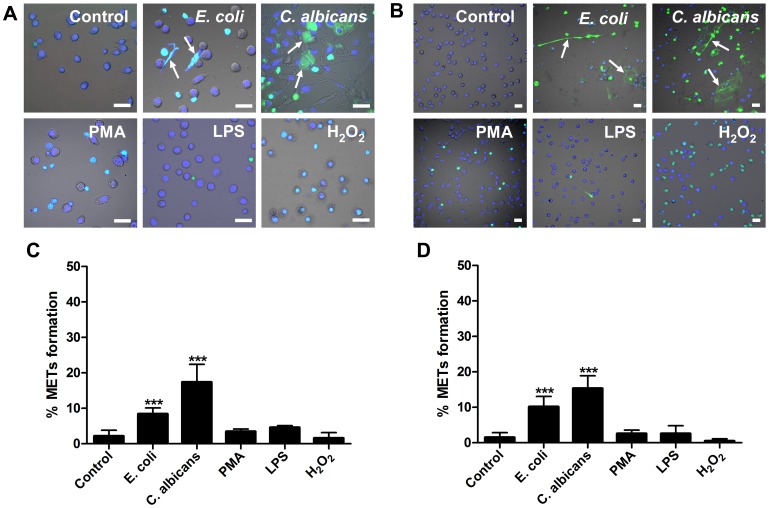
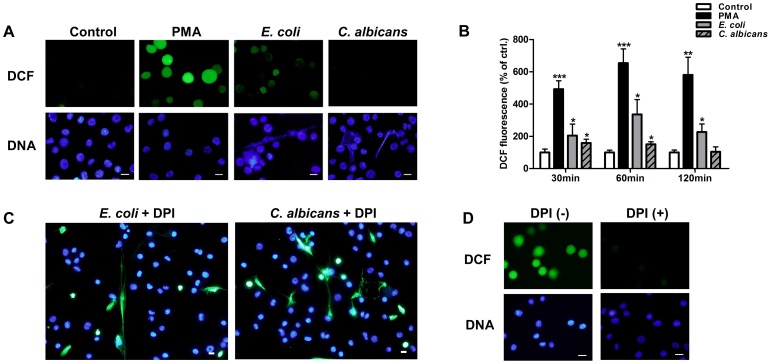
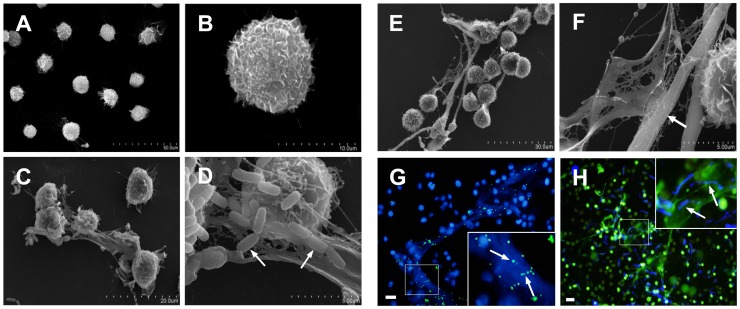
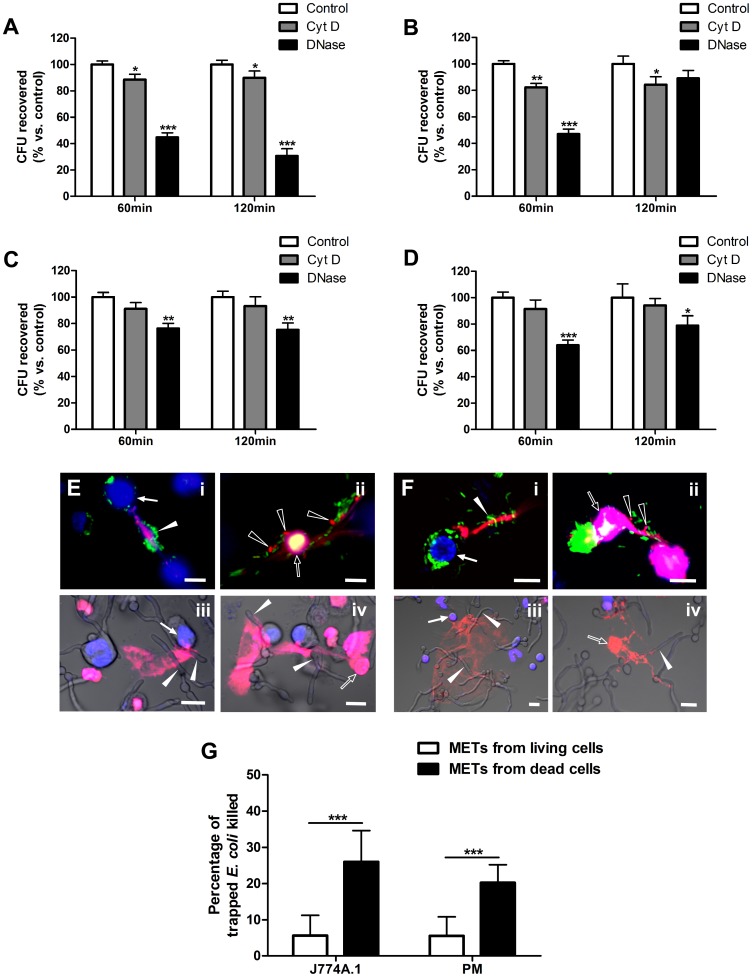
The formation of extracellular traps (ETs) has recently been recognized as a novel defense mechanism in several types of innate immune cells. It has been suggested that these structures are toxic to microbes and contribute significantly to killing several pathogens. However, the role of ETs formed by macrophages (METs) in defense against microbes remains little known. In this study, we demonstrated that a subset of murine J774A.1 macrophage cell line (8% to 17%) and peritoneal macrophages (8.5% to 15%) form METs-like structures (METs-LS) in response to Escherichia coli and Candida albicans challenge. We found only a portion of murine METs-LS, which are released by dying macrophages, showed detectable killing effects on trapped E. coli but not C. albicans. Fluorescence and scanning electron microscopy analyses revealed that, in vitro, both microorganisms were entrapped in J774A.1 METs-LS composed of DNA and microbicidal proteins such as histone, myeloperoxidase and lysozyme. DNA components of both nucleus and mitochondrion origins were detectable in these structures. Additionally, METs-LS formation occurred independently of ROS produced by NADPH oxidase, and this process did not result in cell lysis. In summary, our results emphasized that microbes induced METs-LS in murine macrophage cells and that the microbicidal activity of these METs-LS differs greatly. We propose the function of METs-LS is to contain invading microbes at the infection site, thereby preventing the systemic diffusion of them, rather than significantly killing them.
细胞外陷阱(ETs)的形成最近被认为是几种天然免疫细胞的一种新型防御机制。有人提出,这些结构对微生物有毒,并对杀死几种病原体有重要贡献。然而,巨噬细胞(METs)形成的 ETs 在抵御微生物方面的作用仍知之甚少。在这项研究中,我们证明了一小部分鼠源 J774A.1 巨噬细胞系(8%-17%)和腹腔巨噬细胞(8.5%-15%)在受到大肠杆菌和白色念珠菌的刺激时会形成 METs 样结构(METs-LS)。我们发现只有一部分鼠源 METs-LS 是由死亡的巨噬细胞释放的,对捕获的大肠杆菌具有可检测的杀伤作用,但对白色念珠菌没有。荧光和扫描电子显微镜分析表明,在体外,这两种微生物都被 J774A.1 METs-LS 捕获,这些结构由 DNA 和杀菌蛋白(如组蛋白、髓过氧化物酶和溶菌酶)组成。在这些结构中可以检测到来自细胞核和线粒体的 DNA 成分。此外,METs-LS 的形成独立于 NADPH 氧化酶产生的 ROS,并且这个过程不会导致细胞裂解。总之,我们的结果强调了微生物诱导鼠源巨噬细胞形成 METs-LS,并且这些 METs-LS 的杀菌活性有很大的差异。我们提出,METs-LS 的功能是将入侵的微生物困在感染部位,从而防止它们在体内扩散,而不是显著杀死它们。