Marine Estuarine Environmental Sciences Program, University of Maryland, Baltimore, Maryland, United States of America.
Department of Geography and Environmental Systems, University of Maryland, Baltimore, Maryland, United States of America.
PLoS One. 2014 Feb 26;9(2):e90168. doi: 10.1371/journal.pone.0090168. eCollection 2014.
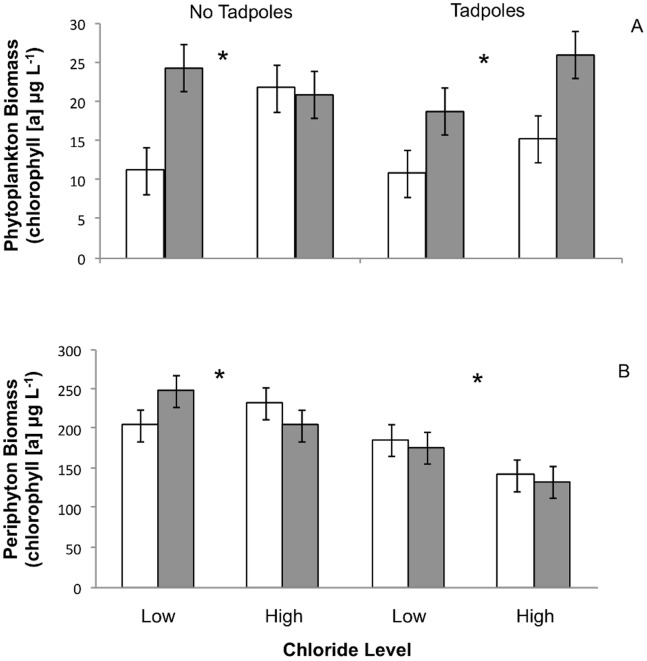
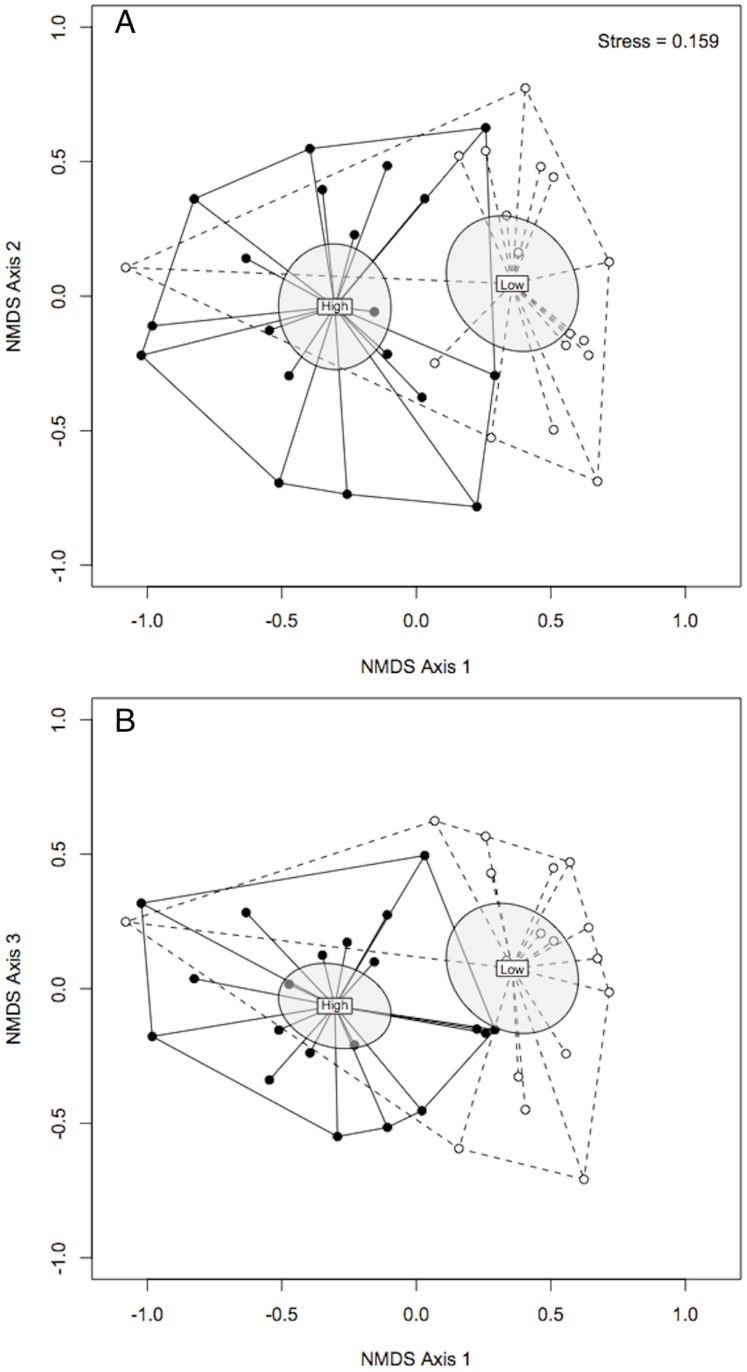
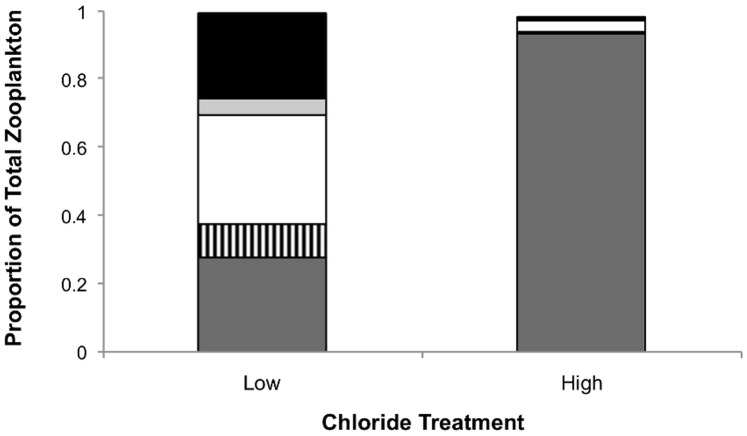
Freshwater salinization is an emerging environmental filter in urban aquatic ecosystems that receive chloride road salt runoff from vast expanses of impervious surface cover. Our study was designed to evaluate the effects of chloride contamination on urban stormwater pond food webs through changes in zooplankton community composition as well as density and biomass of primary producers and consumers. From May - July 2009, we employed a 2×2×2 full-factorial design to manipulate chloride concentration (low = 177 mg L(-1) Cl(-/)high = 1067 mg L(-1) Cl(-)), gray treefrog (Hyla versicolor) tadpoles (presence/absence) and source of stormwater pond algae and zooplankton inoculum (low conductance/high conductance urban ponds) in 40, 600-L mesocosms. Road salt did serve as a constraint on zooplankton community structure, driving community divergence between the low and high chloride treatments. Phytoplankton biomass (chlorophyll [a] µg L(-1)) in the mesocosms was significantly greater for the high conductance inoculum (P<0.001) and in the high chloride treatment (P = 0.046), whereas periphyton biomass was significantly lower in the high chloride treatment (P = 0.049). Gray treefrog tadpole time to metamorphosis did not vary significantly between treatments. However, mass at metamorphosis was greater among tadpoles that experienced a faster than average time to metamorphosis and exposure to high chloride concentrations (P = 0.039). Our results indicate differential susceptibility to chloride salts among algal resources and zooplankton taxa, and further suggest that road salts can act as a significant environmental constraint on urban stormwater pond communities.
淡水盐化是城市水生生态系统中一个新兴的环境过滤器,它接收来自大面积不透水表面覆盖物的氯化物道路盐径流。我们的研究旨在通过浮游动物群落组成以及初级生产者和消费者的密度和生物量的变化来评估氯化物污染对城市雨水池塘食物网的影响。2009 年 5 月至 7 月,我们采用 2×2×2 完全因子设计来操纵氯浓度(低 = 177mg L(-1) Cl(-/)高 = 1067mg L(-1) Cl(-))、灰色树蛙(Hyla versicolor)蝌蚪(存在/不存在)和雨水池塘藻类和浮游动物接种物的来源(低电导/高电导城市池塘)在 40 个、600-L 中体中。道路盐确实限制了浮游动物群落结构,导致低氯和高氯处理之间的群落差异。中体中的浮游植物生物量(叶绿素[a]µg L(-1))在高电导接种物(P<0.001)和高氯处理(P=0.046)中显著更高,而高氯处理中的附生生物量显著更低(P=0.049)。灰色树蛙蝌蚪变态时间在处理之间没有显著差异。然而,经历平均变态时间更快和暴露于高氯浓度的蝌蚪的变态质量更大(P=0.039)。我们的结果表明,藻类资源和浮游动物类群对氯化物盐的敏感性不同,进一步表明道路盐可以成为城市雨水池塘群落的重要环境限制因素。