Pettee Krista M, Dvorak Kaitlyn M, Nestor-Kalinoski Andrea L, Eisenmann Kathryn M
Department of Biochemistry and Cancer Biology, University of Toledo Health Science Campus, Toledo, Ohio, United States of America.
Department of Surgery, University of Toledo Health Science Campus, Toledo, Ohio, United States of America.
PLoS One. 2014 Feb 28;9(2):e90371. doi: 10.1371/journal.pone.0090371. eCollection 2014.
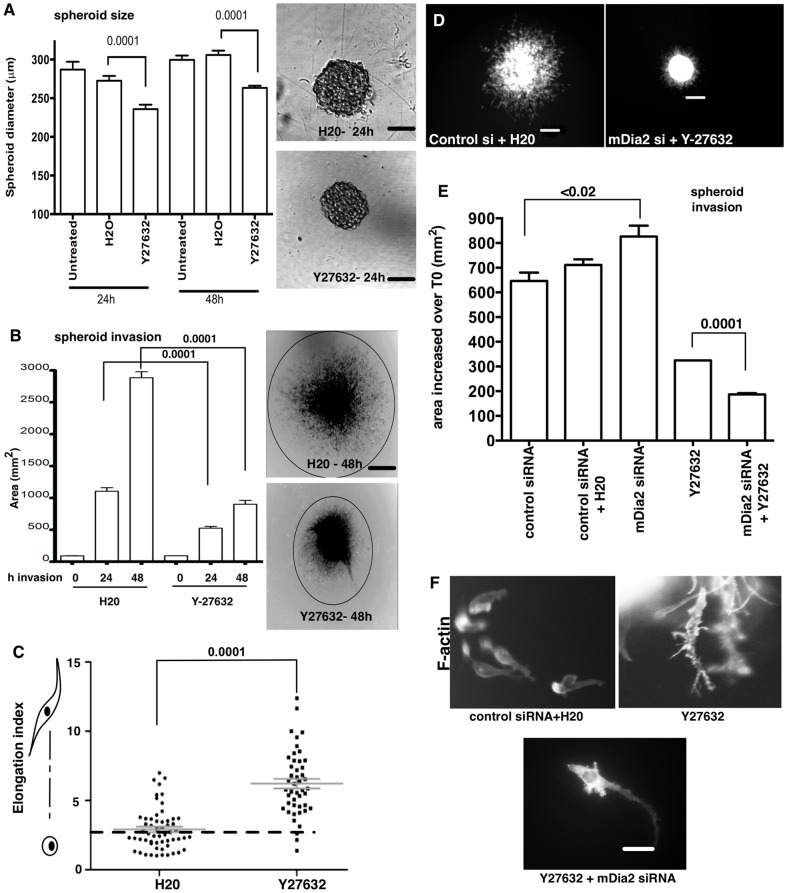
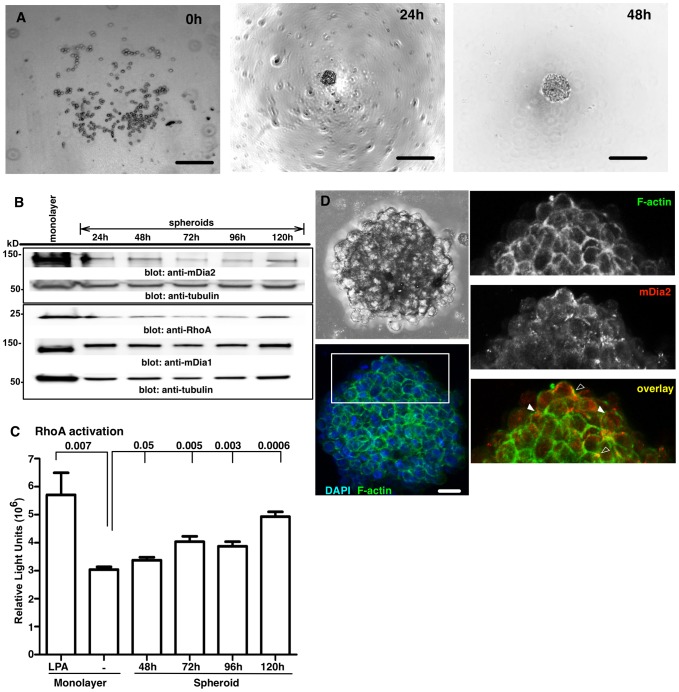
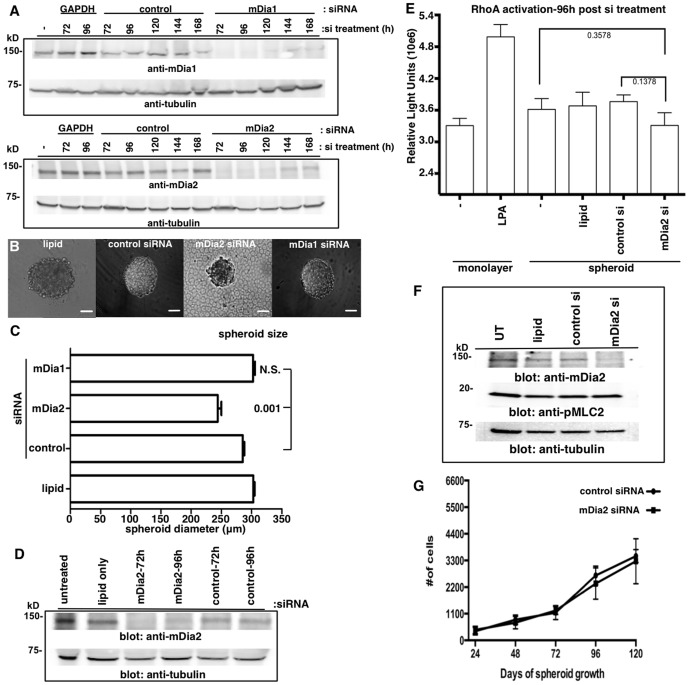
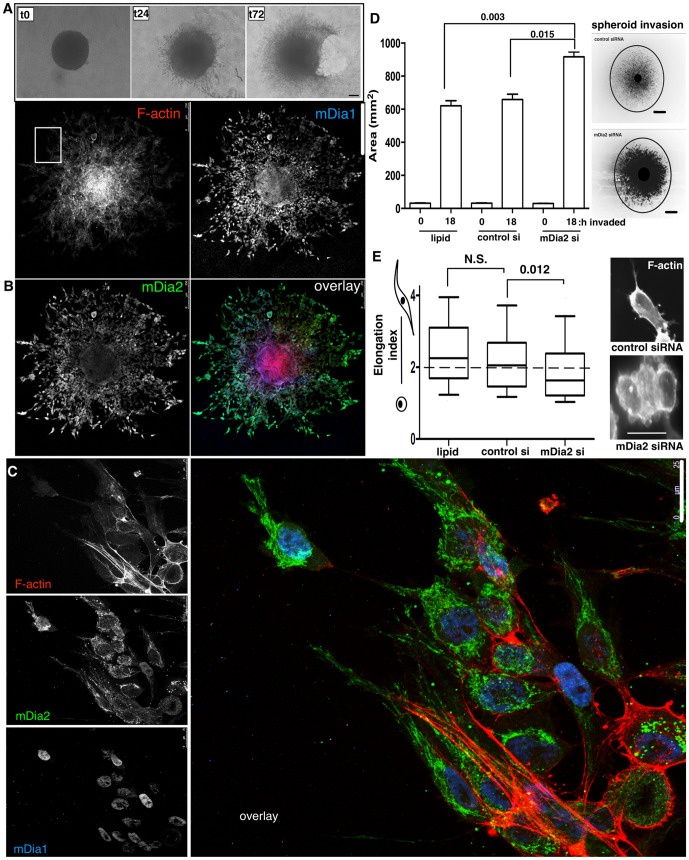
Multi-cellular spheroids are enriched in ascites of epithelial ovarian cancer (OvCa) patients. They represent an invasive and chemoresistant cellular population fundamental to metastatic dissemination. The molecular mechanisms triggering single cell invasive egress from spheroids remain enigmatic. mDia formins are Rho GTPase effectors that are key regulators of F-actin cytoskeletal dynamics. We hypothesized that mDia2-driven F-actin dynamics promote single cell invasive transitions in clinically relevant three-dimensional (3D) OvCa spheroids. The current study is a dissection of the contribution of the F-actin assembly factor mDia2 formin in invasive transitions and using a clinically relevant ovarian cancer spheroid model. We show that RhoA-directed mDia2 activity is required for tight spheroid organization, and enrichment of mDia2 in the invasive cellular protrusions of collagen-embedded OVCA429 spheroids. Depleting mDia2 in ES-2 spheroids enhanced invasive dissemination of single amoeboid-shaped cells. This contrasts with spheroids treated with control siRNA, where a mesenchymal invasion program predominated. Inhibition of another RhoA effector, ROCK, had no impact on ES-2 spheroid formation but dramatically inhibited spheroid invasion through induction of a highly elongated morphology. Concurrent inhibition of ROCK and mDia2 blocked single cell invasion from ES-2 spheroids more effectively than inhibition of either protein alone, indicating that invasive egress of amoeboid cells from mDia2-depleted spheroids is ROCK-dependent. Our findings indicate that multiple GTPase effectors must be suppressed in order to fully block invasive egress from ovarian cancer spheroids. Furthermore, tightly regulated interplay between ROCK and mDia2 signaling pathways dictates the invasive capacities and the type of invasion program utilized by motile spheroid-derived ovarian cancer cells. As loss of the gene encoding mDia2, DRF3, has been linked to cancer progression and metastasis, our results set the stage for understanding molecular mechanisms involved in mDia2-dependent egress of invasive cells from primary epithelial tumors.
多细胞球体在上皮性卵巢癌(OvCa)患者的腹水中富集。它们代表了转移扩散所必需的侵袭性和化疗耐药性细胞群体。触发球体单细胞侵袭性逸出的分子机制仍然不明。mDia formin是Rho GTPase效应器,是F-肌动蛋白细胞骨架动力学的关键调节因子。我们假设mDia2驱动的F-肌动蛋白动力学促进了临床相关的三维(3D)OvCa球体中的单细胞侵袭转变。当前的研究剖析了F-肌动蛋白组装因子mDia2 formin在侵袭转变中的作用,并使用了临床相关的卵巢癌球体模型。我们表明,RhoA导向的mDia2活性是紧密球体组织所必需的,并且mDia2在胶原包埋的OVCA429球体的侵袭性细胞突起中富集。在ES-2球体中耗尽mDia2增强了单个阿米巴样细胞的侵袭性扩散。这与用对照siRNA处理的球体形成对比,在对照siRNA处理的球体中,间充质侵袭程序占主导。另一种RhoA效应器ROCK的抑制对ES-2球体形成没有影响,但通过诱导高度伸长的形态显著抑制了球体侵袭。同时抑制ROCK和mDia2比单独抑制任何一种蛋白质更有效地阻断了ES-2球体的单细胞侵袭,表明来自mDia2耗尽球体的阿米巴样细胞的侵袭性逸出是ROCK依赖性的。我们的研究结果表明,必须抑制多种GTPase效应器才能完全阻断卵巢癌球体的侵袭性逸出。此外,ROCK和mDia2信号通路之间严格调控的相互作用决定了运动性球体来源的卵巢癌细胞的侵袭能力和所采用的侵袭程序类型。由于编码mDia2的基因DRF3的缺失与癌症进展和转移有关,我们的结果为理解原发性上皮肿瘤中mDia2依赖性侵袭细胞逸出所涉及的分子机制奠定了基础。