Department of Earth Sciences, Palaeobiology, Uppsala University, Villavägen 16, 75236 Uppsala, Sweden.
Front Zool. 2014 Mar 5;11(1):22. doi: 10.1186/1742-9994-11-22.
Onychophora is a relatively small phylum within Ecdysozoa, and is considered to be the sister group to Arthropoda. Compared to the arthropods, that have radiated into countless divergent forms, the onychophoran body plan is overall comparably simple and does not display much in-phylum variation. An important component of arthropod morphological diversity consists of variation of tagmosis, i.e. the grouping of segments into functional units (tagmata), and this in turn is correlated with differences in expression patterns of the Hox genes. How these genes are expressed in the simpler onychophorans, the subject of this paper, would therefore be of interest in understanding their subsequent evolution in the arthropods, especially if an argument can be made for the onychophoran system broadly reflecting the ancestral state in the arthropods.
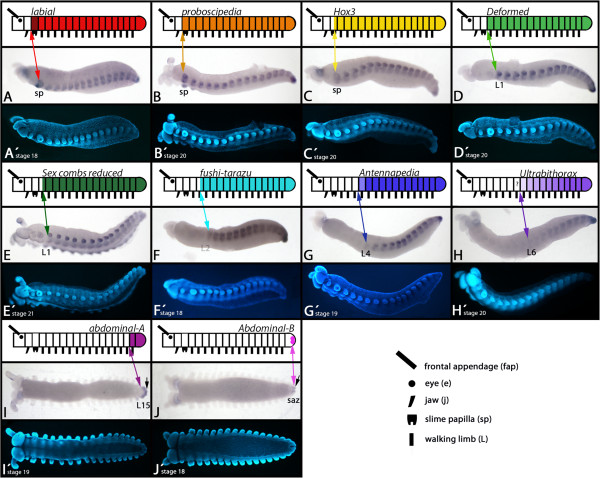
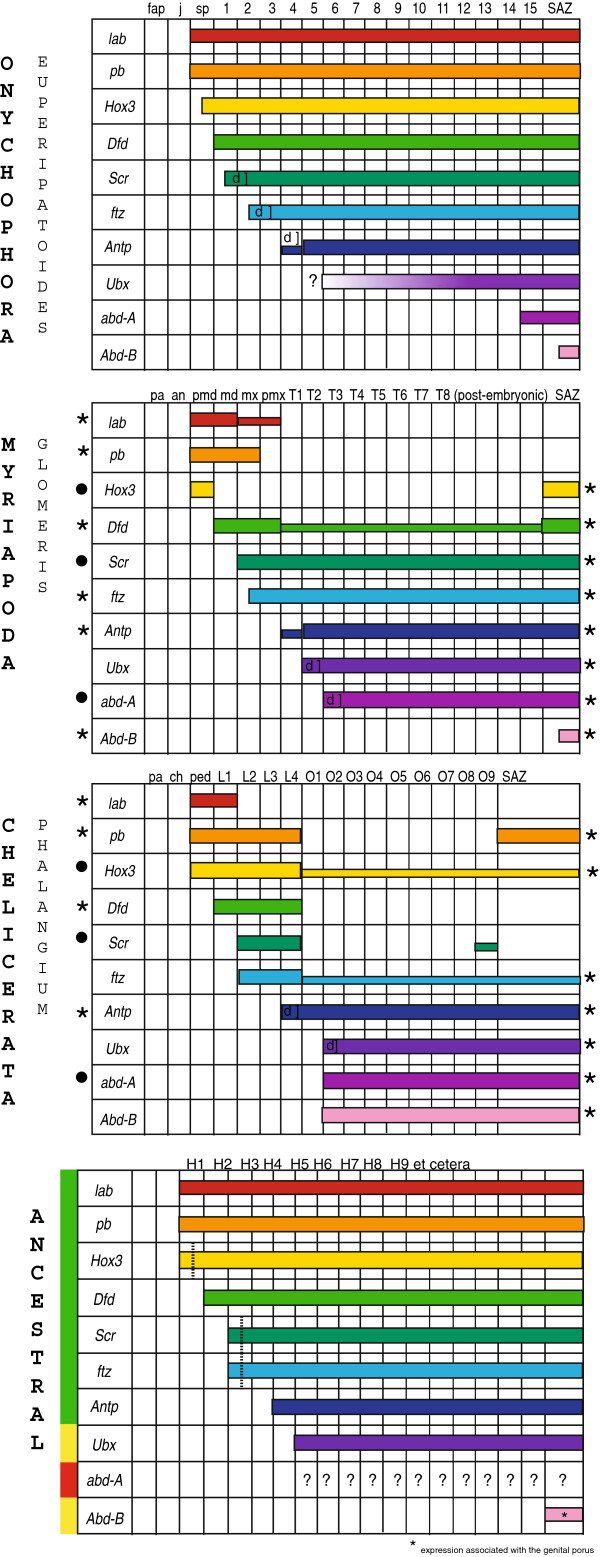
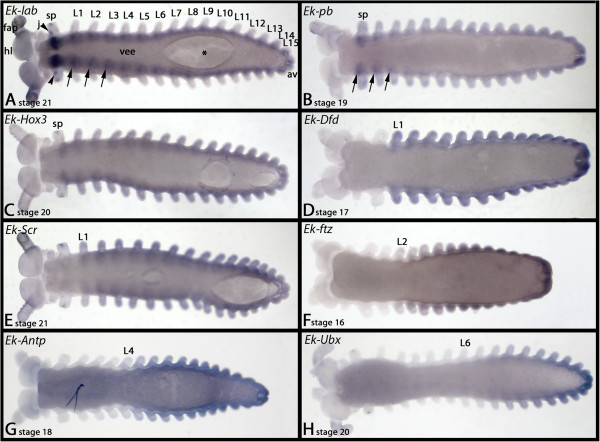
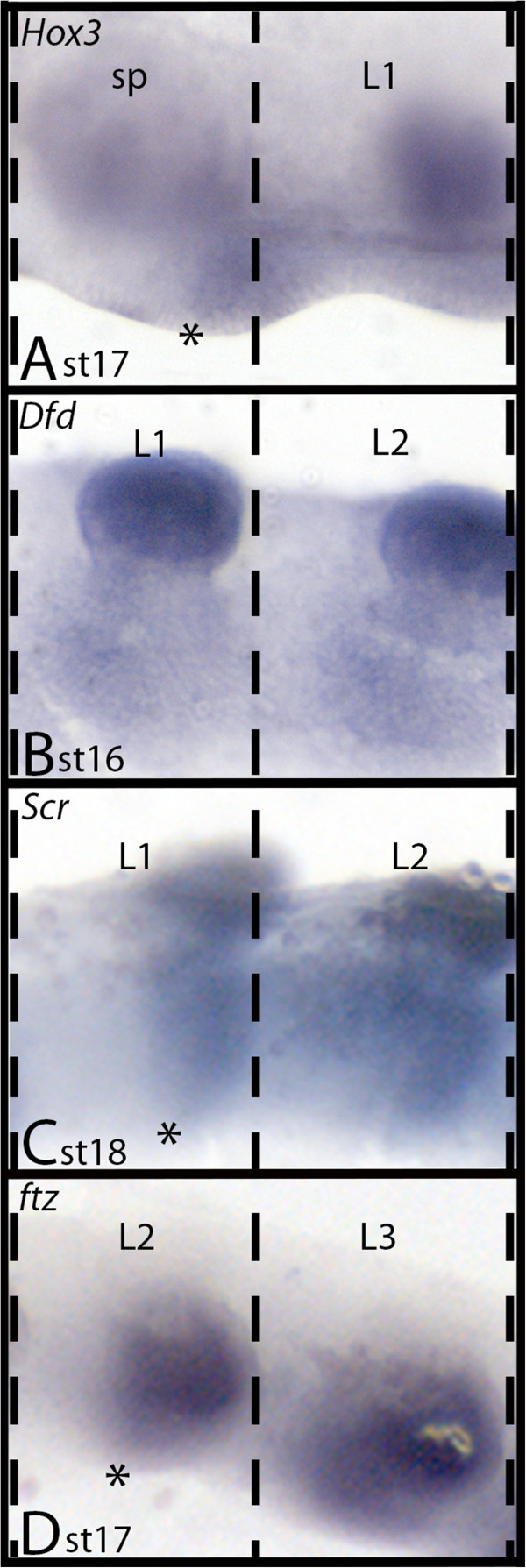
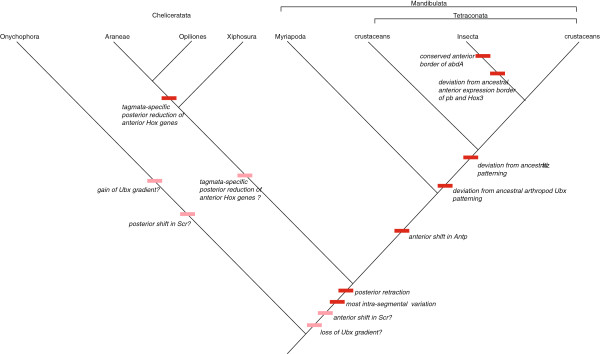
The sequences and embryonic expression patterns of the complete set of ten Hox genes of an onychophoran (Euperipatoides kanangrensis) are described for the first time. We find that they are all expressed in characteristic patterns that suggest a function as classical Hox genes. The onychophoran Hox genes obey spatial colinearity, and with the exception of Ultrabithorax (Ubx), they all have different and distinct anterior expression borders. Notably, Ubx transcripts form a posterior to anterior gradient in the onychophoran trunk. Expression of all onychophoran Hox genes extends continuously from their anterior border to the rear end of the embryo.
The spatial expression pattern of the onychophoran Hox genes may contribute to a combinatorial Hox code that is involved in giving each segment its identity. This patterning of segments in the uniform trunk, however, apparently predates the evolution of distinct segmental differences in external morphology seen in arthropods. The gradient-like expression of Ubx may give posterior segments their specific identity, even though they otherwise express the same set of Hox genes. We suggest that the confined domains of Hox gene expression seen in arthropods evolved from an ancestral onychophoran-like Hox gene pattern. Reconstruction of the ancestral arthropod Hox pattern and comparison with the patterns in the different arthropod classes reveals phylogenetic support for Mandibulata and Tetraconata, but not Myriochelata and Atelocerata.
环节动物是节肢动物门中的一个相对较小的门,被认为是节肢动物的姊妹群。与辐射出无数不同形式的节肢动物相比,环节动物的身体结构总体上相对简单,门内变异不大。节肢动物形态多样性的一个重要组成部分是体节分节的变化,即体节被分组为功能单元(体节),这反过来又与 Hox 基因的表达模式差异相关。因此,本文研究了这些基因在更简单的环节动物中的表达情况,这对于理解它们在节肢动物中的后续进化将很有意义,特别是如果可以认为环节动物系统广泛反映了节肢动物的祖先状态。
首次描述了一种环节动物(Euperipatoides kanangrensis)的整套 10 个 Hox 基因的序列和胚胎表达模式。我们发现它们都以特征模式表达,表明它们具有经典 Hox 基因的功能。环节动物的 Hox 基因遵循空间共线性,除了 Ultrabithorax(Ubx)外,它们都有不同且独特的前表达边界。值得注意的是,Ubx 转录本在环节动物的躯干中从前到后形成一个梯度。所有环节动物 Hox 基因的表达从前边界连续延伸到胚胎后端。
环节动物 Hox 基因的空间表达模式可能有助于形成参与赋予每个体节身份的组合 Hox 密码。然而,这种在统一躯干中分段的模式显然先于节肢动物外部形态中明显的分段差异的进化。Ubx 的梯度样表达可能赋予后部体节特定的身份,即使它们表达的是相同的 Hox 基因集。我们认为,节肢动物中看到的 Hox 基因表达受限域是从祖先环节动物样 Hox 基因模式进化而来的。对祖先节肢动物 Hox 模式的重建以及与不同节肢动物类群的模式进行比较,为 Mandibulata 和 Tetraconata 提供了系统发育支持,但不能为 Myriochelata 和 Atelocerata 提供支持。