Aneskievich B J, Taichman L B
Department of Oral Biology and Pathology, School of Dental Medicine, State University of New York, Stony Brook 11794-8702.
J Virol. 1988 Nov;62(11):4365-8. doi: 10.1128/JVI.62.11.4365-4368.1988.
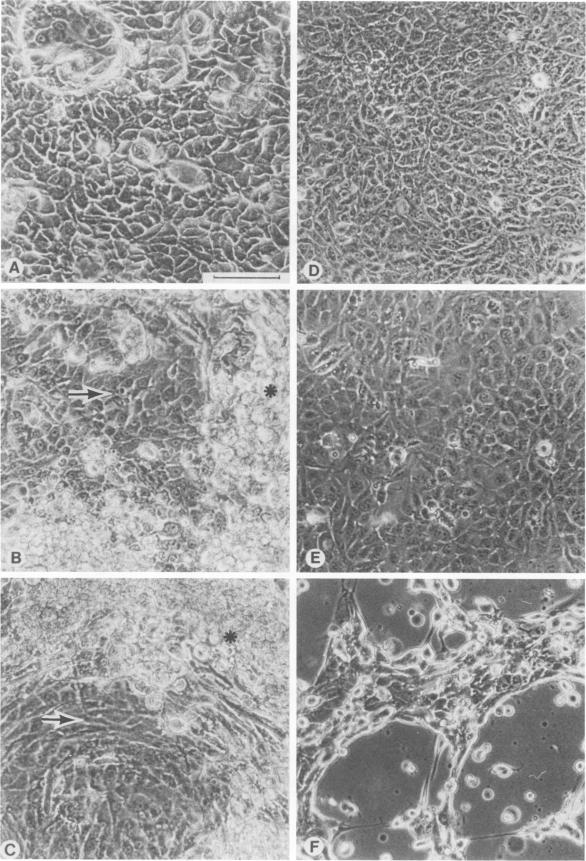
Cultures of epidermal keratinocytes contain two populations of cells, a basal undifferentiated population and a suprabasal terminally differentiated population. When exposed to wild-type adenovirus type 2 (wtAd2), the suprabasal cells are positive by immunofluorescence for capsid antigen and exhibit cytopathic effects (CPE) (R.F. LaPorta, and L.B. Taichman, Virology 110:137-146, 1981). The basal cells, although infected, are not positive for capsid antigen and do not display CPE. Despite CPE and capsid antigens in suprabasal cells, yields of virus from the entire culture are very low (10 PFU per cell). These observations suggest that Ad2 expression is restricted at different times in the viral life cycle in basal and suprabasal cells. To test this hypothesis, we isolated host range (hr) mutants of Ad2 on two lines of squamous cell carcinoma (SCC) keratinocytes which were shown to be restrictive for wtAd2 replication. The hrAd2 mutants produced high yields of progeny virus in epidermal cell cultures (500 to 600 PFU per cell). However, the pattern of CPE induction in these cultures was like that produced by wtAd2, i.e., basal cells were CPE negative and suprabasal cells were CPE positive. The high yield of hrAd2 progeny indicated that the restriction present in suprabasal cells was overcome. However, the failure of hrAd2 mutants to induce CPE in basal cells indicated that the hrAd2 mutants remain restricted in the basal population and supported our hypothesis that a second and distinct restriction exists in basal keratinocytes.
表皮角质形成细胞培养物包含两种细胞群体,一种是基底未分化细胞群体,另一种是基底上层终末分化细胞群体。当暴露于野生型2型腺病毒(wtAd2)时,基底上层细胞通过免疫荧光检测衣壳抗原呈阳性,并表现出细胞病变效应(CPE)(R.F.拉波塔和L.B.泰奇曼,《病毒学》110:137 - 146,1981)。基底细胞虽然被感染,但衣壳抗原检测为阴性,且不表现出CPE。尽管基底上层细胞出现了CPE和衣壳抗原,但整个培养物中的病毒产量非常低(每细胞10个空斑形成单位)。这些观察结果表明,Ad2在基底细胞和基底上层细胞的病毒生命周期不同时间表达受到限制。为了验证这一假设,我们在两株对wtAd2复制具有限制性的鳞状细胞癌(SCC)角质形成细胞系上分离出了Ad2的宿主范围(hr)突变体。hrAd2突变体在表皮细胞培养物中产生了高产量的子代病毒(每细胞500至600个空斑形成单位)。然而,这些培养物中CPE诱导模式与wtAd2产生的模式相似,即基底细胞CPE阴性,基底上层细胞CPE阳性。hrAd2子代病毒的高产量表明基底上层细胞中存在的限制被克服了。然而,hrAd2突变体未能在基底细胞中诱导CPE,这表明hrAd2突变体在基底细胞群体中仍然受到限制,支持了我们的假设,即基底角质形成细胞中存在第二种且不同的限制。