First Department of Pediatrics, Semmelweis University, Budapest, Bókay u, 53-54 H-1083, Hungary.
BMC Neurol. 2014 Mar 6;14:41. doi: 10.1186/1471-2377-14-41.
Acute ischemic stroke (AIS) has a biphasic effect on the peripheral immune system. The initial inflammatory response is followed by systemic immunosuppression, referred to as stroke-induced immunosuppression (SIIS), leading to severe complications in stroke patients. We aimed to identify an inflammatory marker that best represents this biphasic immunological response after AIS.
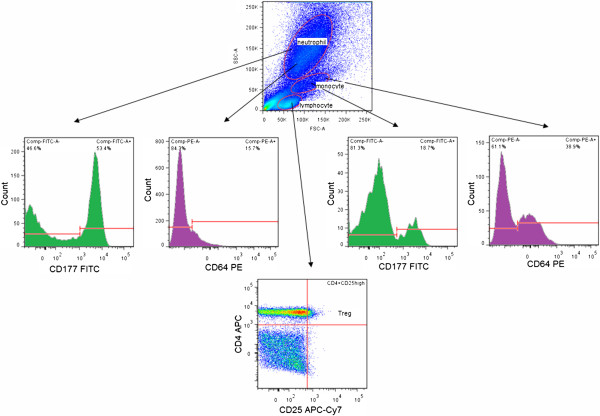
We investigated the alteration of CRP, WBC, neutrophil count, suPAR levels, CD4+ CD25high Tregs, CD64+ and CD177+ neutrophils and monocytes in 12 acute ischemic stroke patients free of infection within 6 hours and one week after the insult. As controls, 14 age-matched healthy individuals were included.
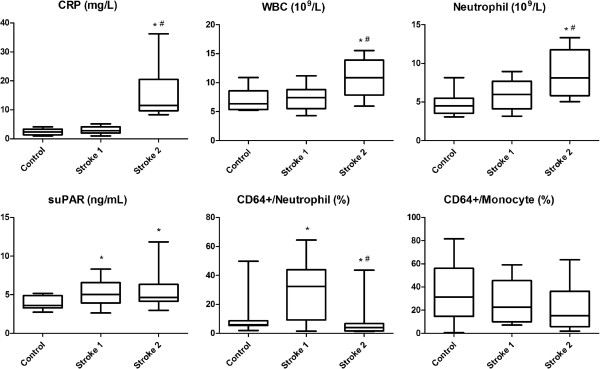
CRP, WBC and neutrophil count values were comparable in stroke patients within 6 hours and controls, however, they were elevated in stroke one week after the insult. suPAR levels were higher in both stroke groups compared to controls. The prevalence of CD64+ neutrophils was higher in stroke patients within 6 hours than in controls and it decreased in stroke one week after the insult below the level in controls (5.95 [5.41-8.75] % vs. 32.38 [9.21-43.93] % vs. 4.06 [1.73-6.77] %, p < 0.05).
Our pilot study identified that the prevalence of CD64+ neutrophils may reflect a biphasic alteration of the immune response following AIS. Since its level decreases below baseline after one week of the CNS insult in stroke patients without infection, it might serve as a reliable candidate to identify the developing inflammatory response due to infection after stroke in the future.
急性缺血性脑卒中(AIS)对周围免疫系统具有双相作用。最初的炎症反应之后是全身免疫抑制,称为卒中诱导的免疫抑制(SIIS),导致卒中患者发生严重并发症。我们旨在确定一种能够最好地代表 AIS 后这种双相免疫反应的炎症标志物。
我们研究了 12 例在发病 6 小时内且无感染的急性缺血性卒中患者以及 1 周后的 CRP、WBC、中性粒细胞计数、suPAR 水平、CD4+CD25high Tregs、CD64+和 CD177+中性粒细胞和单核细胞的变化。作为对照,纳入了 14 名年龄匹配的健康个体。
在发病 6 小时内,卒中患者的 CRP、WBC 和中性粒细胞计数与对照组相当,但在卒中 1 周后则升高。两组卒中患者的 suPAR 水平均高于对照组。在发病 6 小时内,卒中患者中 CD64+中性粒细胞的比例高于对照组,且在卒中 1 周后,其比例下降至低于对照组的水平(5.95[5.41-8.75]%比 32.38[9.21-43.93]%比 4.06[1.73-6.77]%,p<0.05)。
我们的初步研究发现,CD64+中性粒细胞的比例可能反映了 AIS 后免疫反应的双相变化。由于其水平在卒中患者无感染的中枢神经系统损伤 1 周后下降至基线以下,因此它可能成为识别卒中后因感染而发生炎症反应的可靠候选标志物。