Huang Hongxin, Zheng Yayuan, Zhu Jianhong, Zhang Jingjing, Chen Huapu, Chen Xinggui
Clinical Research Center, Affiliated Hospital of Guangdong Medical College, Zhanjiang, China.
Department of Pharmacology, Guangdong Medical College, Zhanjiang, China.
PLoS One. 2014 Mar 5;9(3):e89960. doi: 10.1371/journal.pone.0089960. eCollection 2014.
The risk of fatal adverse events (FAEs) due to bevacizumab-based chemotherapy has not been well described; we carried out an updated meta-analysis regarding this issue.
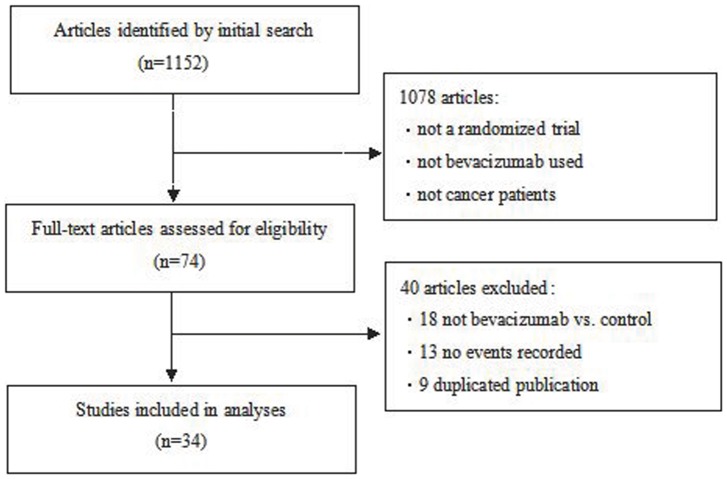
An electronic search of Medline, Embase and The Cochrane Central Register of Controlled Trials was conducted to investigate the effects of randomized controlled trials on bevacizumab treatment on cancer patients. Random or fixed-effect meta-analytical models were used to evaluate the risk ratio (RR) of FAEs due to the use of bevacizumab.
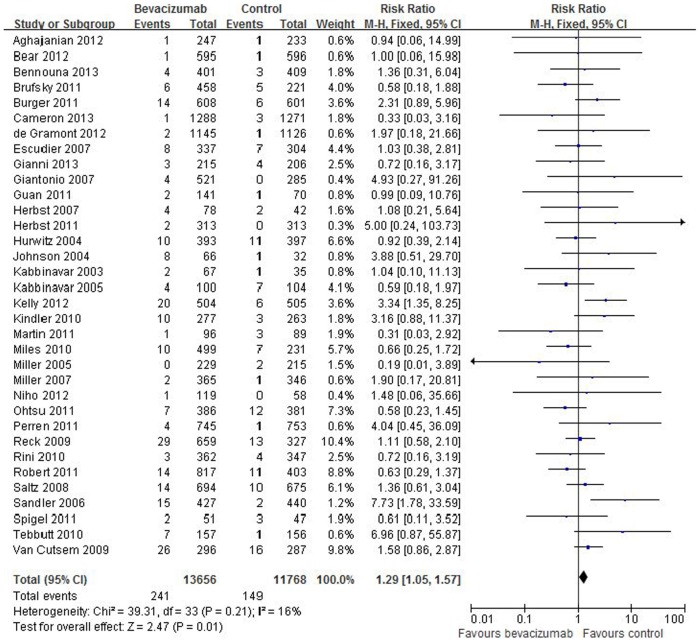
Thirty-four trials were included. Allocation to bevacizumab therapy significantly increased the risk of FAEs; the RR was 1.29 (95% CI:1.05-1.57). This association varied significantly with tumor types (P=0.002) and chemotherapeutic agents (P=0.005) but not with bevacizumab dose (P=0.90). Increased risk was seen in patients with non-small cell lung cancer, pancreatic cancer, prostate cancer, and ovarian cancer. However, FAEs were lower in breast cancer patients treated with bevacizumab. In addition, bevacizumab was associated with an increased risk of FAEs in patients who received concomitant agents of taxanes and/or platinum.
Compared with chemotherapy alone, the addition of bevacizumab was associated with an increased risk of FAEs among patients with special tumor types, particularly when combined with chemotherapeutic agents such as platinum.
基于贝伐单抗的化疗导致致命不良事件(FAEs)的风险尚未得到充分描述;我们针对此问题进行了一项更新的荟萃分析。
对Medline、Embase和Cochrane对照试验中央注册库进行电子检索,以调查随机对照试验中贝伐单抗治疗对癌症患者的影响。采用随机或固定效应荟萃分析模型评估使用贝伐单抗导致FAEs的风险比(RR)。
纳入34项试验。接受贝伐单抗治疗显著增加了FAEs的风险;RR为1.29(95%CI:1.05 - 1.57)。这种关联因肿瘤类型(P = 0.002)和化疗药物(P = 0.005)而异,但与贝伐单抗剂量无关(P = 0.90)。在非小细胞肺癌、胰腺癌、前列腺癌和卵巢癌患者中观察到风险增加。然而,接受贝伐单抗治疗的乳腺癌患者中FAEs较低。此外,在接受紫杉烷和/或铂类联合用药的患者中,贝伐单抗与FAEs风险增加相关。
与单纯化疗相比,添加贝伐单抗会使特定肿瘤类型患者发生FAEs的风险增加,特别是与铂类等化疗药物联合使用时。