Clinical Epidemiology Program, Faculty of Medicine, Chiang Mai University, Chiang Mai ; Department of Social Medicine, Chiangrai Prachanukroh Hospital, Chiang Rai.
Clinical Epidemiology Program, Faculty of Medicine, Thammasat University, Bangkok.
Risk Manag Healthc Policy. 2014 Feb 18;7:29-34. doi: 10.2147/RMHP.S56974. eCollection 2014.
The aim of the study reported here was to validate the risk-scoring algorithm for prognostication of scrub typhus severity.
The risk-scoring algorithm for prognostication of scrub typhus severity developed earlier from two general hospitals in Thailand was validated using an independent dataset of scrub typhus patients in one of the hospitals from a few years later. The predictive performances of the two datasets were compared by analysis of the area under the receiver-operating characteristic curve (AuROC). Classification of patients into non-severe, severe, and fatal cases was also compared.
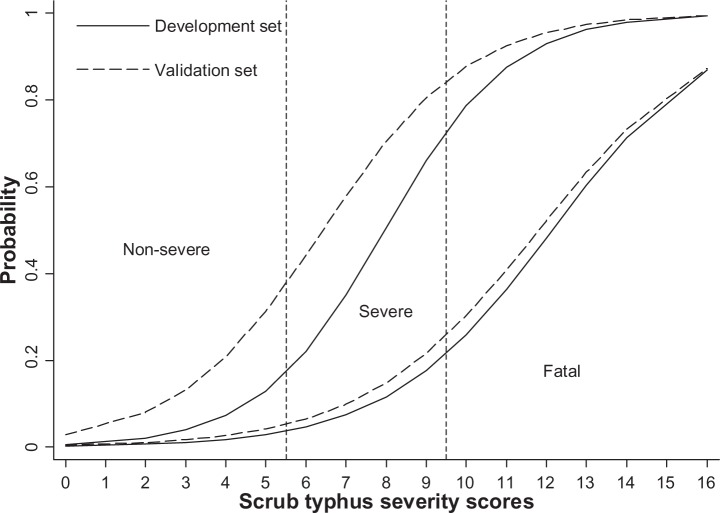
The proportions of non-severe, severe, and fatal patients by operational definition were similar between the development and validation datasets. Patient, clinical, and laboratory profiles were also similar. Scores were similar in both datasets, both in terms of discriminating non-severe from severe and fatal patients (AuROC =88.74% versus 91.48%, P=0.324), and in discriminating fatal from severe and non-severe patients (AuROC =88.66% versus 91.22%, P=0.407). Over- and under-estimations were similar and were clinically acceptable.
The previously developed risk-scoring algorithm for prognostication of scrub typhus severity performed similarly with the validation data and the first dataset. The scoring algorithm may help in the prognostication of patients according to their severity in routine clinical practice. Clinicians may use this scoring system to help make decisions about more intensive investigations and appropriate treatments.
本研究旨在验证用于预测恙虫病严重程度的风险评分算法。
使用来自泰国两家综合医院的早期开发的用于预测恙虫病严重程度的风险评分算法,对几年后来自其中一家医院的独立恙虫病患者数据集进行验证。通过分析接受者操作特征曲线下的面积(AuROC)比较两个数据集的预测性能。还比较了将患者分为非严重、严重和致命病例的分类。
根据操作定义,发展和验证数据集中非严重、严重和致命患者的比例相似。患者、临床和实验室特征也相似。两个数据集的评分相似,无论是在区分非严重与严重和致命患者(AuROC=88.74%与 91.48%,P=0.324),还是在区分致命与严重和非严重患者(AuROC=88.66%与 91.22%,P=0.407)方面。高估和低估相似,且具有临床可接受性。
先前开发的用于预测恙虫病严重程度的风险评分算法在验证数据和第一组数据中表现相似。评分算法可能有助于根据患者的严重程度在常规临床实践中进行预后。临床医生可以使用该评分系统来帮助做出更深入的检查和适当治疗的决策。