Clinical Epidemiology Program, Chiang Mai University, Chiang Mai, Thailand ; Department of Social Medicine, Chiangrai Prachanukroh Hospital, Chiang Rai, Thailand.
Department of General Pediatrics, Nakornping Hospital, Chiang Mai, Thailand.
Risk Manag Healthc Policy. 2013 Dec 16;7:11-7. doi: 10.2147/RMHP.S55305. eCollection 2013.
To develop a simple risk-scoring system to forecast scrub typhus severity.
Seven years' retrospective data of patients diagnosed with scrub typhus from two university-affiliated hospitals in the north of Thailand were analyzed. Patients were categorized into three severity groups: nonsevere, severe, and dead. Predictors for severity were analyzed under multivariable ordinal continuation ratio logistic regression. Significant coefficients were transformed into item score and summed to total scores.
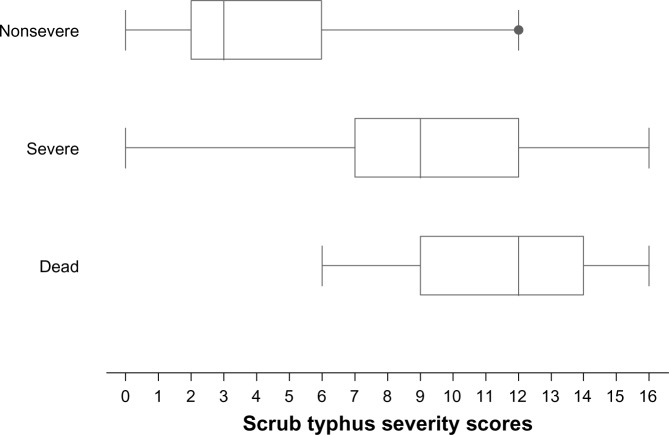
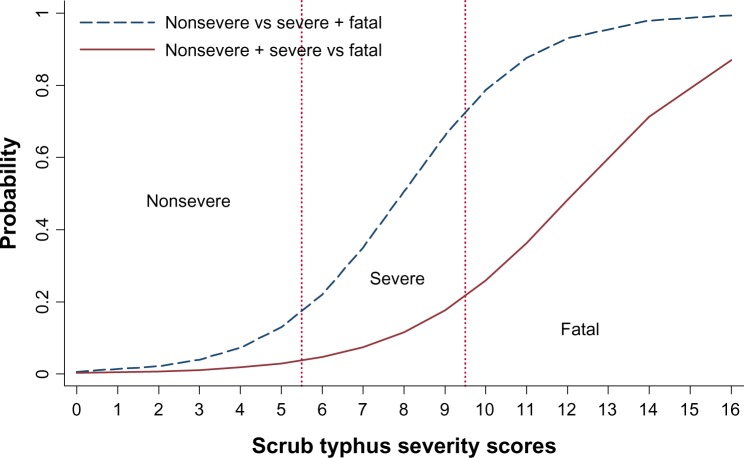
Predictors of scrub typhus severity were age >15 years, (odds ratio [OR] =4.09), pulse rate >100/minute (OR 3.19), crepitation (OR 2.97), serum aspartate aminotransferase >160 IU/L (OR 2.89), serum albumin ≤3.0 g/dL (OR 4.69), and serum creatinine >1.4 mg/dL (OR 8.19). The scores which ranged from 0 to 16, classified patients into three risk levels: non-severe (score ≤5, n=278, 52.8%), severe (score 6-9, n=143, 27.2%), and fatal (score ≥10, n=105, 20.0%). Exact severity classification was obtained in 68.3% of cases. Underestimations of 5.9% and overestimations of 25.8% were clinically acceptable.
The derived scrub typhus severity score classified patients into their severity levels with high levels of prediction, with clinically acceptable under- and overestimations. This classification may assist clinicians in patient prognostication, investigation, and management. The scoring algorithm should be validated by independent data before adoption into routine clinical practice.
开发一种简单的风险评分系统,以预测恙虫病的严重程度。
分析了来自泰国北部两所大学附属医院的 7 年回顾性恙虫病患者数据。患者被分为三组:非重症、重症和死亡。在多变量有序连续比逻辑回归下分析严重程度的预测因素。显著系数转换为项目评分并相加得到总评分。
恙虫病严重程度的预测因素为年龄>15 岁(优势比[OR] =4.09)、脉搏率>100/分钟(OR 3.19)、啰音(OR 2.97)、血清天门冬氨酸氨基转移酶>160 IU/L(OR 2.89)、血清白蛋白≤3.0 g/dL(OR 4.69)和血清肌酐>1.4 mg/dL(OR 8.19)。评分范围为 0 至 16,将患者分为三个风险水平:非重症(评分≤5,n=278,52.8%)、重症(评分 6-9,n=143,27.2%)和致命(评分≥10,n=105,20.0%)。在 68.3%的病例中获得了准确的严重程度分类。低估 5.9%和高估 25.8%是可以接受的临床误差。
该恙虫病严重程度评分系统将患者分为严重程度水平,具有较高的预测水平,低估和高估的临床误差可接受。这种分类可以帮助临床医生预测患者的预后、进行检查和管理。在常规临床实践中采用之前,应通过独立数据验证评分算法。