Chen Xinguang, Brogan Kathryn
Pediatric Prevention Research Center, Wayne State University School of Medicine, Detroit, MI, USA.
Adolesc Health Med Ther. 2012 Mar 29;3:33-42. doi: 10.2147/AHMT.S30178. eCollection 2012.
To detect subgroups with different risks at different ages to develop overweight and obese during the adolescence-young adulthood period.
Accelerated longitudinal design and developmental trajectory analysis were used. The likelihoods to become overweight (body mass index [BMI] >25 kg/m(2)) and obese (BMI >30 kg/m(2)) were assessed across the life course from the ages of 12 to 28 years.
Adolescent participants aged 12-17 years (n = 4119) identified in the National Longitudinal Survey of Youth 1997 at baseline were followed up to 2008.
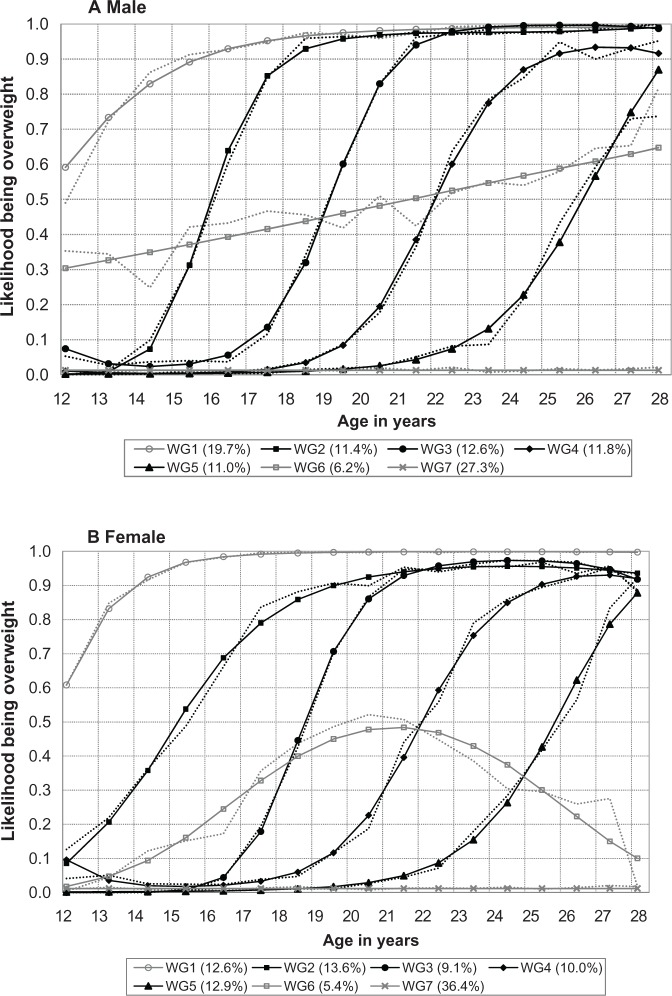
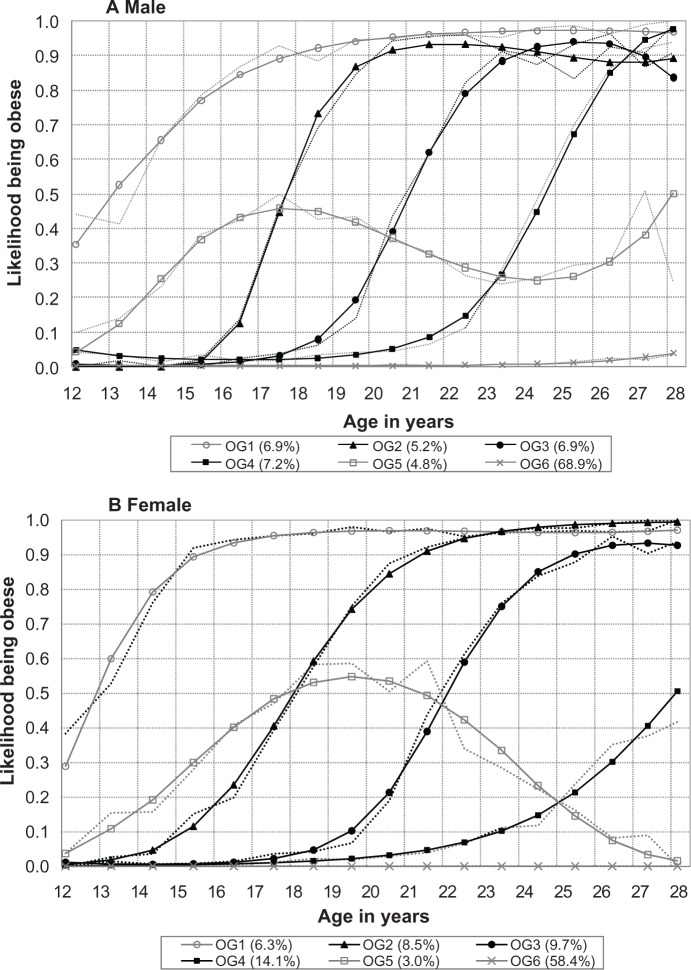
SEVEN OVERWEIGHT RISK GROUPS (WG) WERE DETECTED FOR MALE AND FEMALE SAMPLES RESPECTIVELY, OF WHICH FIVE WERE CLOSELY RELATED TO EACH OF THE FOLLOWING FIVE PERIODS: (a) middle-school ages (19.7% and 12.6% for male and female, respectively), (b) high-school ages (11.4% and 13.6%, respectively), (c) college ages (12.6% and 9.1%, respectively), (d) post-college ages (11.8% and 10.0%, respectively), and (e) work-family-formation ages (11.0% and 12.9%, respectively); two were nonperiod-specific groups: a permanent low-risk group for both sexes (27.3% for male, 36.4% for female), a growing-risk group for males (6.2%), and a self-limiting risk group for females (5.4%, with the likelihood increasing with age, which peaked at the age of 21 years, and then declined). Likewise, six obesity risk groups (OG) were detected, of which four corresponded to the first four high-risk WG groups. The risk groups were relatively independent of race and educational attainment.
Findings of this study imply that five risk groups for weight gain like five consecutive "tests" exist from middle-school period to work-and-family formation. Failure to pass any of these tests in the life course could lead to overweight or obese status. Further research needs to study life-course-specific factors and mechanisms for more effective weight control.
检测在青春期至青年期出现超重和肥胖的不同年龄阶段的不同风险亚组。
采用加速纵向设计和发育轨迹分析。评估了12至28岁整个生命过程中超重(体重指数[BMI]>25kg/m²)和肥胖(BMI>30kg/m²)的可能性。
对1997年全国青年纵向调查基线时确定的12 - 17岁青少年参与者(n = 4119)进行随访至2008年。
分别在男性和女性样本中检测到7个超重风险组(WG),其中5个分别与以下5个时期密切相关:(a)中学年龄(男性为19.7%,女性为12.6%),(b)高中年龄(分别为11.4%和13.6%),(c)大学年龄(分别为12.6%和9.1%),(d)大学毕业后年龄(分别为11.8%和10.0%),以及(e)工作 - 家庭形成年龄(分别为11.0%和12.9%);两个是非特定时期组:男女永久性低风险组(男性为27.3%,女性为36.4%),男性的风险增长组(6.2%),女性的自我限制风险组(5.4%,可能性随年龄增加,在21岁时达到峰值,然后下降)。同样,检测到6个肥胖风险组(OG),其中4个与前4个高风险WG组相对应。这些风险组相对独立于种族和教育程度。
本研究结果表明,从中学期到工作和家庭形成期存在5个体重增加风险组,就像5个连续的“测试”。在生命过程中未能通过任何一项测试都可能导致超重或肥胖状态。进一步的研究需要研究特定生命阶段的因素和机制,以实现更有效的体重控制。