Harris Kathleen Mullan, Lee Hedwig, Deleone Felicia Yang
Carolina Population Center and Department of Sociology University of North Carolina at Chapel Hill 505 University Square East 123 W. Franklin Street Chapel Hill, North Carolina 27516
J Fam Issues. 2010 Aug;31(8):1106-1143. doi: 10.1177/0192513X10365823.
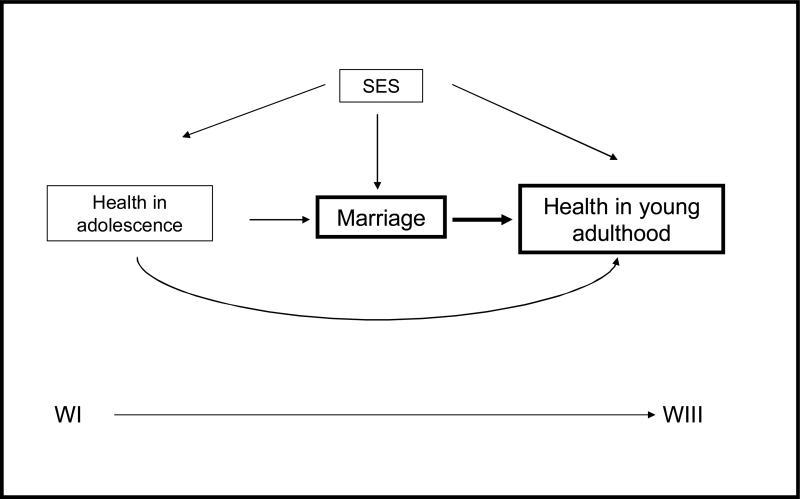
This paper examines the relationship between early marriage (before age 26), cohabitation, and health for African Americans and whites during the transition to adulthood using the National Longitudinal Study of Adolescent Health (Add Health). We examine three categories of health outcomes relevant to young adulthood: physical health, mental health, and health risk behaviors. Lagged dependent variable models are used to examine the health effects of early marriage and cohabitation accounting for potential health selection into unions. Our results indicate that early marriage by young adults does not have protective effects for African Americans, and finds more negative effects for African American men than women. There are mixed results for whites with some protective effects of marriage for binge drinking. Early marriage for both African Americans and whites is associated with increased Body Mass Index (BMI). Cohabitation is uniformly associated with negative health outcomes for all race and sex groups.
本文利用青少年健康全国纵向研究(“增加健康”研究),探讨了非裔美国人和白人在向成年期过渡过程中早婚(26岁之前)、同居与健康之间的关系。我们研究了与青年期相关的三类健康结果:身体健康、心理健康和健康风险行为。滞后因变量模型用于检验早婚和同居对健康的影响,同时考虑到婚姻中潜在的健康选择因素。我们的研究结果表明,年轻人早婚对非裔美国人没有保护作用,而且早婚对非裔美国男性的负面影响大于女性。白人的结果则好坏参半,婚姻对酗酒有一些保护作用。非裔美国人和白人早婚都与体重指数(BMI)升高有关。同居对所有种族和性别的群体都普遍与负面健康结果相关。