Lepeule Johanna, Bind Marie-Abele Catherine, Baccarelli Andrea A, Koutrakis Petros, Tarantini Letizia, Litonjua Augusto, Sparrow David, Vokonas Pantel, Schwartz Joel D
Exposure, Epidemiology, and Risk Program, Department of Environmental Health, Harvard School of Public Health, Boston, Massachusetts, USA.
Environ Health Perspect. 2014 Jun;122(6):566-72. doi: 10.1289/ehp.1206458. Epub 2014 Mar 6.
Few studies have been performed on pulmonary effects of air pollution in the elderly--a vulnerable population with low reserve capacity--and mechanisms and susceptibility factors for potential effects are unclear.
We evaluated the lag structure of air pollutant associations with lung function and potential effect modification by DNA methylation (< or ≥ median) at 26 individual CpG sites in nine candidate genes in a well-characterized cohort of elderly men.
We measured forced vital capacity (FVC), forced expiratory volume in 1 sec (FEV1), and blood DNA methylation one to four times between 1999 and 2009 in 776 men from the Normative Aging Study. Air pollution was measured at fixed monitors 4 hr to 28 days before lung function tests. We used linear mixed-effects models to estimate the main effects of air pollutants and effect modification by DNA methylation.
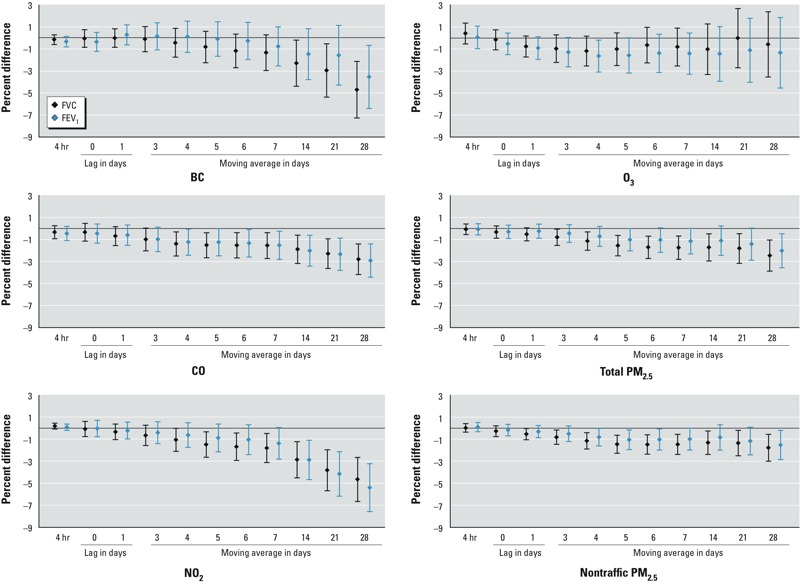
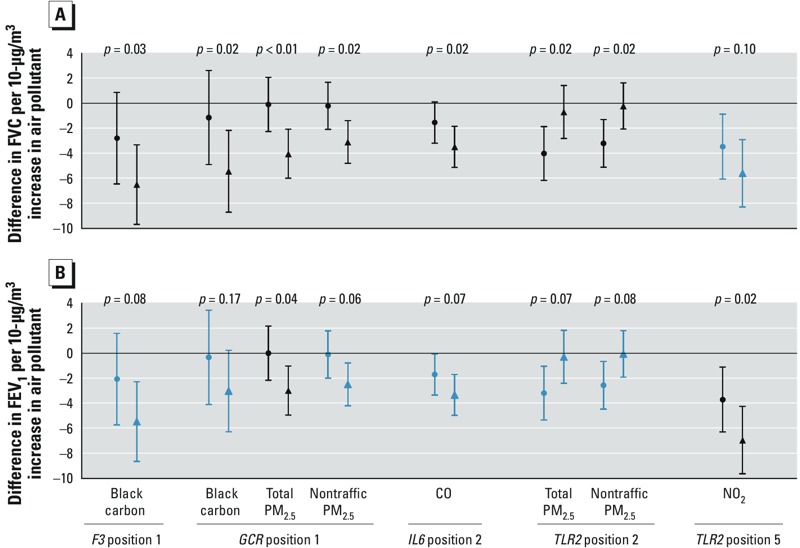
An interquartile range (IQR) increase in subchronic exposure (3 to 28 days cumulated), but not in acute exposure (during the previous 4 hr, or the current or previous day), to black carbon, total and nontraffic particles with aerodynamic diameter ≤ 2.5 μm (PM2.5), carbon monoxide, and nitrogen dioxide was associated with a 1-5% decrease in FVC and FEV1 (p < 0.05). Slope estimates were greater for FVC than FEV1, and increased with cumulative exposure. The estimates slopes for air pollutants (28 days cumulated) were higher in participants with low (< median) methylation in TLR2 at position 2 and position 5 and high (≥ median) methylation in GCR.
Subchronic exposure to traffic-related pollutants was associated with significantly reduced lung function in the elderly; nontraffic pollutants (particles, ozone) had weaker associations. Epigenetic mechanisms related to inflammation and immunity may influence these associations.
针对空气污染对老年人(这一储备能力低下的脆弱人群)肺部影响的研究较少,潜在影响的机制和易感因素尚不清楚。
在一个特征明确的老年男性队列中,我们评估了空气污染物与肺功能关联的滞后结构,以及9个候选基因中26个个体CpG位点的DNA甲基化(<或≥中位数)对潜在效应的修饰作用。
我们在1999年至2009年间,对来自标准老化研究的776名男性进行了1至4次用力肺活量(FVC)、1秒用力呼气量(FEV1)和血液DNA甲基化测量。在肺功能测试前4小时至28天,通过固定监测器测量空气污染情况。我们使用线性混合效应模型来估计空气污染物的主要影响以及DNA甲基化的效应修饰作用。
亚慢性暴露(累积3至28天)中,黑碳、空气动力学直径≤2.5μm的总颗粒物和非交通颗粒物(PM2.5)、一氧化碳和二氧化氮的四分位间距(IQR)增加,与FVC和FEV1降低1-5%相关(p<0.05),而急性暴露(前4小时、当日或前一日)则无此关联。FVC的斜率估计值大于FEV1,且随累积暴露增加。在TLR2基因第2和第5位点甲基化水平低(<中位数)且GCR基因甲基化水平高(≥中位数)的参与者中,空气污染物(累积28天)估计斜率更高。
老年人亚慢性暴露于交通相关污染物与肺功能显著降低有关;非交通污染物(颗粒物、臭氧)的关联较弱。与炎症和免疫相关的表观遗传机制可能影响这些关联。