
一项由护士主导的自我管理干预措施对减少癫痫患者急诊就诊次数的临床及成本效益分析
Clinical- and cost-effectiveness of a nurse led self-management intervention to reduce emergency visits by people with epilepsy.
作者信息
Noble Adam J, McCrone Paul, Seed Paul T, Goldstein Laura H, Ridsdale Leone
机构信息
Department of Psychological Sciences, Institute of Psychology, Health & Society, University of Liverpool/Department of Clinical Neuroscience, Institute of Psychiatry, King's College London, United Kingdom.
Health Service and Population Research, Institute of Psychiatry, King's College London, London United Kingdom.
出版信息
PLoS One. 2014 Mar 6;9(6):e90789. doi: 10.1371/journal.pone.0090789. eCollection 2014.
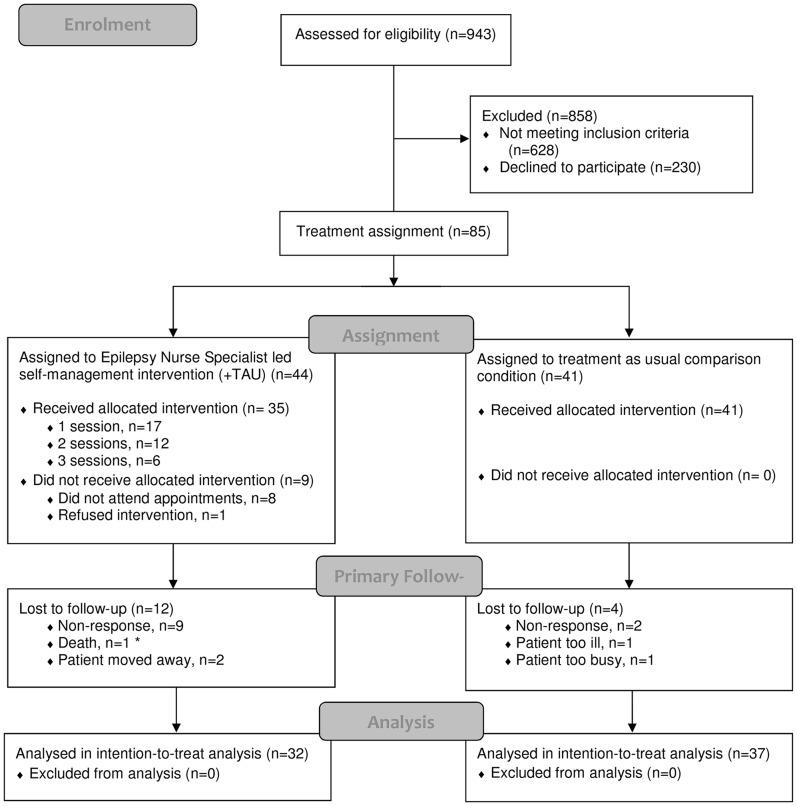
People with chronic epilepsy (PWE) often make costly, and clinically unnecessary emergency department (ED) visits. Some do it frequently. No studies have examined interventions to reduce them. An intervention delivered by an epilepsy nurse specialist (ENS) might reduce visits. The rationale is it may optimize patients' self-management skills and knowledge of appropriate ED use. We examined such an intervention's clinical- and cost-effectiveness. Eighty-five adults with epilepsy were recruited from three London EDs with similar catchment populations. Forty-one PWE recruited from two EDs received treatment-as-usual (TAU) and formed the comparison group. The remaining 44 PWE were recruited from the ED of a hospital that had implemented a new ENS service for PWE attending ED. These participants formed the intervention group. They were offered 2 one-to-one sessions with an ENS, plus TAU. Participants completed questionnaires on health service use and psychosocial well-being at baseline, 6- and 12-month follow-up. Covariates were identified and adjustments made. Sixty-nine (81%) participants were retained at follow-up. No significant effect of the intervention on ED visits at 12 months or on other outcomes was found. However, due to less time as inpatients, the average service cost for intervention participants over follow-up was less than for TAU participants' (adjusted difference £558, 95% CI, -£2409, £648). Covariates most predictive of subsequent ED visits were patients' baseline feelings of stigmatization due to epilepsy and low confidence in managing epilepsy. The intervention did not lead to a reduction in ED use, but did not cost more, partly because those receiving the intervention had shorter hospital admissions. Our findings on long-term ED predictors clarifies what causes ED use, and suggests that future interventions might focus more on patients' perceptions of stigma and on their confidence in managing epilepsy. If addressed, ED visits might be reduced and efficiency-savings generated.
慢性癫痫患者(PWE)经常进行代价高昂且临床上不必要的急诊科(ED)就诊。有些人频繁如此。尚无研究探讨减少此类就诊的干预措施。由癫痫专科护士(ENS)提供的干预可能会减少就诊次数。其理论依据是,这可能会优化患者的自我管理技能以及对适当使用急诊科的认知。我们研究了这种干预措施的临床和成本效益。从伦敦三个具有相似服务人口的急诊科招募了85名成年癫痫患者。从两个急诊科招募的41名PWE接受常规治疗(TAU)并组成对照组。其余44名PWE从一家医院的急诊科招募,该医院已为就诊的PWE实施了新的ENS服务。这些参与者组成干预组。他们接受了与ENS的2次一对一诊疗,外加TAU。参与者在基线、6个月和12个月随访时完成了关于医疗服务使用和心理社会幸福感的问卷调查。确定了协变量并进行了调整。69名(81%)参与者在随访时被保留。未发现干预措施对12个月时的急诊科就诊或其他结果有显著影响。然而,由于住院时间较短,随访期间干预组参与者的平均服务成本低于TAU组参与者(调整差异为558英镑,95%CI,-2409英镑,648英镑)。对随后急诊科就诊预测性最强的协变量是患者因癫痫而产生的基线耻辱感以及对管理癫痫缺乏信心。该干预措施并未导致急诊科使用次数减少,但成本也没有增加,部分原因是接受干预的患者住院时间较短。我们关于长期急诊科预测因素的研究结果阐明了导致急诊科就诊的原因,并表明未来的干预措施可能更多地侧重于患者的耻辱感认知以及他们对管理癫痫的信心。如果这些问题得到解决,急诊科就诊次数可能会减少,并能节省效率成本。
 Zotero 插件