Peng Weiwei, Hu Li, Zhang Zhiguo, Hu Yong
Department of Orthopaedics and Traumatology, The University of Hong Kong, Pokfulam, Hong Kong.
Key Laboratory of Cognition and Personality (Ministry of Education) and School of Psychology, Southwest University, Chongqing, China.
PLoS One. 2014 Mar 6;9(3):e91052. doi: 10.1371/journal.pone.0091052. eCollection 2014.
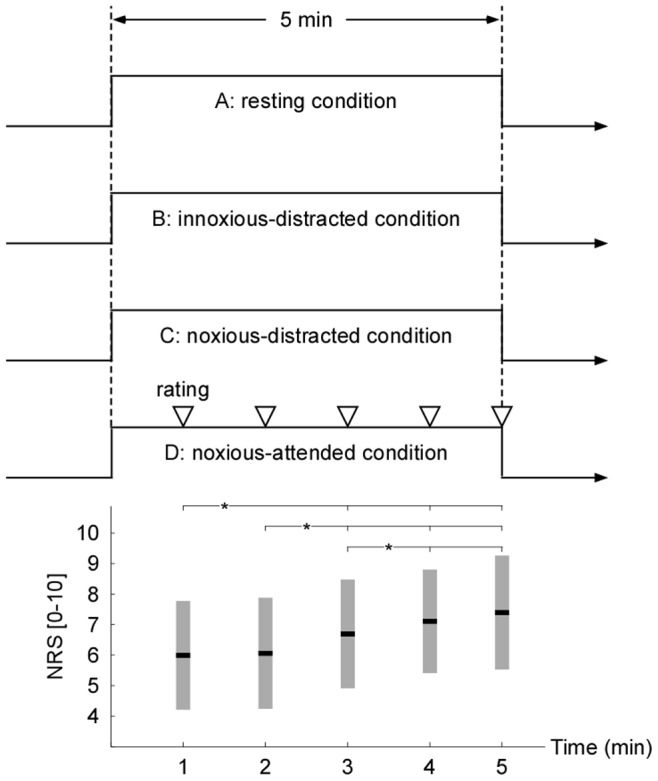
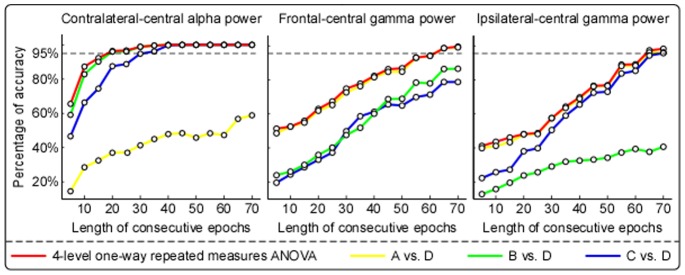
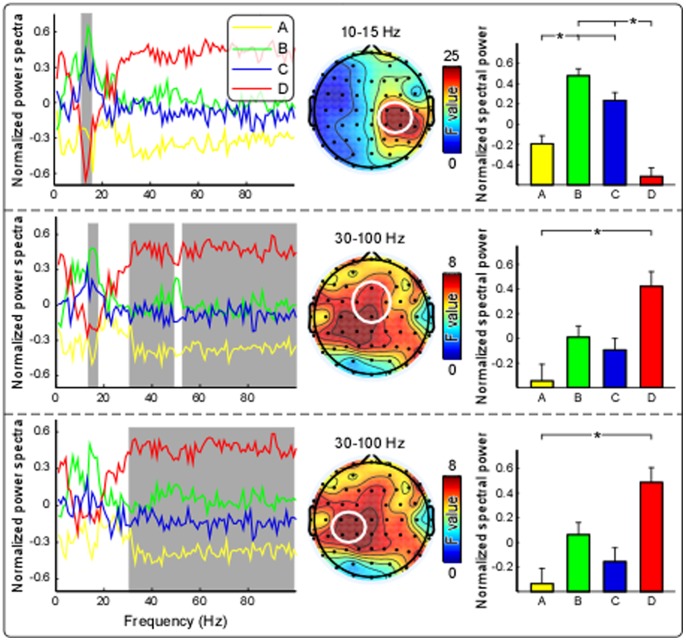
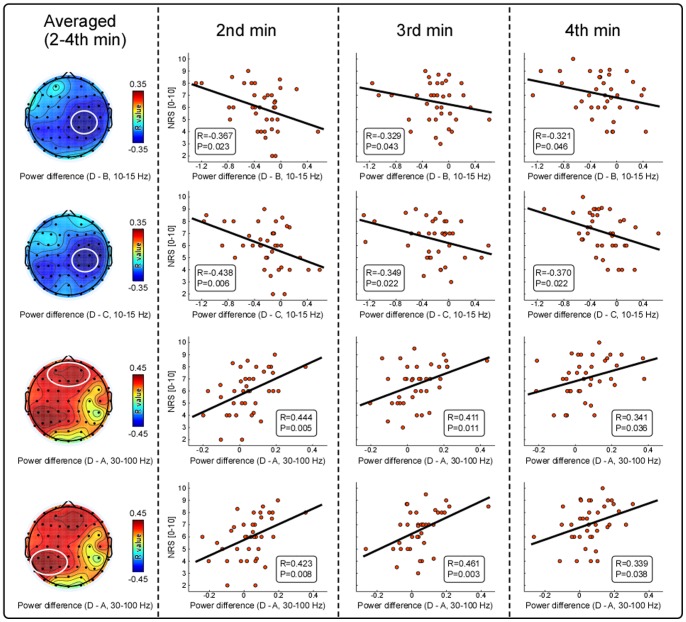
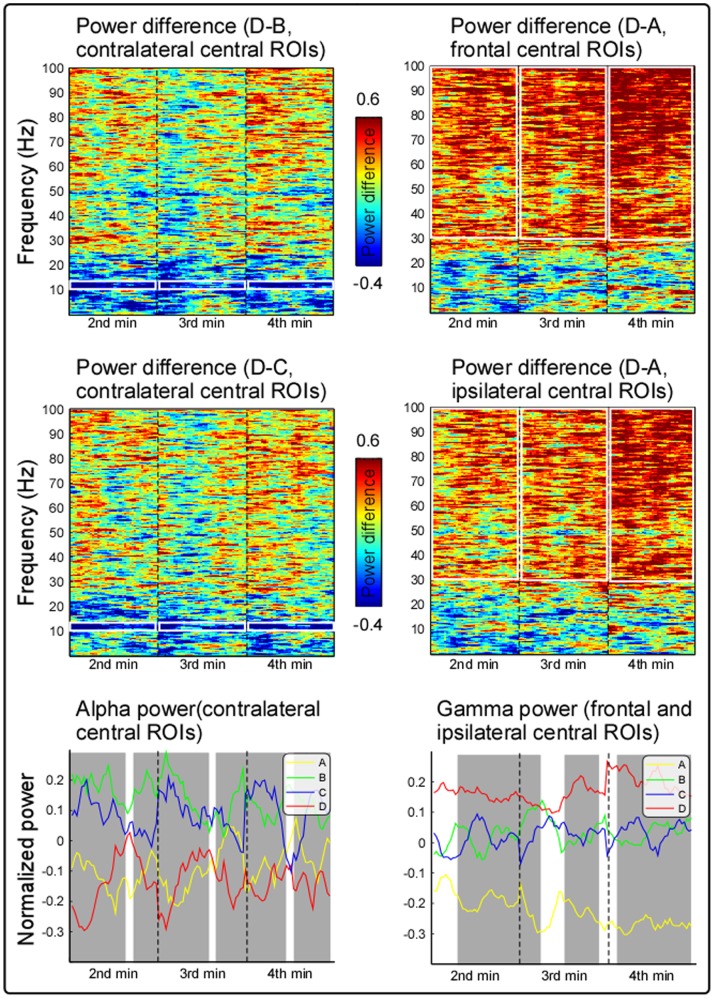
Transient painful stimuli could induce suppression of alpha oscillatory activities and enhancement of gamma oscillatory activities that also could be greatly modulated by attention. Here, we attempted to characterize changes in cortical activities during tonic heat pain perception and investigated the influence of directed/distracted attention on these responses. We collected 5-minute long continuous Electroencephalography (EEG) data from 38 healthy volunteers during four conditions presented in a counterbalanced order: (A) resting condition; (B) innoxious-distracted condition; (C) noxious-distracted condition; (D) noxious-attended condition. The effects of tonic heat pain stimulation and selective attention on oscillatory activities were investigated by comparing the EEG power spectra among the four experimental conditions and assessing the relationship between spectral power difference and subjective pain intensity. The change of oscillatory activities in condition D was characterized by stable and persistent decrease of alpha oscillation power over contralateral-central electrodes and widespread increase of gamma oscillation power, which were even significantly correlated with subjective pain intensity. Since EEG responses in the alpha and gamma frequency band were affected by attention in different manners, they are likely related to different aspects of the multidimensional sensory experience of pain. The observed contralateral-central alpha suppression (conditions D vs. B and D vs. C) may reflect primarily a top-down cognitive process such as attention, while the widespread gamma enhancement (conditions D vs. A) may partly reflect tonic pain processing, representing the summary effects of bottom-up stimulus-related and top-down subject-driven cognitive processes.
短暂的疼痛刺激可诱发α振荡活动的抑制和γ振荡活动的增强,且这些活动也可受到注意力的显著调节。在此,我们试图描述持续性热痛感知过程中皮层活动的变化,并研究定向/分散注意力对这些反应的影响。我们从38名健康志愿者身上收集了5分钟长的连续脑电图(EEG)数据,实验在四种以平衡顺序呈现的条件下进行:(A)静息状态;(B)无害-分散注意力状态;(C)有害-分散注意力状态;(D)有害-集中注意力状态。通过比较四种实验条件下的EEG功率谱,并评估频谱功率差异与主观疼痛强度之间的关系,研究了持续性热痛刺激和选择性注意力对振荡活动的影响。条件D下振荡活动的变化表现为对侧中央电极上α振荡功率稳定且持续下降,以及γ振荡功率广泛增加,且这些变化甚至与主观疼痛强度显著相关。由于α和γ频段的EEG反应受注意力影响的方式不同,它们可能与疼痛多维感觉体验的不同方面相关。观察到的对侧中央α抑制(条件D与B对比以及D与C对比)可能主要反映了一种自上而下的认知过程,如注意力,而广泛的γ增强(条件D与A对比)可能部分反映了持续性疼痛处理,代表了自下而上的刺激相关和自上而下的主体驱动认知过程的综合效应。