Reddy Sagili Vijaya Bhaskar, Jain Anu, Yadav Subhash B, Sharma Kumudini, Bhatia Eesh
Department of Endocrinology, Sanjay Gandhi Postgraduate Institute of Medical Sciences, Lucknow, India.
Indian J Med Res. 2014 Jan;139(1):99-104.
BACKGROUND & OBJECTIVES: The prevalence of Graves' ophthalmopathy (GO) varies widely in different ethnic groups. Indians have been reported to have a lower prevalence of Graves' ophthalmopathy as compared to Caucasians of European origin, but data are sparse and inconclusive. We studied the prevalence, clinical features and association of GO in Indian patients with Graves' disease attending a referral centre in north India.
A prospective study was conducted on 235 consecutive newly referred north Indian patients with Graves' disease presenting to a tertiary care centre in north India. All patients underwent a comprehensive ophthalmological examination as per the European Group on Graves' Orbitopathy (EUGOGO) recommendations.
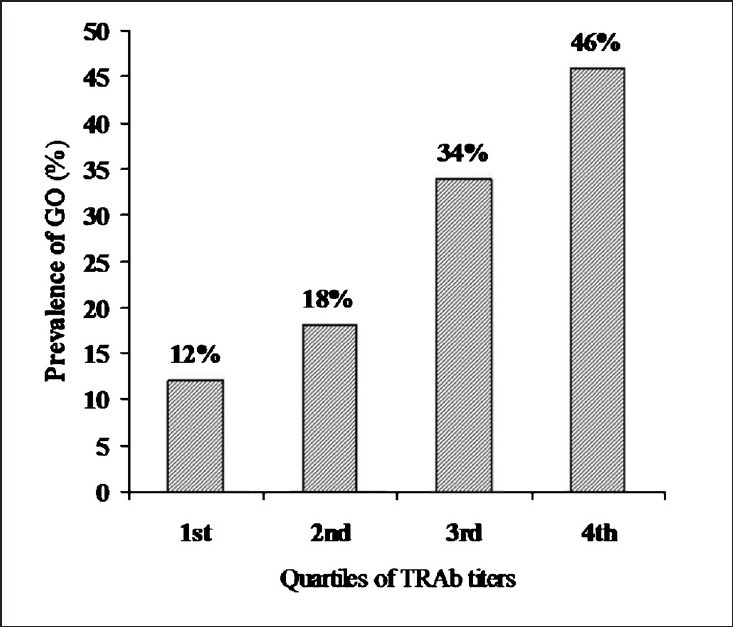
GO was diagnosed in 65 patients (prevalence 28%; 95% confidence interval 22-33%). The prevalence was similar in males (28%) and females (27%). It was mild in 83 per cent, moderate-severe in 15 per cent and sight-threatening in only 2 per cent of cases. Ophthalmopathy was clinically active in only two (3%) cases. Upper eyelid retraction was the most common manifestation (83%), followed by exophthalmos (75%). Extra-ocular muscle involvement (5%) and optic nerve dysfunction (2%) were uncommon. The risk of GO was 3.9- fold (95% confidence interval 1.1-13.6) higher in smokers compared to non-smokers. However, severity of disease in smokers was similar to non-smokers. On multivariate logistic regression analysis, GO was associated only with high thyrotropin receptor antibody titres and current smoking.
INTERPRETATION & CONCLUSIONS: Among north Indian patients with GD studied at a referral center, the prevalence of GO was similar to Caucasians of European descent, but clinically active and severe ophthalmopathy was uncommon. More studies are needed to confirm these findings.
格雷夫斯眼病(GO)在不同种族中的患病率差异很大。据报道,与欧洲裔白种人相比,印度人格雷夫斯眼病的患病率较低,但数据稀少且尚无定论。我们研究了在印度北部一家转诊中心就诊的格雷夫斯病患者中GO的患病率、临床特征及相关性。
对连续转诊至印度北部一家三级医疗中心的235例新诊断的印度北部格雷夫斯病患者进行了一项前瞻性研究。所有患者均按照欧洲格雷夫斯眼眶病研究组(EUGOGO)的建议进行了全面的眼科检查。
65例患者被诊断为GO(患病率28%;95%置信区间22 - 33%)。男性(28%)和女性(27%)的患病率相似。83%的病例病情较轻,15%为中度至重度,仅2%的病例有视力威胁。仅2例(3%)患者的眼病处于临床活动期。上睑退缩是最常见的表现(83%),其次是眼球突出(75%)。眼外肌受累(5%)和视神经功能障碍(2%)并不常见。吸烟者患GO的风险比不吸烟者高3.9倍(95%置信区间1.1 - 13.6)。然而,吸烟者的疾病严重程度与不吸烟者相似。多因素逻辑回归分析显示,GO仅与高促甲状腺素受体抗体滴度和当前吸烟有关。
在印度北部一家转诊中心研究的格雷夫斯病患者中,GO的患病率与欧洲血统的白种人相似,但临床活动期和严重眼病并不常见。需要更多研究来证实这些发现。