Li Xiao, Suo Jing, Shao Shujuan, Xue Liyan, Chen Wei, Dong Lijia, Shi Ji, Fu Ming, Lu Ning, Zhan Qimin, Tong Tong
State Key Laboratory of Molecular Oncology, Cancer Institute & Cancer Hospital, Chinese Academy of Medical Sciences & Peking Union Medical College, Beijing, China; CAS Key Laboratory of Separation Science for Analytical Chemistry, Dalian Institute of Chemical Physics, Chinese Academy of Science, Dalian, Liaoning, China; Department of Histology and Embryology, Dalian Medical University, Dalian, Liaoning, China.
Department of Histology and Embryology, Dalian Medical University, Dalian, Liaoning, China.
PLoS One. 2014 Mar 7;9(3):e90958. doi: 10.1371/journal.pone.0090958. eCollection 2014.
OLC1 was recently identified to be a potential oncogene. However, the role of OLC1 in human esophageal cell carcinoma (ESCC) is unknown. The aim of this study was therefore to evaluate the expression of OLC1 in human ESCC from normal, premalignant, and malignant lesions, and to clarify the mechanisms by which OLC1 contributes to the progression of ESCC.
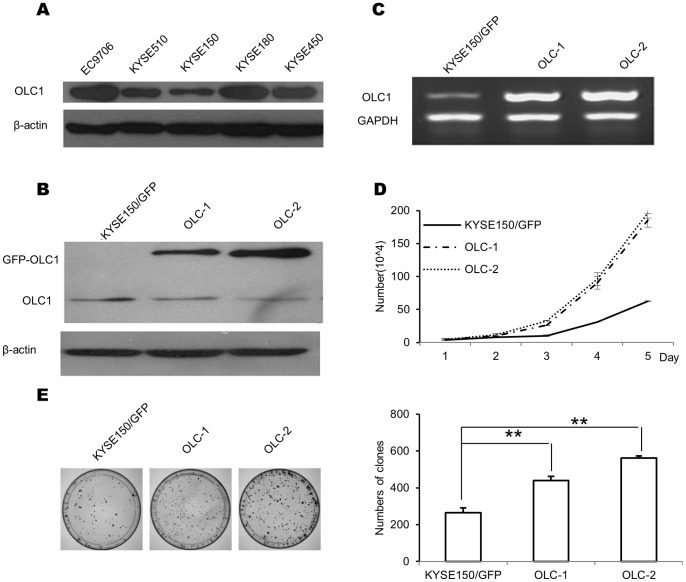
Two hundred and fourteen paired ESCC specimens, and an independent set from 28 ESCC patients, were used to analyze the correlation between OLC1 expression and the pathological characteristics of tumors using immunohistochemistry. Stable OLC1-overexpressing and OLC1-interfering esophageal cancer cells were established and a series of experimental methods were used to investigate the biological functions and mechanisms of action of OLC1.
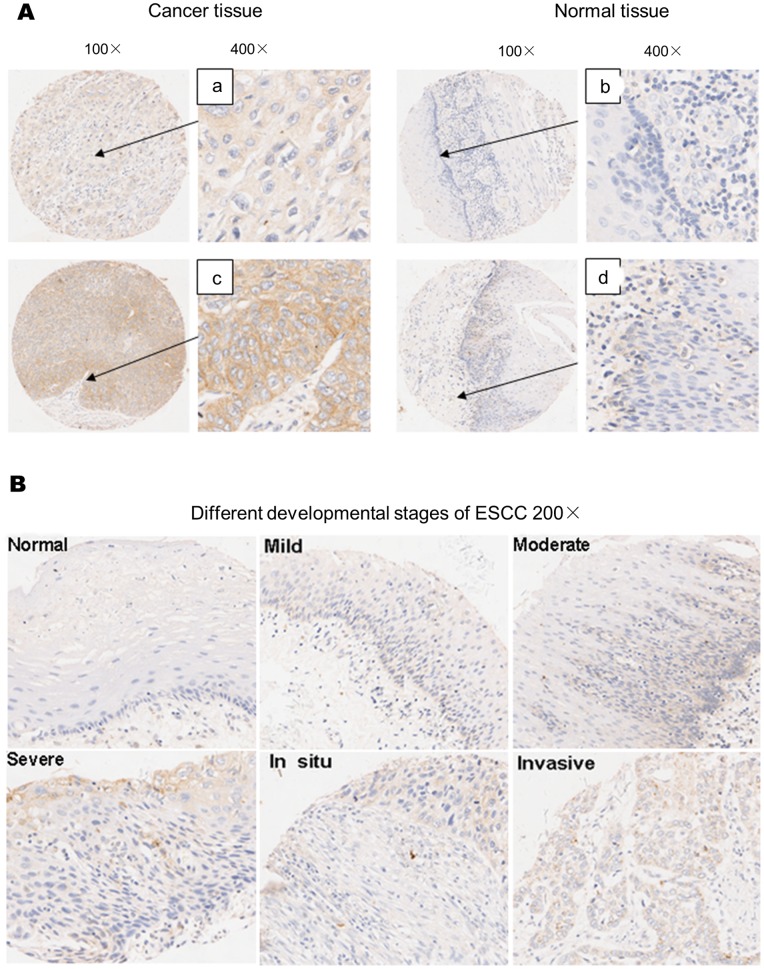
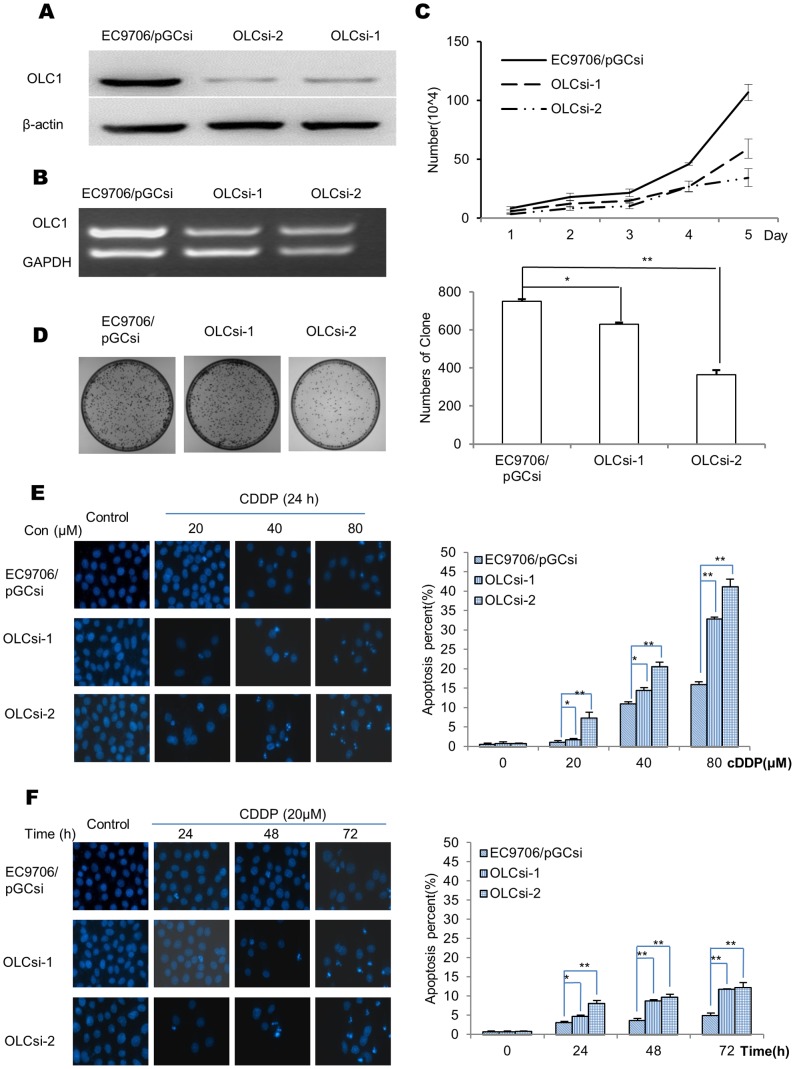
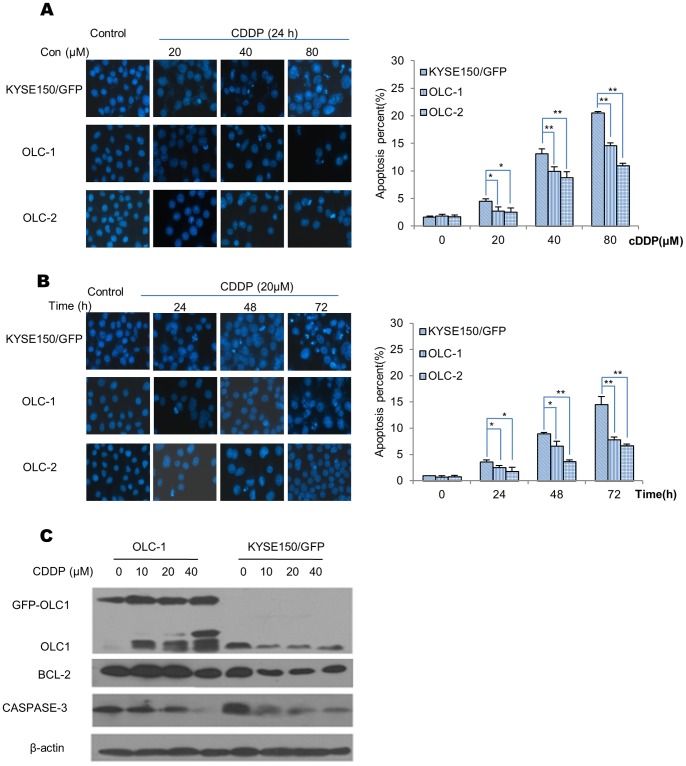
We showed that OLC1 was overexpressed in 145 of 214 (67.8%) of human ESCC specimens, compared with in only 59 of 214 (27.57%) paired adjacent normal tissues (P<0.001). OLC1 overexpression occurred at a rate of 35% (10/28) at the stage of mild/moderate dysplasia, but was significantly upregulated to 66% (22/33) at the stages of severe dysplasia and in situ carcinoma, while 71% positive staining (22/28) was observed in invasive carcinoma tissues compared with normal tissues (P<0.05). We also provided evidence that OLC1 abnormalities significantly altered the cell proliferation and apoptosis induced by cytotoxic agents. OLC1 overexpression suppressed apoptosis, and was associated with attenuated caspase-3 activation and increased Bcl-2 stability.
Our study provides strong evidence suggesting OLC1 abnormalities may contribute to the development of human ESCC and have some important clinical significance.
OLC1最近被鉴定为一种潜在的癌基因。然而,OLC1在人类食管癌细胞癌(ESCC)中的作用尚不清楚。因此,本研究的目的是评估OLC1在人类ESCC正常、癌前和恶性病变中的表达,并阐明OLC1促进ESCC进展的机制。
使用214对ESCC标本以及来自28例ESCC患者的独立样本,通过免疫组织化学分析OLC1表达与肿瘤病理特征之间的相关性。建立了稳定过表达OLC1和干扰OLC1的食管癌细胞,并采用一系列实验方法研究OLC1的生物学功能和作用机制。
我们发现,在214例人类ESCC标本中,有145例(67.8%)OLC1过表达,而在214对配对的相邻正常组织中只有59例(27.57%)过表达(P<0.001)。在轻度/中度发育异常阶段,OLC1过表达率为35%(10/28),但在重度发育异常和原位癌阶段显著上调至66%(22/33),而在浸润癌组织中与正常组织相比观察到71%的阳性染色(22/28)(P<0.05)。我们还提供证据表明,OLC1异常显著改变了细胞毒性药物诱导的细胞增殖和凋亡。OLC1过表达抑制凋亡,并与caspase-3激活减弱和Bcl-2稳定性增加有关。
我们的研究提供了有力证据,表明OLC1异常可能促进人类ESCC的发生发展,并具有重要的临床意义。