Wachtel Mitchell S, Yang Shengping
Department of Pathology and Cancer Center, School of Medicine, Texas Tech University Health Sciences Center, Lubbock, Texas.
Cancer Med. 2014 Jun;3(3):660-6. doi: 10.1002/cam4.213. Epub 2014 Mar 10.
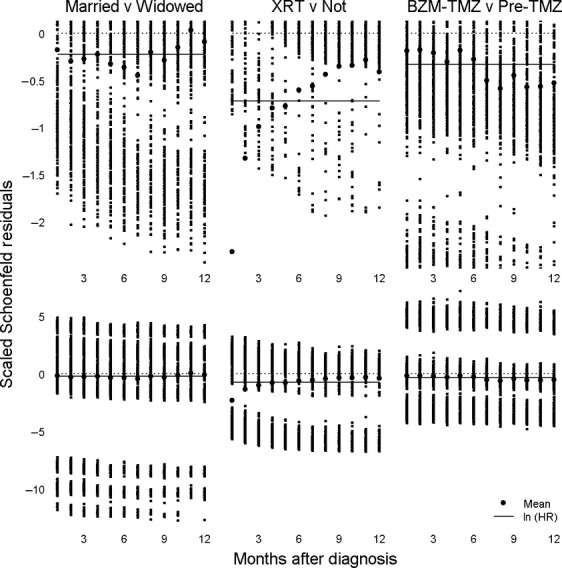
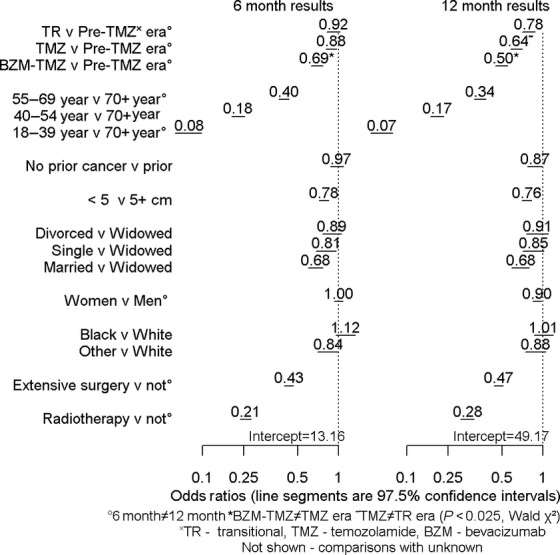
Bevacizumab (BZM) and temozolomide (TMZ) have been shown to be beneficial in the treatment of patients with glioblastoma. We sought evidence for the benefit of BZM in the general patient population at large. The Surveillance, Epidemiology, and End Results SEER database was queried for patients diagnosed with glioblastoma between 2000 and 2009, divided into a pre-TMZ era (January 2000-June 2003), a transitional era (July 2003-March 2005), a TMZ era (April 2005-October 2007), and a BZM-TMZ era (November 2007-December 2009). Binomial logit regression analyzed odds of death, taking into account age at diagnosis, tumor size, gender, race, marital status, radiotherapy, and extensive surgery. Compared with the pre-TMZ era, odds of death were decreased in the TMZ era by 12% (97.5% CI [confidence interval] 3-20%) 6 months after diagnosis and 36% (30-42%) a year after diagnosis; corresponding values for BZM-TMZ were 31% (24-37%) and 50% (45-55%). For era comparisons, decreases in odds of death were larger at 12 than 6 months; the opposite was true for extensive surgery and radiotherapy (P < 0.025, Wald χ(2) test, for each analysis). For both 6 and 12 month comparisons, odds of death in the BZM-TMZ era were lower than in the TMZ era (P < 0.025, Wald χ(2) test, for each analysis). The results provide evidence that TMZ positively impacted survival of glioblastoma patients and that the addition of BZM further improved survival, this lends support to the addition of BZM to the chemotherapeutic armamentarium. Evaluation of odds of death is an attractive alternative to Cox regression when proportional hazards assumptions are violated and follow-up is good.
贝伐单抗(BZM)和替莫唑胺(TMZ)已被证明对胶质母细胞瘤患者的治疗有益。我们试图寻找BZM对广大普通患者群体有益的证据。查询监测、流行病学和最终结果(SEER)数据库中2000年至2009年期间诊断为胶质母细胞瘤的患者,分为替莫唑胺前时代(2000年1月至2003年6月)、过渡时代(2003年7月至2005年3月)、替莫唑胺时代(2005年4月至2007年10月)和贝伐单抗-替莫唑胺时代(2007年11月至2009年12月)。二项式logit回归分析死亡几率,同时考虑诊断时的年龄、肿瘤大小、性别、种族、婚姻状况、放疗和广泛手术。与替莫唑胺前时代相比,替莫唑胺时代诊断后6个月死亡几率降低了12%(97.5%置信区间[CI]3-20%),诊断后1年降低了36%(30-42%);贝伐单抗-替莫唑胺时代的相应值分别为31%(24-37%)和50%(45-55%)。对于时代比较,死亡几率在12个月时的降低幅度大于6个月时;广泛手术和放疗的情况则相反(每次分析的P<0.025,Waldχ(2)检验)。对于6个月和12个月的比较,贝伐单抗-替莫唑胺时代的死亡几率均低于替莫唑胺时代(每次分析的P<0.025,Waldχ(2)检验)。结果提供了证据表明替莫唑胺对胶质母细胞瘤患者的生存有积极影响,并且添加贝伐单抗进一步改善了生存,这支持将贝伐单抗添加到化疗药物库中。当比例风险假设被违反且随访良好时,评估死亡几率是Cox回归的一个有吸引力的替代方法。