Grossman Stuart A, Ye Xiaobu, Piantadosi Steven, Desideri Serena, Nabors Louis B, Rosenfeld Myrna, Fisher Joy
Sidney Kimmel Comprehensive Cancer Center at Johns Hopkins University, Baltimore, Maryland, USA.
Clin Cancer Res. 2010 Apr 15;16(8):2443-9. doi: 10.1158/1078-0432.CCR-09-3106. Epub 2010 Apr 6.
Novel agents are currently combined with radiation and temozolomide (RT + TMZ) in newly diagnosed glioblastoma using overall survival as the primary end point. Results of these phase II studies are typically compared with the phase III European Organization for Research and Treatment of Cancer (EORTC) survival data that resulted in RT + TMZ becoming standard therapy.
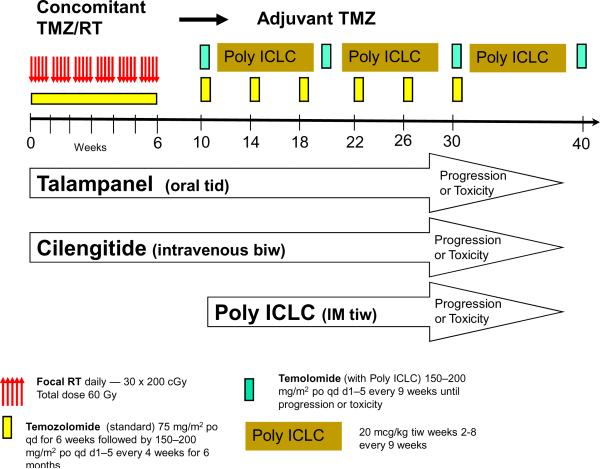
The New Approaches to Brain Tumor Therapy (NABTT) Consortium assigned 365 patients with glioblastoma to four single-cohort studies with similar eligibility criteria. Patients received RT + TMZ with talampanel (n = 72), poly-ICLC (n = 97), or cilengitide (n = 112) or RT + TMZ alone with monitoring of CD4 counts (n = 84). Overall survival of those ages 18 to 70 years with glioblastoma was compared with published EORTC data.
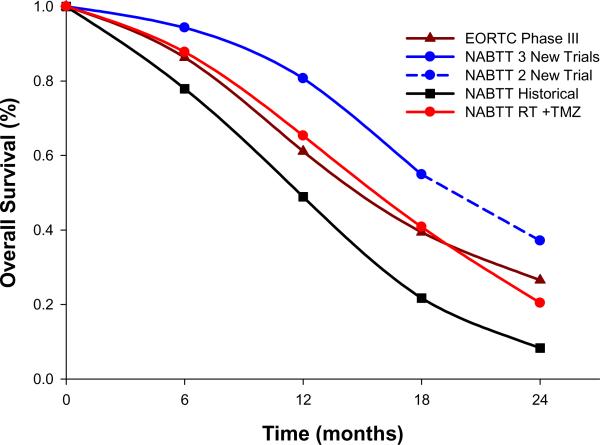
NABTT and EORTC patients had comparable performance status and debulking surgery. Median, 12-month, and 24-month survival rates for the EORTC patients (n = 287) and the comparable NABTT patients receiving RT + TMZ and novel agents (n = 244) are 14.6 versus 19.6 months, 61% versus 81%, and 27% versus 37%, respectively. This represents a 37% reduction in odds of death (P < 0.0001) through 2 years of follow-up. NABTT and EORTC patients receiving only RT + TMZ had similar survival.
Newly diagnosed glioblastoma treated recently with RT + TMZ and talampanel, poly-ICLC, or cilengitide had significantly longer survival than similar patients treated with only RT + TMZ accrued internationally from 2000 to 2002. These differences could result from the novel agents or changing patterns of care. Until the reasons for these different survival rates are clarified, comparisons of outcomes from phase II studies with published RT + TMZ survival data should be interpreted with caution.
目前,在新诊断的胶质母细胞瘤中,新型药物正与放疗和替莫唑胺(RT + TMZ)联合使用,将总生存期作为主要终点。这些II期研究的结果通常与III期欧洲癌症研究与治疗组织(EORTC)的生存数据进行比较,后者使得RT + TMZ成为标准疗法。
脑肿瘤治疗新方法(NABTT)联盟将365例胶质母细胞瘤患者分配到四项具有相似入选标准的单队列研究中。患者接受RT + TMZ联合他拉莫泮(n = 72)、聚肌胞苷酸(聚肌胞苷酸,n = 97)或西仑吉肽(n = 112)治疗,或仅接受RT + TMZ并监测CD4计数(n = 84)。将18至70岁胶质母细胞瘤患者的总生存期与已发表的EORTC数据进行比较。
NABTT和EORTC患者的表现状态和肿瘤切除手术情况相当。EORTC患者(n = 287)以及接受RT + TMZ和新型药物的可比NABTT患者(n = 244)的中位生存期、12个月和24个月生存率分别为14.6个月对19.6个月、61%对81%、27%对37%。这代表在长达2年的随访期内死亡几率降低了37%(P < 0.0001)。仅接受RT + TMZ治疗的NABTT和EORTC患者生存期相似。
近期接受RT + TMZ联合他拉莫泮、聚肌胞苷酸或西仑吉肽治疗的新诊断胶质母细胞瘤患者,其生存期显著长于2000年至2002年在国际上招募的仅接受RT + TMZ治疗的类似患者。这些差异可能源于新型药物或护理模式的改变。在明确这些不同生存率的原因之前,II期研究结果与已发表的RT + TMZ生存数据的比较应谨慎解读。