Cope Thomas E, Grube Manon, Mandal Arnab, Cooper Freya E, Brechany Una, Burn David J, Griffiths Timothy D
Auditory Group, Institute of Neuroscience, Newcastle University, Newcastle-upon-Tyne, United Kingdom.
Auditory Group, Institute of Neuroscience, Newcastle University, Newcastle-upon-Tyne, United Kingdom.
Neuropsychologia. 2014 May;57(100):29-37. doi: 10.1016/j.neuropsychologia.2014.02.021. Epub 2014 Mar 5.
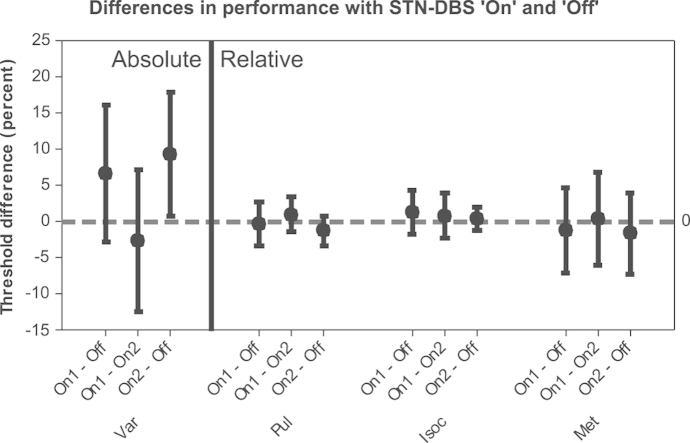
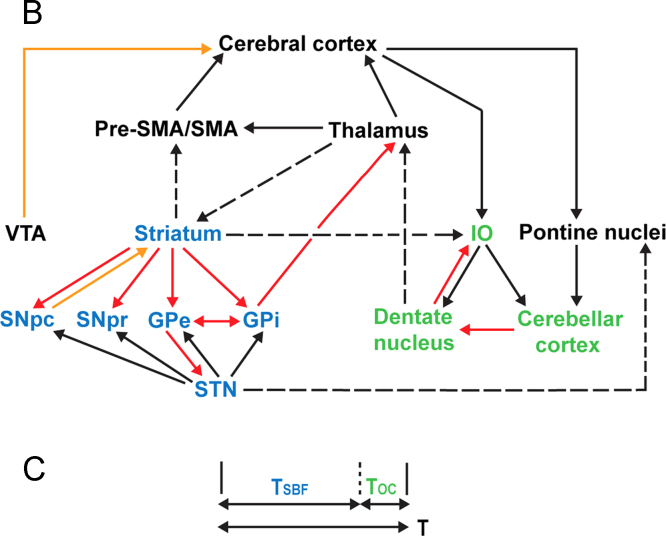
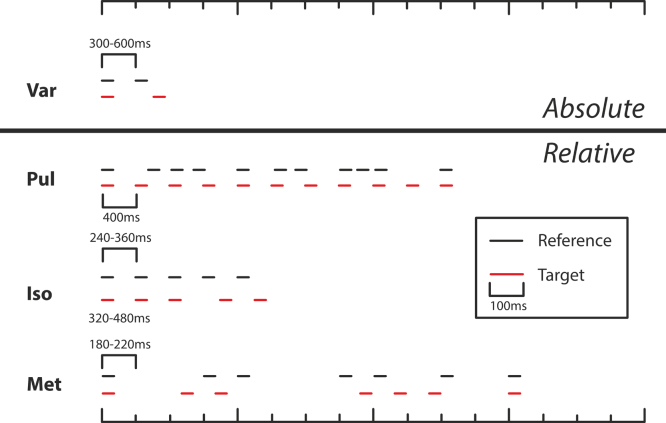
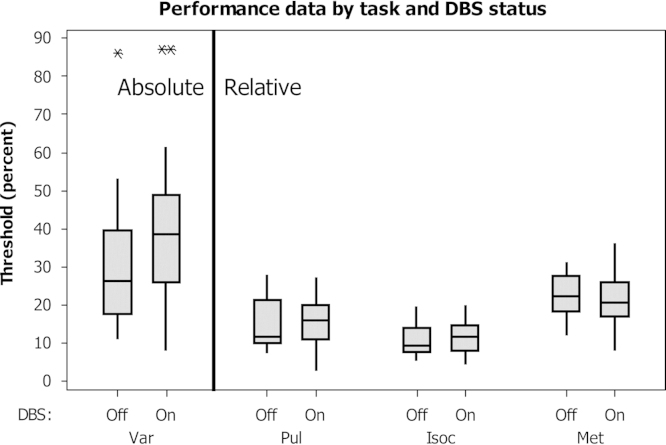
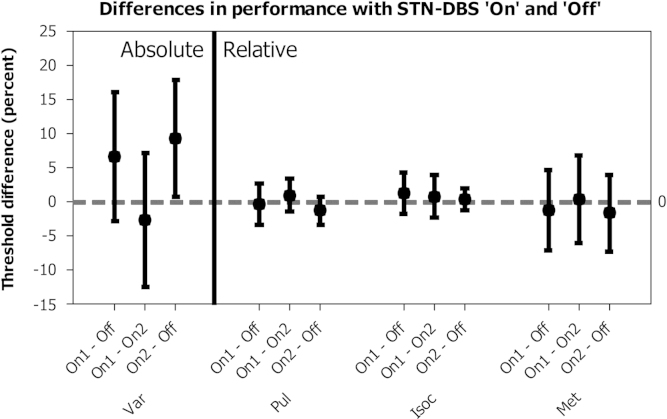
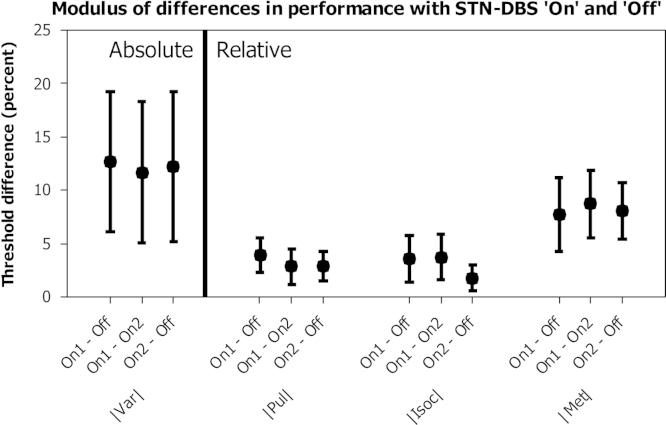
Bilateral, high-frequency stimulation of the basal ganglia (STN-DBS) is in widespread use for the treatment of the motor symptoms of Parkinson׳s disease (PD). We present here the first psychophysical investigation of the effect of STN-DBS upon perceptual timing in the hundreds of milliseconds range, with both duration-based (absolute) and beat-based (relative) tasks; 13 patients with PD were assessed with their STN-DBS 'on', 'off', and then 'on' again. Paired parametric analyses revealed no statistically significant differences for any task according to DBS status. We demonstrate, from the examination of confidence intervals, that any functionally relevant effect of STN-DBS on relative perceptual timing is statistically unlikely. For absolute, duration-based timing, we demonstrate that the activation of STN-DBS may either worsen performance or have no effect, but that it is unlikely to lead to significant improvement. Although these results are negative they have important implications for our understanding of perceptual timing and its relationship to motor functions within the timing network of the brain. They imply that the mechanisms involved in the perceptual processing of temporal information are likely to be functionally independent from those that underpin movement. Further, they suggest that the connections between STN and the subtantia nigra and globus pallidus are unlikely to be critical to beat-based perceptual timing.
双侧高频刺激基底神经节(STN-DBS)被广泛用于治疗帕金森病(PD)的运动症状。我们在此展示了对STN-DBS在数百毫秒范围内对感知定时影响的首次心理物理学研究,采用了基于持续时间(绝对)和基于节拍(相对)的任务;对13名帕金森病患者在其STN-DBS“开启”、“关闭”然后再“开启”的状态下进行了评估。配对参数分析显示,根据DBS状态,任何任务均无统计学上的显著差异。通过对置信区间的检查,我们证明STN-DBS对相对感知定时的任何功能相关影响在统计学上不太可能。对于基于持续时间的绝对定时,我们证明STN-DBS的激活可能会使表现变差或没有效果,但不太可能导致显著改善。尽管这些结果是否定的,但它们对我们理解感知定时及其与大脑定时网络内运动功能的关系具有重要意义。它们意味着参与时间信息感知处理的机制可能在功能上独立于那些支撑运动的机制。此外,它们表明STN与黑质和苍白球之间的连接不太可能对基于节拍的感知定时至关重要。