Department of Clinical Neurosciences, School of Clinical Medicine, Addenbrookes Hospital, Cambridge CB2 0SP.
Auditory Group, Institute of Neuroscience, Newcastle University, Newcastle-upon-Tyne, United Kingdom.
Neuropsychologia. 2014 Jan;52:73-81. doi: 10.1016/j.neuropsychologia.2013.09.039. Epub 2013 Oct 14.
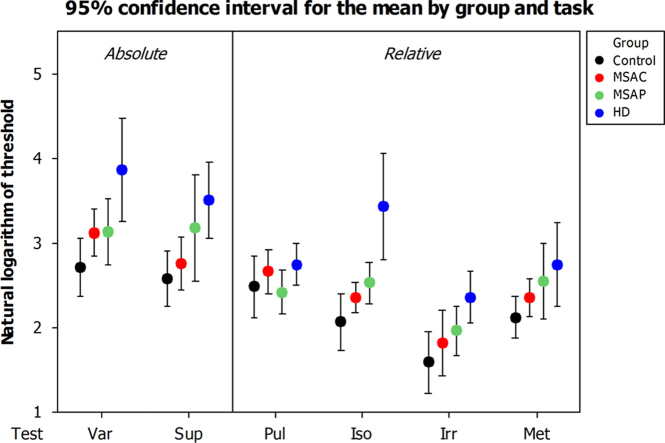
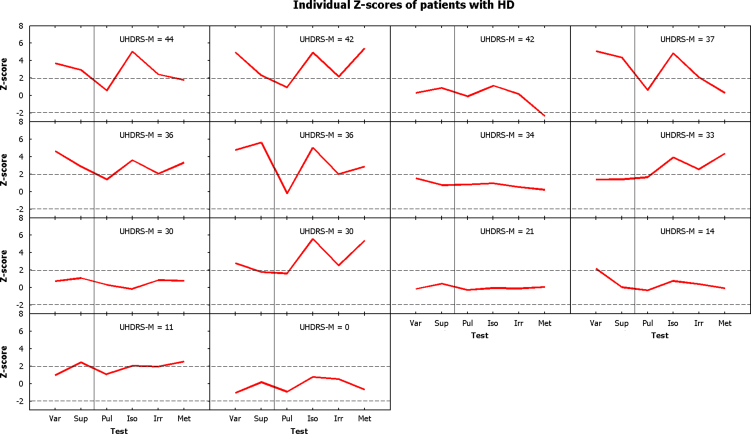
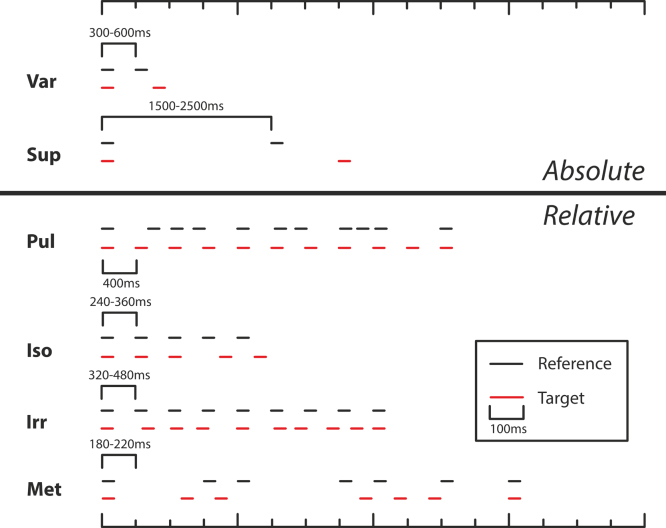
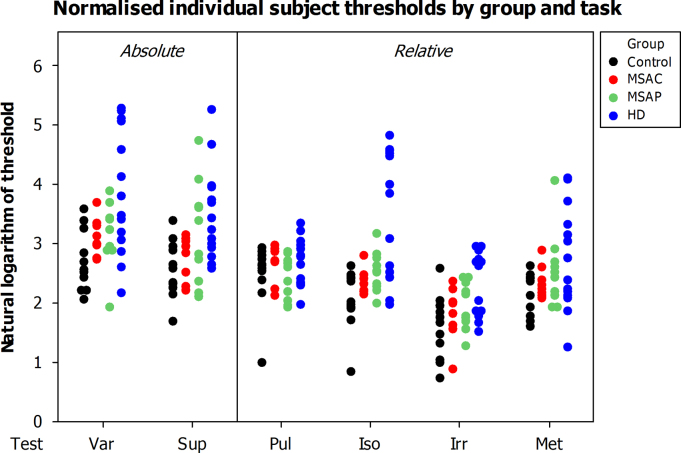
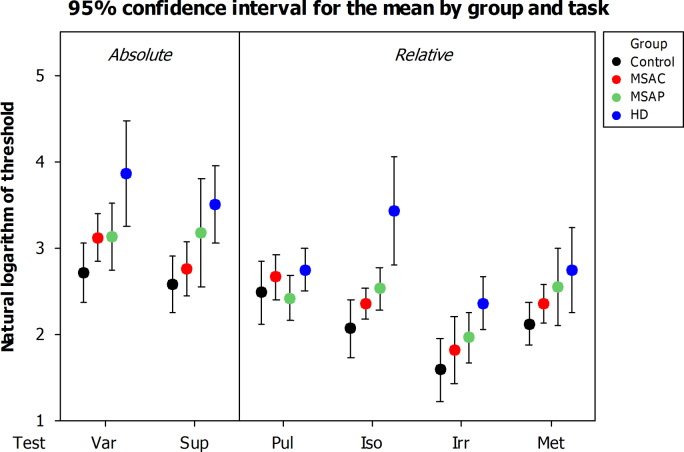
The timing of perceptual events depends on an anatomically and functionally connected network comprising basal ganglia, cerebellum, pre-frontal cortex and supplementary motor area. Recent studies demonstrate the cerebellum to be involved in absolute, duration-based timing, but not in relative timing based on a regular beat. Conversely, functional involvement of the striatum is observed in relative timing, but its role in absolute timing is unclear. This work tests the specific role of the basal ganglia in the perceptual timing of auditory events. It aims to distinguish the hypothesised unified model of time perception (Teki, Grube, & Griffiths, 2012), in which the striatum is a mandatory component for all timing tasks, from a modular system in which they subserve relative timing, with absolute timing processed by the cerebellum. Test groups comprised individuals with Multiple System Atrophy, a disorder in which similar pathology can produce clinical deficits associated with dysfunction of the cerebellum (MSA-C, n = 8) or striatum (MSA-P, n = 10), and early symptomatic Huntington's disease (HD, n = 14). Individuals with chronic autoimmune peripheral neuropathy (n = 11) acted as controls. Six adaptive tasks were carried out to assess perceptual thresholds for absolute timing through duration discrimination for sub- and supra-second time intervals, and relative timing through the detection of beat-based regularity and irregularity, detection of a delay within an isochronous sequence, and the discrimination of sequences with metrical structure. All three patient groups exhibited impairments in performance in comparison with the control group for all tasks, and severity of impairment was significantly correlated with disease progression. No differences were demonstrated between MSA-C and MSA-P, and the most severe impairments were observed in those with HD. The data support an obligatory role for the basal ganglia in all tested timing tasks, both absolute and relative, as predicted by the unified model. The results are not compatible with models of a brain timing network based upon independent modules.
感知事件的时间取决于一个解剖学和功能上连接的网络,包括基底神经节、小脑、前额叶皮层和辅助运动区。最近的研究表明,小脑参与基于绝对时间的计时,但不参与基于规则节拍的相对计时。相反,纹状体的功能参与了相对计时,但它在绝对计时中的作用尚不清楚。这项工作测试了基底神经节在听觉事件感知计时中的特定作用。它旨在区分假设的时间感知统一模型(Teki、Grube 和 Griffiths,2012),在该模型中,纹状体是所有计时任务的强制性组成部分,以及模块化系统,其中它们服务于相对计时,而绝对计时由小脑处理。测试组包括多系统萎缩症患者,这种疾病的相似病理学可导致与小脑(MSA-C,n = 8)或纹状体(MSA-P,n = 10)功能障碍相关的临床缺陷,以及早期症状性亨廷顿病(HD,n = 14)患者。慢性自身免疫性周围神经病患者(n = 11)作为对照组。进行了六项自适应任务,以通过亚秒和秒级时间间隔的持续时间辨别来评估绝对计时的感知阈值,以及通过基于节拍的规律性和不规则性的检测、在等时序列内检测延迟以及辨别具有韵律结构的序列来评估相对计时。与对照组相比,所有三组患者在所有任务中的表现都存在障碍,且障碍严重程度与疾病进展显著相关。MSA-C 和 MSA-P 之间没有显示出差异,HD 患者的障碍最严重。数据支持基底神经节在统一模型预测的所有测试计时任务中都具有强制性作用,包括绝对计时和相对计时。结果与基于独立模块的大脑计时网络模型不兼容。