Aatola Heikki, Hutri-Kähönen Nina, Juonala Markus, Laitinen Tomi T, Pahkala Katja, Mikkilä Vera, Telama Risto, Koivistoinen Teemu, Lehtimäki Terho, Viikari Jorma S A, Raitakari Olli T, Kähönen Mika
Department of Clinical Physiology, University of Tampere and Tampere University Hospital, Tampere, Finland.
J Am Heart Assoc. 2014 Mar 10;3(2):e000532. doi: 10.1161/JAHA.113.000532.
In 2010, the American Heart Association defined ideal cardiovascular health as the simultaneous presence of 4 favorable health behaviors (nonsmoking, ideal body mass index, physical activity at goal, and dietary pattern that promotes cardiovascular health) and 3 favorable health factors (ideal levels of total cholesterol, blood pressure, and fasting glucose). The association between a change in ideal cardiovascular health status and pulse wave velocity, a surrogate marker of cardiovascular disease, has not been reported.
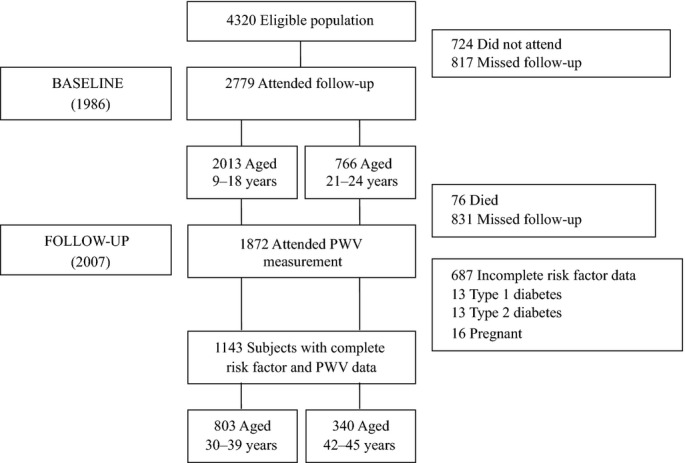
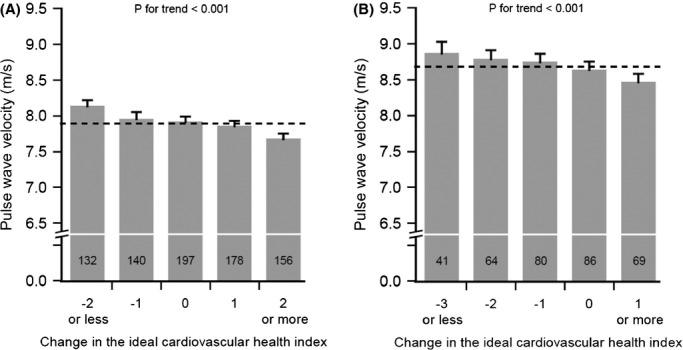
The study cohort consisted of 1143 white adults from the Cardiovascular Risk in Young Finns Study who were followed for 21 years since baseline (1986). This cohort was divided in 2 subgroups: 803 participants (aged 9 to 18 years at baseline) to study the health status change from childhood to adulthood and 340 participants (aged 21 to 24 years at baseline) to study health status change from young adulthood to middle age. The change in the ideal cardiovascular health index was inversely associated with pulse wave velocity (adjusted for age, sex, and heart rate), every 1-point increase corresponded to a 0.09-m/s (P<0.001) decrease in pulse wave velocity in both groups. This association remained significant in subgroups based on the ideal cardiovascular health index at baseline.
The change in ideal cardiovascular health status, both from childhood to adulthood and from young adulthood to middle age, was an independent predictor of adult pulse wave velocity. Our results support the concept of ideal cardiovascular health as a useful tool for primordial prevention of cardiovascular disease.
2010年,美国心脏协会将理想心血管健康定义为同时具备4种有益健康行为(不吸烟、理想体重指数、达到目标的身体活动量以及促进心血管健康的饮食模式)和3种有益健康因素(总胆固醇、血压和空腹血糖的理想水平)。理想心血管健康状态的变化与心血管疾病替代标志物脉搏波速度之间的关联尚未见报道。
研究队列包括来自芬兰青年人心血管风险研究的1143名白人成年人,自基线(1986年)起随访21年。该队列分为2个亚组:803名参与者(基线时年龄为9至18岁)用于研究从儿童期到成年期的健康状态变化,340名参与者(基线时年龄为21至24岁)用于研究从青年期到中年期的健康状态变化。理想心血管健康指数的变化与脉搏波速度呈负相关(根据年龄、性别和心率进行调整),两组中理想心血管健康指数每增加1分,脉搏波速度相应降低0.09米/秒(P<0.001)。在基于基线理想心血管健康指数的亚组中,这种关联仍然显著。
从儿童期到成年期以及从青年期到中年期,理想心血管健康状态的变化是成人脉搏波速度的独立预测因素。我们的结果支持将理想心血管健康概念作为心血管疾病一级预防的有用工具这一观点。