Department of Pathology, School of Medicine, Tohoku University, Sendai, Japan.
Cancer Sci. 2014 May;105(5):568-75. doi: 10.1111/cas.12396. Epub 2014 Apr 9.
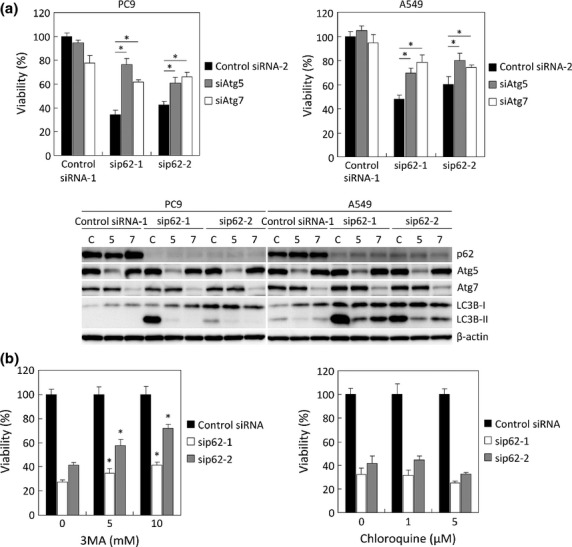
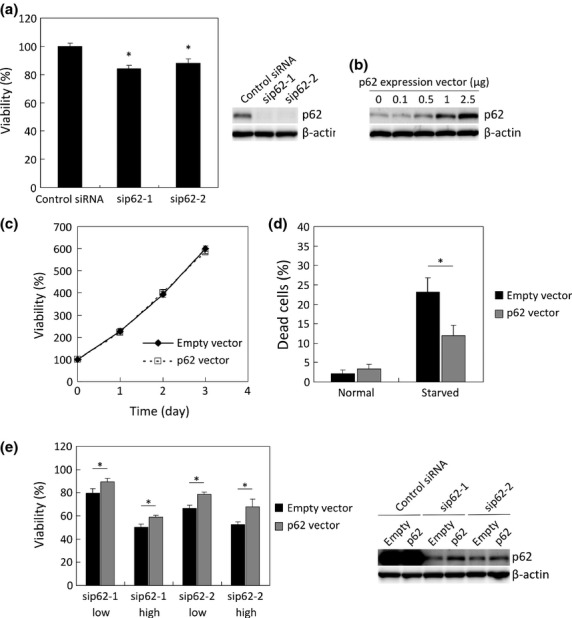
p62/SQSTM1 (p62) is a multifunctional protein implicated in several signal transduction pathways and selectively degraded by autophagy, a process for lysosomal degradation of both protein and organelle. p62 was also recently reported to be overexpressed in various malignancies and its inhibition to suppress carcinoma cell proliferation. However, its correlation with autophagy in carcinoma cells has remained largely unknown. Therefore, in this study, we examined the effects of p62 inhibition on the regulation of autophagy and cell survival in p62-positive carcinoma cells. p62-silencing dramatically suppressed cell proliferation and induced autophagy in p62 expressing PC9 and A549 cells. Electron microscopical analysis revealed the formation of autophagosomes with multilayer membranes caused by p62-silencing. p62 silencing-mediated reduced cell viability was restored by both genomic and pharmacological inhibition of autophagy but not that of apoptosis. These findings were also detected in several types of carcinoma cell lines including adenocarcinomas and squamous cell carcinomas. Results of our present study revealed that an inhibition of p62 resulted in the formation of mis-regulated autophagosomes with multilayer membranes and an autophagic cell death, and p62 can therefore be an attractive target for the development of anti-neoplastic agents.
p62/SQSTM1(p62)是一种多功能蛋白,参与多种信号转导途径,并被自噬选择性降解,自噬是一种溶酶体降解蛋白质和细胞器的过程。最近也有报道称,p62 在多种恶性肿瘤中过度表达,其抑制作用可抑制癌细胞增殖。然而,其与癌细胞自噬的相关性在很大程度上仍不清楚。因此,在本研究中,我们研究了 p62 抑制对 p62 阳性癌细胞中自噬和细胞存活的调节作用。p62 沉默显著抑制了 p62 表达的 PC9 和 A549 细胞的增殖,并诱导了自噬。电子显微镜分析显示,p62 沉默导致多层膜自噬体的形成。p62 沉默介导的细胞活力降低可通过基因组和药理学抑制自噬恢复,但不能通过抑制细胞凋亡恢复。这些发现也在包括腺癌和鳞状细胞癌在内的几种癌细胞系中得到了检测。本研究结果表明,p62 的抑制导致多层膜的错误调节自噬体的形成和自噬性细胞死亡,因此 p62 可以成为开发抗肿瘤药物的有吸引力的靶标。