Kucharski Adam, Mills Harriet, Pinsent Amy, Fraser Christophe, Van Kerkhove Maria, Donnelly Christl A, Riley Steven
Department of Infectious Disease Epidemiology, London School of Hygiene & Tropical Medicine, London, UK.
Department of Infectious Disease Epidemiology, Imperial College London, London, UK.
PLoS Curr. 2014 Mar 7;6:ecurrents.outbreaks.e1473d9bfc99d080ca242139a06c455f. doi: 10.1371/currents.outbreaks.e1473d9bfc99d080ca242139a06c455f.
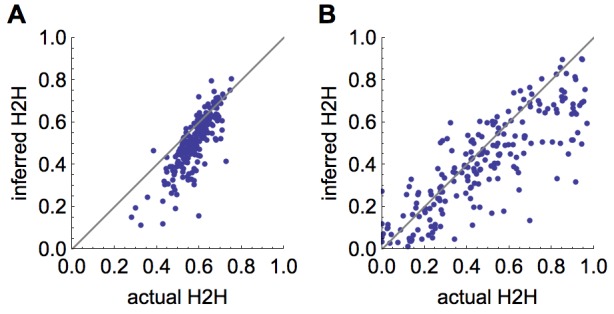
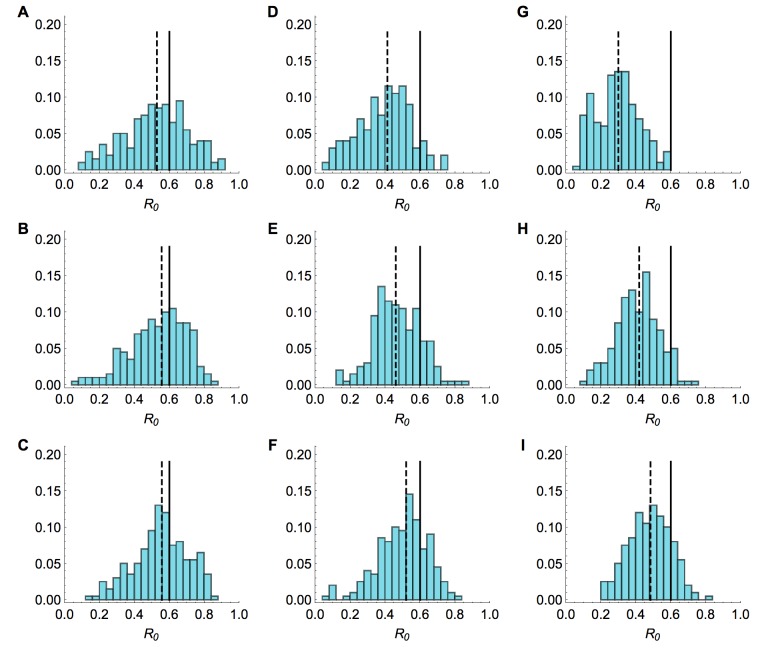
Pathogens such as MERS-CoV, influenza A/H5N1 and influenza A/H7N9 are currently generating sporadic clusters of spillover human cases from animal reservoirs. The lack of a clear human epidemic suggests that the basic reproductive number R0 is below or very close to one for all three infections. However, robust cluster-based estimates for low R0 values are still desirable so as to help prioritise scarce resources between different emerging infections and to detect significant changes between clusters and over time. We developed an inferential transmission model capable of distinguishing the signal of human-to-human transmission from the background noise of direct spillover transmission (e.g. from markets or farms). By simulation, we showed that our approach could obtain unbiased estimates of R0, even when the temporal trend in spillover exposure was not fully known, so long as the serial interval of the infection and the timing of a sudden drop in spillover exposure were known (e.g. day of market closure). Applying our method to data from the three largest outbreaks of influenza A/H7N9 outbreak in China in 2013, we found evidence that human-to-human transmission accounted for 13% (95% credible interval 1%-32%) of cases overall. We estimated R0 for the three clusters to be: 0.19 in Shanghai (0.01-0.49), 0.29 in Jiangsu (0.03-0.73); and 0.03 in Zhejiang (0.00-0.22). If a reliable temporal trend for the spillover hazard could be estimated, for example by implementing widespread routine sampling in sentinel markets, it should be possible to estimate sub-critical values of R0 even more accurately. Should a similar strain emerge with R0>1, these methods could give a real-time indication that sustained transmission is occurring with well-characterised uncertainty.
中东呼吸综合征冠状病毒(MERS-CoV)、甲型H5N1流感病毒和甲型H7N9流感病毒等病原体目前正引发零星的人传人病例群,这些病例源自动物宿主。缺乏明显的人类疫情表明,这三种感染的基本再生数R0均低于或非常接近1。然而,对于低R0值,基于聚类的可靠估计仍然是可取的,以便在不同的新发感染之间合理分配稀缺资源,并检测不同聚类之间以及随时间的显著变化。我们开发了一种推断性传播模型,能够将人传人传播信号与直接溢出传播(例如来自市场或农场)的背景噪声区分开来。通过模拟,我们表明,只要知道感染的连续间隔时间和溢出暴露突然下降的时间(例如市场关闭日),即使溢出暴露的时间趋势不完全清楚,我们的方法也能获得无偏的R0估计值。将我们的方法应用于2013年中国甲型H7N9流感三大疫情的数据,我们发现有证据表明,人传人传播占总病例数的13%(95%可信区间为1%-32%)。我们估计这三个聚类的R0值分别为:上海0.19(0.01-0.49),江苏0.29(0.03-0.73);浙江0.03(0.00-0.22)。如果能够估计出溢出风险的可靠时间趋势,例如通过在定点市场进行广泛的常规采样,那么应该能够更准确地估计R0的亚临界值。如果出现R0>1的类似毒株,这些方法可以实时表明正在发生持续传播,且不确定性特征明确。